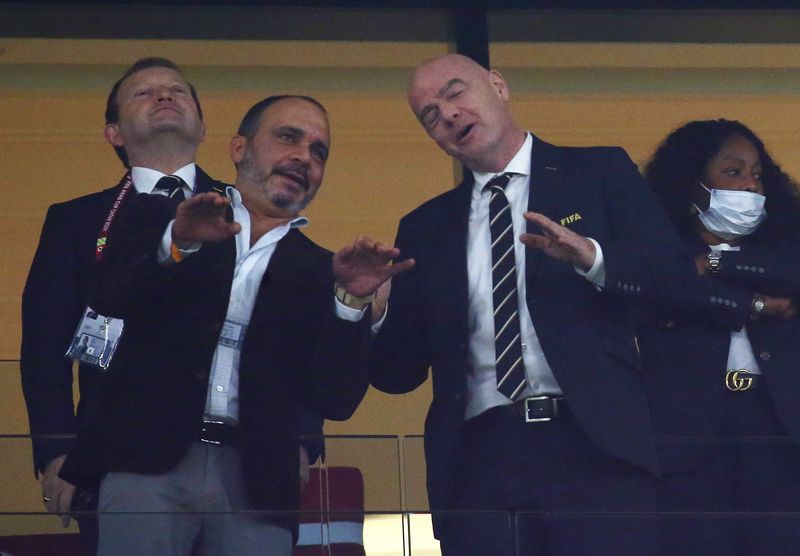
FIFA has finally transferred outstanding prize money to Jordan's national football team and support staff for their participation in last December's Arab Cup tournament in Qatar, according to Jordan Football Association President Prince Ali bin Hussein. The payment arrived on Thursday morning, arriving more than eight months after the team reached the competition's final, effectively ending a prolonged delay that had become entangled in broader governance tensions within international football.
The resolution of this financial dispute came just two days after Prince Ali levelled serious accusations against FIFA leadership, claiming the organisation had engaged in what amounted to conditional funding. In a particularly pointed assertion, Prince Ali alleged that FIFA officials had verbally indicated during World Cup discussions that supporting FIFA President Gianni Infantino "would go a long way to helping our FA out." This characterisation painted a troubling picture of FIFA deploying financial leverage—withholding legitimate prize earnings—as a mechanism to secure political backing from national football associations ahead of presidential elections.
Prince Ali's public acknowledgement of the payment delivery was notably measured in tone, delivered through a statement on social media platform X. He expressed gratitude for the funds reaching Jordan's players and coaching staff, yet his remarks carried an unmistakable undertone of frustration regarding the extended timeline. The eight-month delay represented an extraordinary deviation from standard practice in international sports governance, where prize distributions typically occur within weeks of tournament completion, not seasons later. This protracted delay had left the Jordanian football programme financially constrained during a critical period of development and planning.
The broader context of Prince Ali's grievances extends beyond the simple matter of delayed payments. His criticism of FIFA President Gianni Infantino emerged amid the organisation's handling of a controversial proposal to restructure World Cup commercial rights. Infantino had initially advocated for FIFA to sell a stake in the tournament's commercial operation, a proposal that generated significant resistance from football confederations and national associations worldwide. When Infantino subsequently reversed this position under mounting pressure, Prince Ali seized the moment to articulate deeper concerns about FIFA's operational culture and decision-making processes.
In his public remarks, Prince Ali framed the late payment as symptomatic of systemic dysfunction within FIFA's administration rather than an isolated administrative oversight. He specifically linked the delayed funding to what he characterised as recurring challenges faced by national football associations, problems he argued were habitually intensified around FIFA presidential election cycles. This observation suggests a pattern of institutional behaviour where financial obligations become bargaining chips in political negotiations, creating an environment of uncertainty and leverage that disadvantages smaller football federations competing for legitimacy within FIFA's hierarchical structure.
Despite receiving the overdue funds, Prince Ali made unambiguously clear that this resolution would not alter his fundamental position regarding FIFA's leadership direction. He announced definitively that both his football association and he personally would withhold endorsement for President Infantino and would not vote in support of his re-election. This stance represents a significant development in FIFA electoral politics, as Jordan's vote, while representing a smaller confederation, joins a growing international consensus questioning Infantino's continued leadership of the global governing body.
FIFA has not publicly responded to Prince Ali's specific allegations of conditional funding or the characterisation of withholding prize money as a leverage mechanism. The organisation's silence on these serious governance accusations stands in contrast to its broader communications strategy regarding recent controversies. The body did issue an apology to its membership for errors committed during the abandoned commercial rights proposal, acknowledging that the initiative had created institutional turbulence and requiring corrective action to restore confidence among member associations.
Despite the criticisms directed at Infantino and concerns raised by numerous confederation leaders, FIFA's institutional apparatus has demonstrated resilience in maintaining support for the president's continued tenure. Following a crisis meeting convened in Morocco on Wednesday, FIFA's leadership structure formally reaffirmed its backing for Infantino, signalling that internal power structures remain aligned around his leadership even as external pressure from national associations intensifies. This dynamic underscores the distinction between formal governance structures and the broader political landscape of international football.
The Jordan funding resolution carries significance for Southeast Asian football governance, as smaller nations frequently encounter similar delays and bureaucratic obstacles when interfacing with FIFA's centralised administrative systems. Malaysia and other regional associations navigating FIFA processes should observe how this episode evolved, recognising that financial transparency and timely payments represent fundamental operational standards that all nations should expect. The incident illustrates how governance challenges at FIFA's apex can cascade downward, affecting individual countries' planning capacity and competitive preparation.
Looking forward, the ramifications of Prince Ali's public stance will likely reverberate through FIFA electoral dynamics. His willingness to articulate specific governance failures and to announce a withdrawal of support positions him within an emerging coalition of federation leaders questioning the current presidential arrangement. Whether this translates into substantive electoral consequences or represents a symbolic gesture within FIFA's entrenched power structures remains an open question, but the visibility of such criticism represents a notable departure from the organisation's historically insular political culture.

