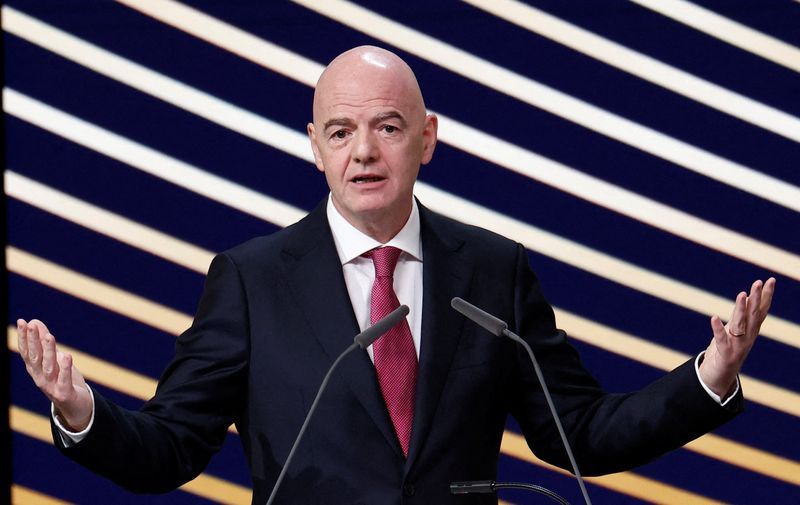
FIFA President Gianni Infantino faces mounting political pressure as his bid for a second consecutive term encounters serious headwinds. The catalyst for his declining fortunes stems from a controversial proposal to sell a private equity stake in the World Cup tournament, a scheme that has fractured his coalition of support among the world's major football confederations. National football associations from Serbia, Sweden, and Wales have already withdrawn backing, signalling deeper dissatisfaction within FIFA's membership and setting the stage for what promises to be a contentious leadership contest. The presidential election is scheduled for March 18 in Morocco, determining who will lead global football through 2031.
The turmoil surrounding Infantino's tenure reveals fundamental tensions within FIFA's governance structure. His attempt to privatise a revenue stream from football's flagship tournament exposed what critics characterise as opaque decision-making processes that marginalise smaller federations from meaningful consultation. This governance failure has emboldened opposition figures across multiple continents, each bringing distinct constituencies and platforms to a potential challenge. The scale of institutional dissatisfaction suggests the March election will be more competitive than observers initially anticipated, moving beyond a coronation scenario that typically favours incumbent leaders.
Victor Montagliani, the Canadian businessman who heads CONCACAF, the regional confederation governing North American football, has emerged as a serious contender. As president of the confederation representing the continent hosting the 2026 World Cup, Montagliani commands significant institutional leverage and represents an appealing narrative of championing smaller football nations. While CONCACAF formally rejected Infantino's privatisation proposal, the confederation stopped short of the full-throated boycott that UEFA orchestrated, suggesting Montagliani maintains strategic flexibility and potential credibility as a unifying figure capable of bridging regional divides.
European football's establishment is coalescing around alternative candidates, signalling that UEFA's rejection of Infantino extends beyond rhetorical positioning. Aleksander Ceferin, the Slovenian UEFA president, has become the embodiment of European opposition through his symbolic boycott of the World Cup final and his vocal criticism of Infantino's administrative approach. Ceferin's potential candidacy would represent a direct confrontation between competing visions of FIFA governance, pitting UEFA's emphasis on consultation and democratic process against Infantino's more centralised executive style.
From Asia's perspective, Sheikh Salman bin Ibrahim Al Khalifa of Bahrain represents a conservative voice within FIFA's power structure. As both AFC president and a senior vice president on the FIFA Council, he has consistently opposed Infantino's expansionist initiatives, particularly the controversial expansion of the World Cup to 64 teams. The AFC's official statement criticising the private equity proposal for exposing weaknesses in FIFA's institutional processes demonstrates that Asian football's leadership shares broader concerns about executive accountability, lending Sheikh Salman credibility as a reform-minded alternative.
Qatari sports executive Nasser Al-Khelaifi has garnered significant support from European football officials, according to recent reporting from political observers tracking FIFA dynamics. As Paris Saint-Germain's president and a prominent figure in Middle Eastern sports investment, Al-Khelaifi brings commercial expertise and international standing. His candidacy would appeal to constituencies valuing business acumen and the increasing integration of capital from the Gulf region within European football structures, though his background in private sector sports management might reinforce concerns about commercialisation that currently plague Infantino's reputation.
Norwegian Football Federation President Lise Klaveness represents perhaps the most ideologically distinct challenge to Infantino's leadership. As one of global football's most prominent female executives, Klaveness emerged as a principled opponent of Infantino's World Cup privatisation scheme and has championed governance transparency and ethical standards. Norway's previous consideration of filing an ethics complaint regarding the controversial suspension lift on American player Folarin Balogun—a decision that drew scrutiny for appearing influenced by United States President Donald Trump—illustrates Klaveness's willingness to confront perceived political interference in FIFA affairs.
The Balogun episode encapsulates broader anxieties about Infantino's stewardship that extend beyond commercial disputes. His apparent willingness to accommodate American political pressure over sporting regulations has troubled federations concerned about FIFA's independence and institutional integrity. This controversy has amplified existing criticism that Infantino conducts FIFA business through personalised relationships rather than established procedures, a governance deficit that multiple potential successors have positioned themselves to remedy. For Malaysian and Southeast Asian readers, such questions about FIFA's procedural legitimacy carry implications for how regional football confederations exercise influence within the global system.
The timing and location of the March election in Morocco holds its own strategic significance. The selection of a North African venue signals FIFA's attempt to engage African confederation support, a bloc that remains relatively cohesive within FIFA but could prove decisive in a competitive election. Candidates will need to demonstrate commitment to African football's development and voice, particularly regarding infrastructure investment and revenue distribution mechanisms that have historically advantaged wealthier confederations.
For the AFC and its member nations, the presidential succession represents an opportunity to reassess FIFA's governance priorities and advocacy platforms. Whether the AFC ultimately supports Sheikh Salman's candidacy or aligns with alternative candidates, the federation should articulate clear demands for institutional reforms addressing consultation processes, transparency in decision-making, and equitable revenue distribution. The current turmoil within FIFA presents an unusually open moment for regional confederations to influence the global football body's future direction.
The range of credible challengers emerging against Infantino underscores that his accumulated political capital has substantially eroded. The private equity proposal functioned as a catalyst, but deeper frustrations about governance style and administrative accountability animate the opposition. Each potential successor brings distinct strengths and represents different constituencies, suggesting that the March election will genuinely test FIFA's membership rather than constitute a predetermined endorsement. For global football's stability and legitimacy, a competitive election that forces candidates to articulate specific reform commitments may ultimately strengthen the institution's democratic character.

