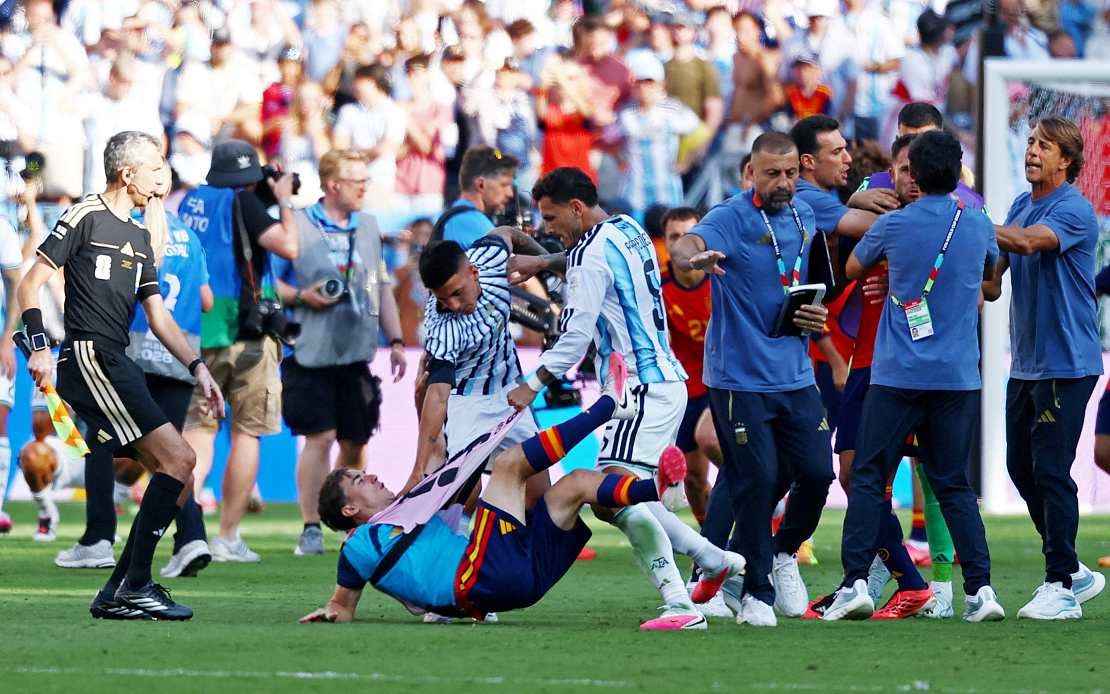
Football's governing body FIFA has formally initiated an investigation into disciplinary violations allegedly committed by Argentina during their World Cup final match against Spain, according to reports from PA Media and dpa news agencies. The inquiry centres on post-match conduct that unfolded in New Jersey after the final whistle, when tensions between the two sides boiled over on the pitch as Spain's players celebrated their victory. The decision to probe potential breaches marks FIFA's continued effort to maintain discipline and decorum in international football competitions, though the move also highlights the organisation's inconsistent approach to policing player behaviour across different jurisdictions and cultural contexts.
At the heart of the investigation is an incident involving Argentina midfielder Leandro Paredes, who appeared to direct punches towards members of the Spanish squad immediately following the conclusion of the match. The specific nature of these confrontations was documented in the match commissioner's report, which FIFA officials subsequently reviewed before determining that a formal investigation was warranted. Such physical altercations between opposing teams represent serious violations of football's fundamental principles of sportsmanship and fair play, and FIFA's willingness to pursue the matter underscores its stated commitment to protecting player safety and maintaining standards of conduct.
FIFA has formally appointed a Disciplinary and Ethics Prosecutor to examine whether Argentina's actions violated the FIFA disciplinary code. According to a statement released by the organisation, this appointment follows the comprehensive assessment of match reports from the World Cup final, undertaken in accordance with Article 36 of the disciplinary code. The prosecutor will conduct a thorough investigation before submitting findings to the FIFA Disciplinary Committee, which will subsequently determine what, if any, sanctions should be imposed on the players or the Argentine Football Association. The committee has indicated that additional details regarding the investigation will be released once the prosecutor completes their review.
Argentina's conduct during the tournament had drawn scrutiny earlier as well, particularly following their semi-final victory over England. Beyond the Paredes incident, the South American side faced criticism for their overall physical approach throughout their matches, demonstrating a pattern of aggressive play that dominated discussions about their path to the final. In the England encounter, midfielder Enzo Fernandez received a red card after accumulating two yellow cards, a clear indication that the referee had already begun clamping down on the team's disciplinary record. This context suggests FIFA's investigators will examine whether the post-match altercation represents an escalation of behaviour that had characterised Argentina's entire campaign.
A separate dimension of the investigation concerns whether FIFA is examining Argentina's conduct in relation to political gestures made during the tournament. Specifically, there remains uncertainty about whether the Disciplinary Committee is investigating Argentine players for displaying a banner asserting Argentine sovereignty over the Falkland Islands following their semi-final triumph against England. Such political statements on the pitch represent potential violations of Article 34.3 of the tournament regulations, which seek to keep international football free from political messaging. The Falkland Islands claim remains a historically sensitive issue for Argentina, and the use of football matches as a platform for such assertions has sparked debate about the intersection of sport and international politics.
Argentina has encountered FIFA penalties for similar conduct previously. Following a 2014 friendly match against Slovenia, the Argentine Football Association was fined over a comparable political gesture, demonstrating that FIFA has previously acted against such displays. However, enforcement of these rules appears to vary considerably depending on context and jurisdiction. The Union of European Football Associations, UEFA, has taken notably stronger action in analogous situations, notably imposing one-match suspension bans on Spanish players Rodri and Alvaro Morata after they engaged in chanting about Spain's claims to Gibraltar following their victory at Euro 2024. This disparity in enforcement between FIFA and UEFA raises questions about consistency in how international football bodies interpret and apply disciplinary codes regarding political conduct.
FIFA's approach to monitoring and sanctioning political expression by players has shifted over time and demonstrated variable stringency depending on the nature of the political message involved. During the 2022 World Cup in Qatar, FIFA took a firm stance against what it considered political activism, warning the English FA that captain Harry Kane would face sporting sanctions beginning with a yellow card if he wore the rainbow-coloured 'OneLove' armband at the tournament. This decisive action occurred in Qatar, where same-sex relationships remain criminalised under national law, illustrating FIFA's prioritisation of compliance with host nation regulations over individual player expression. The contrast between this intervention and FIFA's response to other political gestures raises questions about the principle underlying FIFA's disciplinary philosophy.
For Malaysian and Southeast Asian observers of international football, these developments carry particular significance. The investigation into Argentina's conduct during the World Cup final provides insight into how global football governance operates when high-profile incidents occur at the sport's most prestigious events. The apparent inconsistency in how FIFA and other continental bodies enforce disciplinary codes across different scenarios offers a cautionary tale about the challenges inherent in applying universal standards across diverse political and cultural contexts. Regional fans and administrators watching these proceedings may draw conclusions about how their own national teams and players might be treated under similar circumstances.
The investigation's outcome will likely establish important precedent for how FIFA approaches player discipline and political conduct in future international tournaments. Whether FIFA imposes meaningful sanctions on Argentina will signal whether the organisation prioritises consistency in enforcement or maintains flexibility based on the specific circumstances of each case. As FIFA completes its review and the Disciplinary Committee reaches conclusions, the football community across Asia and beyond will be observing whether the outcome reflects genuine commitment to uniform standards or reveals the organisational complexities that sometimes result in inconsistent application of rules. The findings may influence how national football associations counsel their players regarding appropriate behaviour at future World Cups and continental championships.

