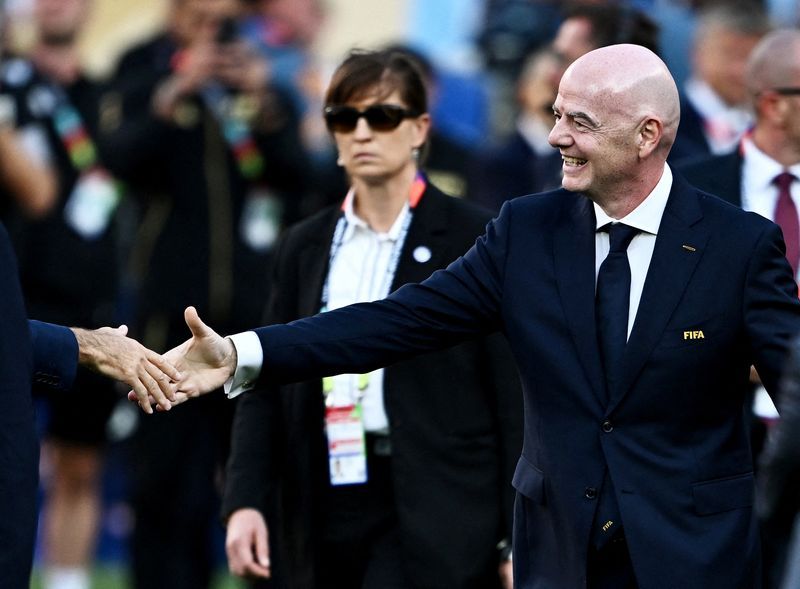
The global football governance crisis deepened this week as major football nations split decisively over FIFA President Gianni Infantino's future, with Mexico and Argentina publicly endorsing his leadership while other continental confederations escalate calls for institutional reform. The two South American and North American powerhouses have broken ranks with their respective regional governing bodies to stand firmly behind the Swiss administrator, creating an unusual fault line in international football politics that will likely shape the struggle for control of world soccer over the coming months.
Infantino's troubled path to potential reelection for a fourth term has been upended by fallout from his now-withdrawn proposal to monetise portions of the World Cup's commercial future, a move that triggered extraordinary backlash across multiple continents. The Mexican Football Federation, which recently co-hosted the tournament, issued a forceful statement rejecting any effort to remove Infantino through mechanisms outside FIFA's formal 211-member voting structure, essentially throwing down a procedural gauntlet to his opponents. This stance directly contradicted CONCACAF, the regional confederation that oversees Mexico and other North American and Caribbean nations, which had demanded comprehensive institutional reckoning with Infantino's presidency.
The regional divisions expose deeper fractures within international football's power structure. The Confederation of African Football unanimously supported Infantino on Thursday, providing crucial backing from a bloc controlling substantial FIFA Congress votes. Yet UEFA, representing Europe's wealthiest and most influential football nations, has committed to boycotting FIFA competitions in protest, a nuclear option that underscores the severity of the governance dispute. Asia's continental confederation explicitly aligned itself with UEFA and CONCACAF, suggesting a potential Asian-European coalition forming against the FIFA president, though their actual voting power remains uncertain.
Argentina's position carries particular symbolic weight as the nation of 2022 World Cup champions. The Argentine Football Association sent a carefully calibrated letter acknowledging that the commercial rights proposal created uncertainty and that procedural mistakes occurred, yet it argued that the solution lay in continued cooperation under Infantino's stewardship rather than his removal. This nuanced endorsement—accepting fault while rejecting regime change—provided Infantino crucial political cover and suggested that South American football's economic interests remained aligned with his administration. CONMEBOL, South America's governing confederation, similarly stipulated that any action against Infantino must involve a full membership vote, effectively insulating him from regional removal attempts.
The governance proposal itself represented an extraordinary overreach of executive power that alarmed stakeholders across football's ecosystem. FIFA's plan to commercialise portions of World Cup rights without transparent consultation triggered accusations from players' union FIFPRO of a "profound abuse of presidential power," language suggesting that the dispute transcends routine administrative disagreement. The proposal violated established norms of dialogue and transparency that FIFA itself had introduced over a decade earlier to prevent exactly this kind of unilateral executive action, creating an apparent contradiction that CONMEBOL specifically highlighted in its statement.
FIFA's attempt at damage control following meetings in Rabat acknowledged mistakes in communication and process but stopped short of admitting governance violations, a distinction that will prove crucial in determining whether the crisis genuinely threatens Infantino's position. The organisation pledged to review decision-making procedures, a commitment that may satisfy some members seeking procedural reforms without fundamentally challenging the administration. However, national associations including Croatia have withdrawn support, joining England and Albania in the opposition camp, suggesting that apologies and procedural reviews may prove insufficient for those seeking deeper institutional change.
The March 2026 FIFA Congress in Morocco remains the formal battleground, though the landscape has shifted dramatically from two months earlier when Infantino's reelection appeared inevitable. No credible alternative candidate has yet emerged to challenge him, a vacuum that may prove decisive if the regional blocs remain fractured. Mexico and Argentina's public backing signals that the Global South—particularly nations invested in FIFA's continental development programmes—retains confidence in the current administration, offsetting European and Asian scepticism.
For Malaysian and Southeast Asian football stakeholders, these internecine FIFA disputes carry practical implications. The Asian Football Confederation's alignment with UEFA and CONCACAF against Infantino could shape future tournament hosting decisions, commercial distribution of media rights, and development funding priorities that directly affect regional football infrastructure. Southeast Asian nations depend substantially on FIFA's development programmes and tournament revenue-sharing arrangements, making continental confederation positioning strategically significant.
The institutional landscape Infantino has inherited includes genuine reforms introduced over a decade ago to prevent the corruption and opaque decision-making that plagued FIFA under previous leadership. Yet his World Cup commercialisation proposal suggested that these safeguards remain fragile when confronted by executive ambition, validating concerns that FIFA's governance reforms remain incomplete. The current crisis ultimately reflects whether FIFA's membership believes that modernisation and transparency have genuinely taken root or whether they remain superficial overlays on fundamentally autocratic structures.
Infantino's political survival may ultimately depend less on the merits of the World Cup proposal and more on his demonstrated ability to maintain coalition support from key voting blocs. Mexico and Argentina's backing provides crucial geographic and economic anchors, while African confederation support offers numerical voting advantage. Yet the boycott threat from UEFA and the solidarity demonstrated by Asian confederation members signal that significant portions of global football's most commercially valuable regions remain willing to impose costs if institutional governance does not substantially improve.

