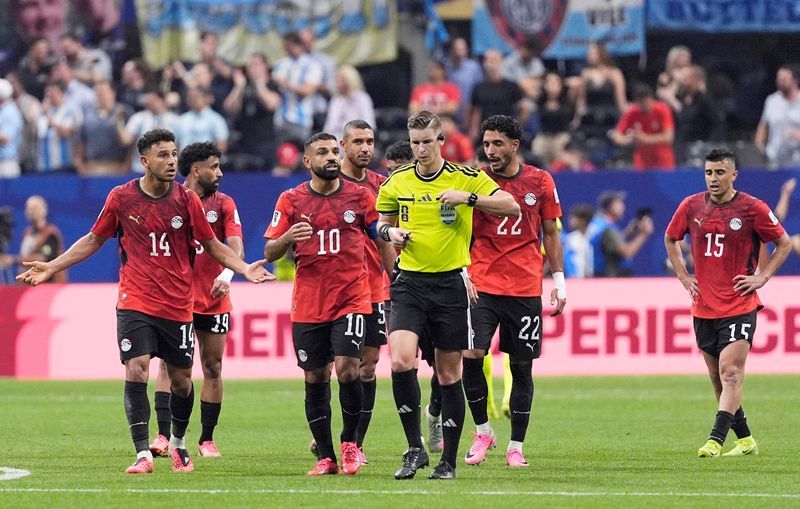
FIFA's head of refereeing has moved to quell a brewing diplomatic row over the integrity of international football governance, defending the officiating decisions that allowed Argentina to overcome Egypt 3-2 in a dramatic World Cup knockout clash. Pierluigi Collina's robust statement came in response to complaints from Egypt's coaching staff and football federation, who alleged that crucial decisions had been made unfairly, potentially influenced by considerations beyond the sport itself.
The controversy centres on two pivotal moments in the match that fundamentally altered its trajectory. Egypt's Mostafa Zico thought he had extended his team's lead with a second-half goal, only to see it disallowed following a Video Assistant Referee intervention. Moments later, as Argentina pressed forward in search of an equaliser, Mohamed Salah appeared to be fouled by defender Julian Alvarez, yet no penalty was awarded. These two decisions bookended a dramatic turnaround in which Argentina scored three unanswered goals, including a stoppage-time winner from Enzo Fernandez that sent the North African nation crashing out of the tournament.
Egypt's coach Hossam Hassan suggested immediately after the match that external pressure may have influenced the match official, a hint that FIFA authorities would have viewed as a serious challenge to the institution's credibility. The Egyptian Football Association followed suit with an official statement, noting that "several key incidents raised serious concerns and left profound questions about the consistency and fairness of decisions that directly influenced the course of the game." Such language represents more than mere sour grapes; it constitutes an implicit accusation that the World Cup's refereeing apparatus may have been compromised.
Collina's response was characteristically uncompromising, reflecting FIFA's zero-tolerance approach to suggestions that its officials operate anything other than autonomously. In an interview published on the governing body's official website, the Italian football administrator categorically stated that match officials at the World Cup could not be influenced by anyone, including FIFA president Gianni Infantino. He emphasised that while constructive debate about specific decisions is natural and acceptable in football, allegations attacking the integrity of referees venture into territory that FIFA considers utterly unacceptable. This distinction between critiquing a decision and questioning an official's impartiality has become crucial in modern football governance.
The refereeing chief articulated a particular concern about the wider consequences of integrity accusations. When officials face allegations of bias or corruption, Collina argued, they and their families can become targets for threats and intimidation. This perspective reflects growing security concerns surrounding international football, where passionate fan bases and significant financial interests can occasionally spill into dangerous territory. By framing the integrity question as one that carries real human consequences, Collina sought to reposition the Egyptian complaints as not merely wrong, but potentially harmful.
Regarding the disallowed goal, Collina pointed to what VAR officials had identified during the reviewing process: a foul committed by Marwan Attia on Argentina's Lisandro Martinez. According to FIFA's interpretation, a foul is a foul, regardless of whether it appears minor or marginal. The principle that VAR can recommend overturn of on-field decisions when contact constitutes a violation, even if the referee initially missed it, has become foundational to how the technology operates. Collina presented this not as an arbitrary judgment call but as consistent application of documented rules.
The penalty decision proved equally complex in Collina's explanation. The contact between Salah and Alvarez presented a question about where to draw the line between normal competitive play and punishable contact. Collina explained that while stepping directly on an opponent's foot represents a clear foul, a defender who makes contact with the ball first and subsequently makes what constitutes normal football contact has not violated the rules. This distinction between different types of contact occupies considerable grey area in modern football, where defenders and attackers engage in constant physical contest. The VAR officials judged the Alvarez-Salah interaction to fall within acceptable competitive parameters.
Conceding that some refereeing decisions inevitably involve subjective judgment, Collina nonetheless expressed satisfaction that VAR principles had been properly applied throughout the tournament. This acknowledgement of occasional subjectivity represents a pragmatic recognition that football, despite technological advances, cannot be reduced to mathematical certainty. What matters, in FIFA's view, is that the process by which decisions are reached remains transparent and governed by consistent interpretation of the rules.
For Malaysian and Southeast Asian readers, this dispute carries implications beyond the immediate World Cup drama. The governance of international football reflects broader questions about institutional legitimacy and transparency that resonate throughout global sports. When organisations like FIFA face credibility challenges, particularly from smaller football nations, the response sets precedents for how disputes are handled across the sport. The Egyptian complaint represents a moment when a developing football nation explicitly challenged the establishment narrative, testing whether FIFA would genuinely defend its systems or dismiss criticism from less powerful federations.
The incident also illustrates how technological intervention in sport creates new categories of controversy. VAR was introduced partly to reduce obvious errors, yet its application generates disputes of its own, raising questions about consistency and fairness that arguably supersede the original problems it was meant to solve. Different match officials may interpret the same contact differently, and when stakes are high—particularly in World Cup knockout stages—those interpretative differences become sources of international diplomatic tension.
Egypt's exit from the tournament following this disputed match deprives African football of a compelling narrative and raises questions about whether smaller nations genuinely compete on level ground in international tournaments. While Collina's technical defence of the refereeing decisions may be legally sound, the broader concern about whether the World Cup's officiating apparatus truly operates with complete impartiality remains a legitimate topic for football governance to address. FIFA's confidence in its systems will ultimately be measured not merely by the explanations it offers, but by whether similar disputes emerge in future tournaments.

