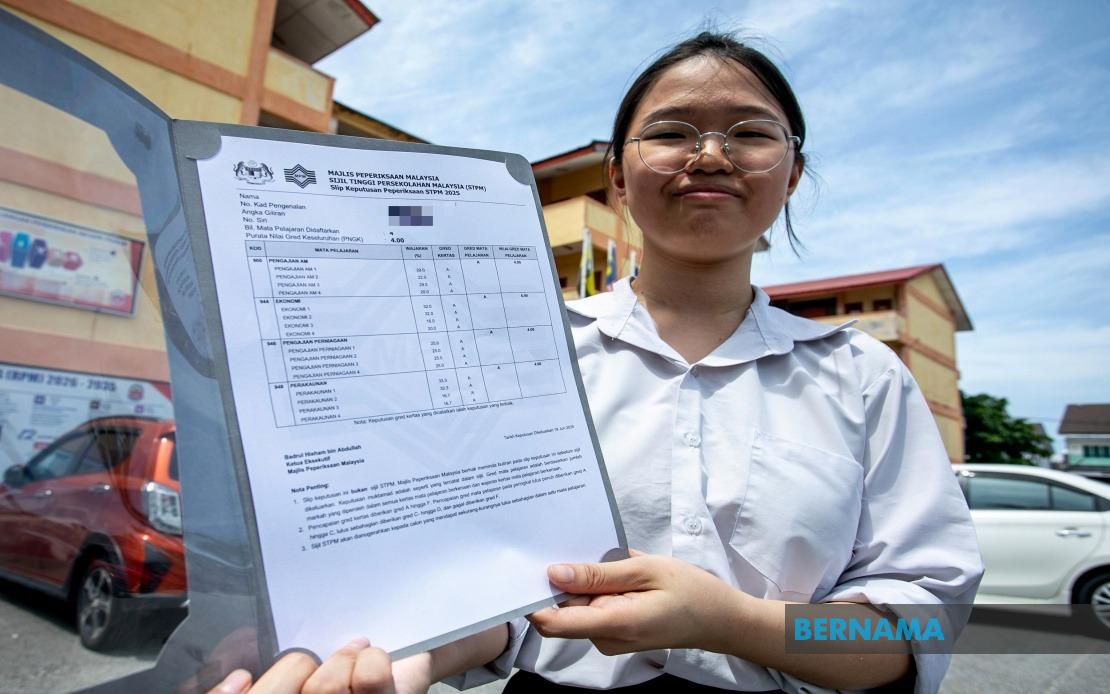
Yong Xin Yi's stellar performance in the 2025 Sijil Tinggi Persekolahan Malaysia (STPM) examination—securing perfect grades across all four subjects—illustrates a fundamental principle that resonates with Malaysian education: consistent, methodical effort outperforms sporadic cramming. The 20-year-old student from SMK Jalan Tasek in Ipoh achieved four A grades with a Cumulative Grade Point Average of 4.00, placing her among an elite cohort of five top-performing students from her institution and offering valuable insights into examination success that can guide other pre-university learners across the country.
Xin Yi's strategy centred on a non-negotiable daily commitment: five hours of structured revision every evening from 5:00 pm to 10:00 pm following regular school sessions. Rather than treating study as a last-minute scramble before examinations, she embedded learning into her daily rhythm, treating it as integral to her routine rather than an extraordinary undertaking. This consistency proved transformative, creating what education specialists recognise as the spacing effect—the principle that distributed practice over time produces superior retention compared to massed practice compressed into brief periods. For Malaysian students navigating the demanding STPM curriculum, which requires synthesis across multiple complex subjects, such discipline addresses a common challenge: managing the cognitive load of simultaneous subject mastery without experiencing burnout.
Equally significant in Xin Yi's approach was her emphasis on classroom engagement as the foundation for all subsequent revision. She prioritised focused attention during lessons, recognising that understanding concepts directly from teacher explanation dramatically reduces confusion during independent study. This hierarchy—classroom comprehension before home revision—inverts the approach many students adopt, where home study becomes an exercise in deciphering poorly understood material. By concentrating fully on pedagogical delivery in school, Xin Yi minimised the time required for home revision to simply reinforce and consolidate rather than remediate gaps. For Malaysian educators and parents, this underscores an often-overlooked reality: the quality of classroom attention directly determines revision efficiency.
Xin Yi obtained her four A grades in General Studies, Principles of Accounting, and Economics, demonstrating capability across both quantitative and qualitative disciplines. Her performance was particularly noteworthy in General Studies, a subject she identified as initially problematic due to its demanding writing requirements and rigorous format specifications. Rather than accepting this weakness, she deliberately invested additional attention in the subject, conducting targeted practice on essay structure and marking scheme alignment. This adaptive strategy—identifying vulnerability and reallocating effort accordingly—reflects metacognitive maturity that many pre-university students lack. Southeast Asian examination systems like STPM require precisely this kind of strategic self-awareness, where students must recognise subject-specific demands and calibrate preparation intensity accordingly.
The completion of all assigned homework formed another pillar of Xin Yi's success. While homework completion is often viewed as routine obligation, she contextualised it as essential mastery practice that deepened conceptual understanding beyond classroom boundaries. Malaysian teachers frequently assign homework as reinforcement; students who treat such assignments as genuine learning opportunities rather than compliance exercises extract considerably greater value. Xin Yi's approach suggests that homework's efficacy depends less on its assignment and more on the mindset with which students engage it—whether as busywork or as integrated consolidation of newly acquired knowledge.
Family support proved instrumental throughout her examination journey. Born to parents working in modest professions—her mother employed as a clerk and her father as a phone salesman—Xin Yi benefited from parental encouragement that sustained motivation through demanding pre-university study. This context resonates throughout Malaysian society, where many students from non-professional backgrounds successfully breach academic barriers through family encouragement combined with personal discipline. Xin Yi's explicit articulation of gratitude towards her parents reflects an understanding that academic achievement emerges from collaborative effort rather than individual brilliance alone, a perspective particularly relevant in Southeast Asian educational contexts where family involvement shapes outcomes substantially.
Xin Yi's trajectory following STPM exemplifies purposeful career planning grounded in realistic self-assessment. Rather than pursuing a field based on prestige or assumption, she evaluated her genuine interests and career prospects, concluding that economics offered the best alignment with her capabilities and aspirations. Her intention to pursue economics at Universiti Putra Malaysia represents a continuation of the same methodical, evidence-based decision-making that characterised her examination preparation. For Malaysian students contemplating university pathways, her approach models how to move beyond vague ambition toward concrete, informed choices based on personal aptitude and labour market reality.
Xin Yi's aspiration to become an economist carries particular significance given Malaysia's ongoing economic complexities and regional positioning. As the country navigates challenges ranging from skills gaps to structural economic transformation, economists play critical roles in policy formulation and business strategy. Her determination to improve her family's circumstances through educational advancement reflects the persistent truth that credentials remain gateway mechanisms for social mobility in Malaysia, particularly for students whose parents lack higher education qualifications.
The broader implications of Xin Yi's success extend beyond individual achievement to educational pedagogy. Her experience suggests that the foundational variables determining STPM performance—consistent daily effort, classroom attention, strategic weakness remediation, complete assignment engagement, and family support—remain constant across diverse student demographics. Malaysian education stakeholders, from principals to parents, might contemplate how systematically these variables can be promoted and supported across schooling systems. While Xin Yi's 4As represent exceptional outcomes, the disciplinary framework enabling them remains teachable and replicable, offering template approaches for other aspirational students navigating STPM's demanding landscape across the country.

