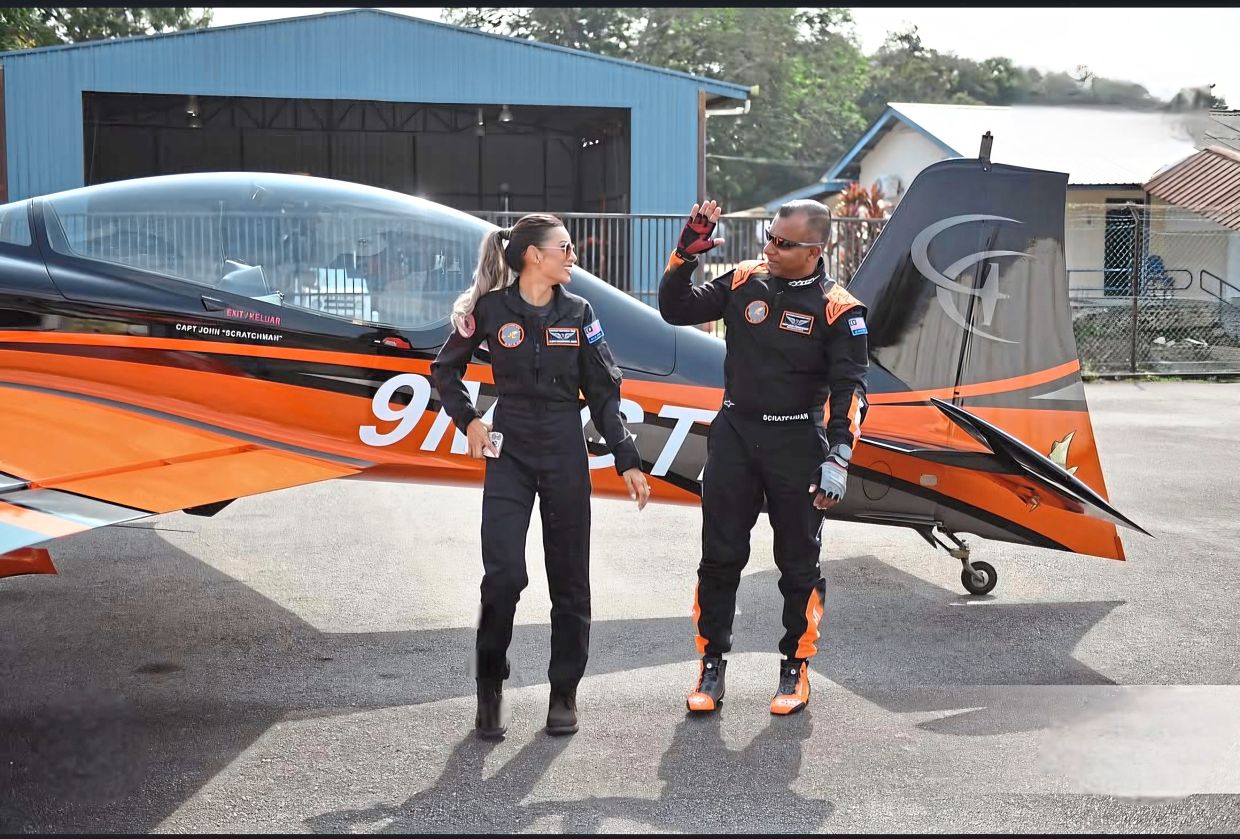
When aviation runs in the family, inspiration takes flight at an early age. Samantha Laura John, 26, represents a new generation of Malaysian pilots shaped by her father's illustrious career in the skies. Having completed her flight training in Ipoh in 2025, she now holds a pilot's licence, walking a path carved decades earlier by her father, Lieutenant-Colonel (Retired) John Sham Alagarsamy, 54, who spent over two decades as a fighter pilot with the Royal Malaysian Air Force. Their shared passion for aviation illustrates how formative childhood experiences and strong family bonds can nurture professional aspirations across generations.
Samantha's attraction to aviation was nurtured by watching her father embark on what she perceived as missions throughout her childhood—the training exercises and navigation drills that defined his military career. That sense of pride in his service to Malaysia, combined with her fascination with aircraft and the uniforms worn by military personnel, crystallised into a clear life direction from an early age. Yet her father never imposed this path upon her; instead, he offered guidance rooted in ambition and possibility. "I always hoped my children would follow in my footsteps, but I never forced them," John explains. "I always told them that if they aim for the stars, at least they'd reach the sky. The bigger your dreams, the greater your success – you have to dream it before you achieve it." This philosophy of encouragement without coercion appears to have shaped Samantha's own approach to her career decisions.
John's credentials in aviation are substantial. His 26-year tenure in the RMAF encompassed roles as a fighter pilot, instructor, and examiner before he transitioned into commercial aviation in 2019. Beyond his military service, he holds a distinction that few in Malaysia can claim: recognition by the Civil Aviation Authority of Malaysia as the country's first and only civil aviator certified for aerobatics. This expertise has earned him numerous opportunities to perform at prestigious airshows, most notably the Langkawi International Maritime and Aerospace Exhibition (Lima), where he has demonstrated aerobatic manoeuvres in the GB1 GameBird aircraft. His remarkable career trajectory—from combat readiness to precision aerobatic flying—demonstrates the breadth of possibilities within aviation professions.
What further sets John apart is his multifaceted talents extending beyond the cockpit. He is an accomplished musician and professional deejay operating under the moniker "Scratchman", a title earned legitimately when he won the Malaysian Open DJ Competition in 1992 during the era of vinyl and turntablism. This creative dimension adds unexpected depth to his character, suggesting that the discipline required for military aviation and the artistry demanded by music production are not as incompatible as one might assume. These parallel pursuits reveal a personality that thrives on precision, technical mastery, and creative expression—qualities that may well have influenced his daughter's own multifaceted career approach.
Samantha's current life reflects a pragmatic balance between her pilot's licence and other professional pursuits. Based in Kota Kinabalu, she operates an event management company alongside her husband, David Chong, 30, and provides vocal coaching on a freelance basis. While these endeavours keep her professionally engaged, she views them as stepping stones rather than final destinations. She remains committed to eventually returning to aviation and pursuing a career in commercial flying, suggesting that her pilot's licence represents not a completed goal but the foundation for future aspirations. This measured approach to career development contrasts with the immediate assumption that obtaining a pilot's licence must immediately lead to professional flying roles.
The family's history of geographical mobility, driven by her father's military postings, proved formative in unexpected ways. Samantha spent her early childhood moving across Malaysia—from Labuan to Kuantan, Alor Setar, and Butterworth in Penang—before reaching primary school age. Rather than viewing these relocations as disruptive, she recognises them as developmentally significant. Living on air force bases immersed her in an environment characterised by discipline and collective purpose, exposing her to the serious responsibilities that RMAF pilots undertake in protecting Malaysia's airspace and maritime borders. These childhood observations provided context for her career aspirations, transforming abstract notions of "becoming a pilot" into concrete understanding of aviation's role in national defence.
A pivotal period came in 2012 when the family relocated to Canberra, where John was attached to the Australian Defence Force while pursuing a master's degree in military and defence studies from the Australian National University. For Samantha, this international exposure proved transformative, broadening her perspective on how different nations approach aviation and defence cooperation. Living in Australia during formative teenage years provided comparative experience that enriched her understanding of global aviation systems and international military partnerships. This global perspective distinguishes her experience from many Malaysian pilots whose training remains largely domestic, potentially providing her with valuable cross-cultural competencies relevant in an increasingly interconnected aviation industry.
Research from Universiti Teknologi Malaysia's social science journal, titled "Parental Influence and Undergraduates' Career Choice Intentions", provides empirical support for what the John family exemplifies. The study demonstrates that strong parent-child relationships, open communication, and mutual trust significantly influence career decisions by encouraging exploration and facilitating long-term planning. Samantha's journey confirms these findings: her parents consistently encouraged her to pursue her own interests rather than simply replicate her father's exact path. This approach granted her the autonomy to explore alternative directions, including a two-year cadet pilot programme with an airline in Sepang, Selangor, which she undertook in 2018 after completing her IGCSE qualifications.
That exploration, while ultimately not her final destination, proved valuable for self-discovery. Although the cadet programme offered rewarding experiences, Samantha eventually recognised it did not align with her deeper aspirations. This recognition catalysed her decision to pursue formal pilot training, ultimately leading to her flight school graduation in 2025. Her willingness to test alternative paths before committing to aviation training demonstrates mature decision-making rather than impulsive career selection. "Sure, I tried a different path, but deep down, I always knew I would come back to aviation," she reflects with characteristic candour. This self-awareness suggests she brings intentionality to her professional choices rather than simply following inherited expectations.
Samantha describes the experience of piloting in almost meditative terms, highlighting the profound cognitive and physical demands of flying. "Once you're in the cockpit, you have to be fully focused and aware of your surroundings. You're always looking ahead, thinking ahead, and staying situationally aware. It's almost like working in six dimensions." This description captures why aviation attracts individuals with particular psychological profiles—those who thrive under complex, multi-layered cognitive demands and find satisfaction in mastery of intricate systems. The therapeutic quality she identifies suggests that flying addresses something deeper than career ambition, perhaps fulfilling an almost spiritual need for presence and focus that characterises many professional pilots' accounts of their work.
The relationship between Samantha and her father, evident in their recent family gathering at a Klang Valley restaurant, embodies mutual respect alongside affection. She speaks to him with evident deference rooted in childhood discipline and family values, while he addresses her with evident pride tempered by humility about his role in her development. John's receipt of the Most Gallant Order of Military Service (Kesatria Angkatan Tentera) during his RMAF career marks official recognition of his dedication, yet his reflections on legacy focus less on personal accolades and more on intergenerational influence. "It is measured by the positive impact we leave on others, especially our children, who often learn more from what we do than what we say," he observes. This philosophy—that example outweighs exhortation—appears to have guided his parenting across his children's lives and continues shaping family dynamics.
The John family story resonates within Malaysia's broader aviation narrative. Other families have similarly produced multiple aviation professionals, including the sisters Safia Amira Abu Bakar and Safia Anisa Abu Bakar, who followed their father Captain Abu Bakar Shafie into the field. These examples suggest that aviation professions, despite their technical and demanding nature, attract family involvement through a combination of exposure, inspiration, and the tangible benefits of having parents who understand the industry's demands and opportunities. For Malaysia specifically, where female representation in aviation professions remains relatively limited despite growing acceptance, Samantha's achievement carries particular significance. Her presence in the cockpit represents not merely individual accomplishment but incremental progress toward gender parity in roles historically dominated by men.
Looking ahead, Samantha's trajectory embodies contemporary approaches to career development that prioritise authenticity and alignment with deeper values over linear progression. Her current work in event management and vocal coaching maintains professional engagement while she considers optimal timing for transitioning to commercial aviation roles. This flexibility contrasts with older generational patterns of permanent career commitment and reflects evolving workforce expectations among millennials and younger professionals. Her story ultimately illustrates how family legacies in professional fields persist not through rigid replication but through cultivation of genuine interest, provision of opportunity, and respect for individual agency in charting one's own course through the complexities of modern career landscapes.

