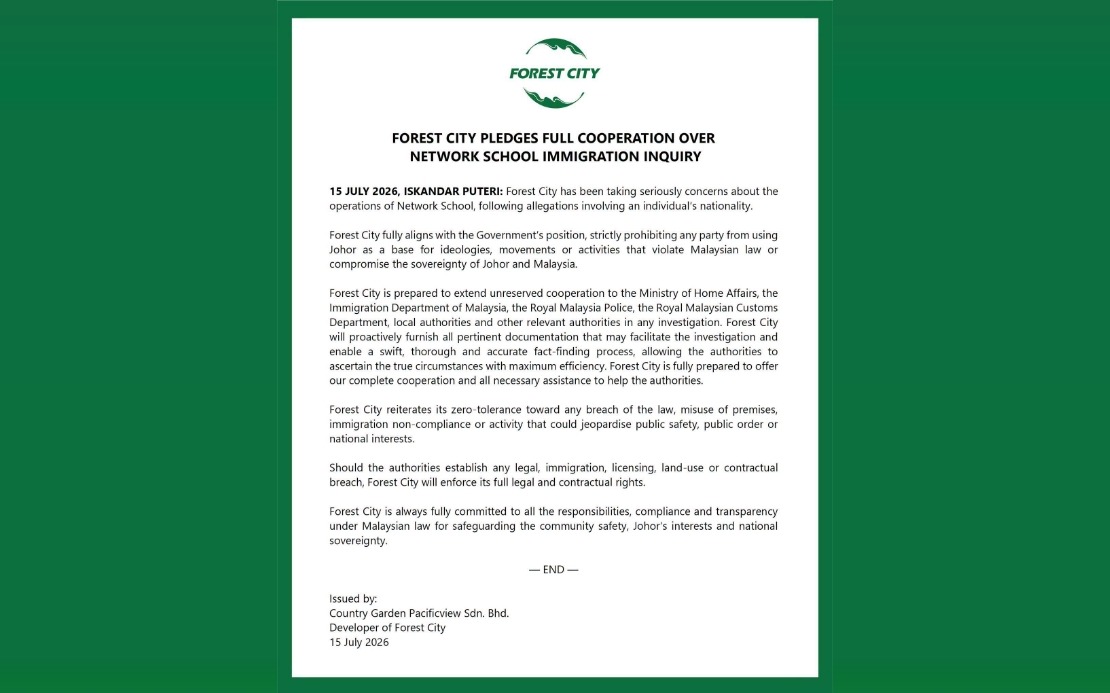
The developer of the Forest City residential and commercial complex in Johor Bahru has committed to providing full assistance to government agencies investigating the controversial Network School programme, which reportedly drew participants from Israel using secondary passports to circumvent immigration protocols. In a statement released on July 15, Country Garden Pacificview Sdn Bhd—the company behind the sprawling megaproject—emphasised its support for Malaysia's sovereignty and declared its readiness to cooperate with multiple federal and state bodies to resolve the matter.
The statement represents an attempt by the developer to distance itself from potential regulatory breaches at the residential and investment hub located in the south. Country Garden Pacificview stressed that it takes the allegations seriously and aligns itself with the federal government's clear position that Johor and Malaysia as a whole cannot become a venue for activities that breach domestic laws or compromise national interests. This positioning is strategically important for the developer, as the Forest City project has faced international scrutiny since its inception, particularly from Jewish advocacy groups critical of its operations.
Country Garden Pacificview explicitly stated its commitment to collaborate with the Home Ministry (KDN), Immigration Department (JIM), Royal Malaysia Police, Royal Malaysian Customs Department, municipal authorities, and all relevant enforcement agencies. This multi-agency cooperation framework underscores the scope of the investigation, which touches on immigration compliance, security protocols, and municipal oversight—regulatory domains that intersect across several government portfolios. The developer's willingness to engage across this spectrum signals recognition that the matter extends beyond simple corporate compliance issues.
The company pledged to furnish all documentation required by investigators to accelerate the fact-finding process while ensuring thoroughness and accuracy. By positioning itself as a cooperative partner rather than a reluctant subject of inquiry, Country Garden Pacificview aims to demonstrate institutional responsibility and administrative transparency. The developer also articulated a zero-tolerance position regarding law violations, misuse of facilities, immigration regulation breaches, and activities that endanger public safety and social order—language crafted to pre-emptively address concerns about lax on-site oversight.
The investigation itself was catalysed by Johor Menteri Besar Datuk Onn Hafiz Ghazi's public call on July 14 for federal authorities to examine the Network School's activities at Forest City. Onn Hafiz revealed that foreign nationals attending the programme were believed to have entered Malaysia using passports from third countries, effectively masking their national origins and circumventing standard scrutiny that Israeli citizens would normally encounter. This alleged practice raised alarm bells across the state government and triggered immediate inspection protocols.
In response to the political pressure, the Immigration Department mobilised rapidly, conducting an inspection of 266 foreign nationals representing 40 countries within the Forest City precinct on July 14. While preliminary verification confirmed that all inspected individuals held valid immigration documentation, officials indicated that comprehensive investigations would continue beyond the initial screening phase. This discrepancy between surface-level documentation compliance and underlying concerns about traveller identities highlights the sophistication of the alleged circumvention scheme and the complexity of modern immigration fraud.
The Network School controversy carries significant implications for Malaysia's tourism and education sectors, as well as for the broader question of border integrity in the Southeast Asian region. Malaysia has maintained a consistent diplomatic position toward Israeli-Palestinian matters, and the discovery of organised Israeli participation in activities within the country—conducted covertly through document manipulation—strikes at both immigration enforcement and the nation's geopolitical consistency. For Johor specifically, which aspires to position itself as a premier regional investment and lifestyle destination, the incident represents an embarrassing oversight in security governance.
Forest City itself represents a substantial Chinese investment into Malaysia, involving billions of ringgit in mixed-use development. The complex has previously attracted controversy over financing structures and regulatory questions, making this investigation yet another reputational challenge for the project. For potential investors and residents, the incident raises questions about the depth of due diligence conducted by the developer regarding activities and organisations operating within its boundaries, regardless of tenancy arrangements or operational independence.
The broader context reveals a tension within Malaysia's regulatory environment: the country's openness to foreign investment and international commerce, balanced against national security and diplomatic policy imperatives. The Network School case suggests that enforcement agencies may be struggling to maintain effective oversight of foreign nationals and organised activities within large private complexes, particularly when sophisticated document fraud is employed. This regulatory gap has consequences not only for immigration policy but also for Malaysia's credibility in managing security risks in an era of increasing mobility and digital identity manipulation.
As investigations proceed across multiple agencies, the focus will likely extend beyond Forest City itself to examine the broader Network School operation, its funding sources, organisational structure, and participant profiles. The Immigration Department's commitment to ongoing investigation suggests that the preliminary finding of valid documentation may conceal deeper irregularities in application materials, sponsorship declarations, or stated purposes of entry. Malaysia's federal authorities will need to balance thoroughness with efficiency, as prolonged investigations could further damage Forest City's international reputation while also consuming substantial government resources.
The developer's cooperative posture may facilitate the investigation's progress, but it also reflects an underlying vulnerability: large private developments in Malaysia remain subject to varying degrees of oversight, and the complexity of modern real estate operations—which often involve multiple tenants, contractors, and international service providers—creates governance blind spots. The incident underscores the need for more robust inter-agency coordination mechanisms and clearer regulatory frameworks governing activities within private commercial zones, particularly those hosting international operations.
Moving forward, the outcome of the Network School investigation will likely influence how Malaysia's regulatory bodies approach oversight of similar international programmes and foreign-operated institutions within private complexes. Policymakers may respond by tightening sponsorship verification requirements, enhancing immigration screening protocols, or mandating greater developer accountability for on-site activities. For Forest City and similar megaprojects, the case serves as a reminder that administrative vigilance in a security-conscious era carries significant business implications, and that reputational damage from operational irregularities can persist long after formal investigations conclude.

