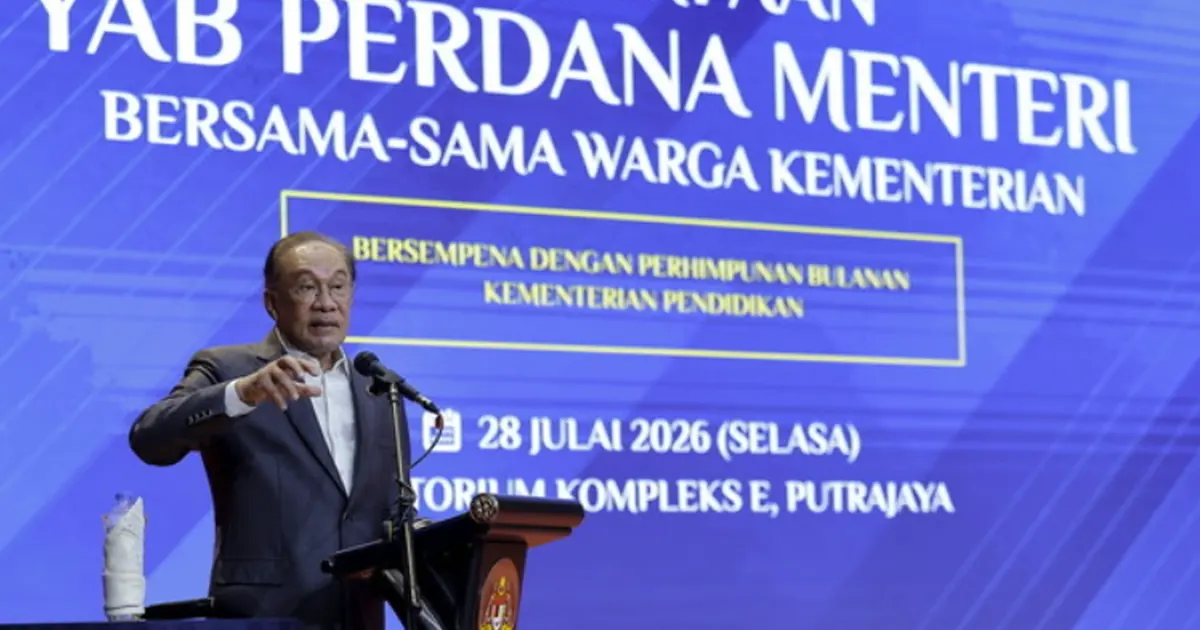
Prime Minister Anwar Ibrahim has moved to settle ongoing questions about the administrative future of Malaysia's Form 6 programme, declaring that it will continue to operate under the Education Ministry rather than being transferred elsewhere. The decision underscores the government's commitment to maintaining the current institutional framework governing post-secondary education, despite periodic discussions about potential restructuring that have circulated within policy circles.
Anwar's clarification addresses mounting uncertainty that has surrounded the programme's governance in recent months. The confirmation comes as stakeholders across the education sector seek clarity on long-term institutional arrangements affecting both the delivery and oversight of upper secondary education in the country. By reaffirming the Education Ministry's continued stewardship, the Prime Minister has provided the policy certainty that schools and administrators require for effective planning and resource allocation.
The decision reflects considerations that extend beyond simple administrative convenience. The Prime Minister cited multiple interrelated factors underpinning the choice to maintain the existing arrangement. Institutional cohesion stands foremost among these concerns—the various systems, protocols, and procedural frameworks that govern Form 6 operations are deeply embedded within the ministry's structures and have evolved over years of implementation. Dismantling or relocating these systems would introduce considerable disruption to current operations.
Teacher allocation and workforce management constitute another critical dimension influencing the determination. The Form 6 system depends upon a carefully calibrated deployment of qualified educators across hundreds of institutions nationwide. The existing administrative machinery within the Education Ministry handles this complex logistical challenge, managing subject specialisation, geographical distribution, and professional development requirements. Transferring such responsibilities to another agency would necessitate substantial reorganisation of these established networks, potentially creating gaps in educational provision during transition periods.
The broader pedagogical ecosystem surrounding Form 6 also shaped the government's thinking. The programme operates in concert with the secondary school system below it and the university framework above it—alignments that function smoothly because they remain coordinated through a single ministry. Related curriculum matters, examination standards, assessment protocols, and certification procedures all benefit from unified oversight. Fragmenting this coordination across multiple institutions would risk creating inconsistencies and friction points that could disadvantage students navigating the transition to tertiary education.
For Malaysian schools themselves, the announcement brings welcome stability. Form 6 institutions have invested considerable effort in aligning their operations with Education Ministry directives and integrating with broader ministry initiatives. The confirmation that this relationship will persist allows headmasters and senior administrators to move forward with medium-term strategic planning without fear of sudden institutional reorganisation. It provides assurance for teacher recruitment and retention efforts, as educators can rely upon established career pathways and professional structures.
The decision also has implications for parents and students contemplating upper secondary options. Clarity about administrative governance allows families to understand how Form 6 fits within the overall education landscape and how quality assurance mechanisms operate. Students can proceed with their studies confident that the programme operates within a stable institutional framework with clear accountability lines and established procedures for addressing grievances or concerns.
Regionally, Malaysia's approach to maintaining Form 6 under direct ministry supervision distinguishes it from some neighbouring jurisdictions where secondary and post-secondary education operate under different governance structures. The integrated model reflects a particular philosophy about educational continuity and the importance of seamless progression through the academic pipeline. This orientation has produced measurable benefits in terms of curriculum alignment and student transition success, considerations that likely influenced the Prime Minister's reasoning.
Looking forward, the confirmation suggests that any future evolution in Form 6's structure will occur incrementally within the Education Ministry framework rather than through wholesale institutional relocation. This approach allows for measured refinement of policies and practices while preserving the underlying administrative architecture. Potential improvements in pedagogy, infrastructure investment, or teacher support mechanisms can thus be pursued through ministry channels already equipped to implement them effectively.
The announcement also reflects pragmatic recognition of the institutional inertia involved in major administrative reorganisation. Any transfer of Form 6 to alternative governance would require legislative changes, budget reallocation, personnel reassignment, and establishment of entirely new reporting relationships—an undertaking of considerable scope that would necessarily divert attention and resources from the core mission of enhancing educational quality and outcomes.
For the Education Ministry itself, the confirmation validates its continued role as the primary steward of Malaysia's academic development infrastructure. The ministry can now proceed with confidence in shaping Form 6's evolution, whether through curriculum modernisation, investment in facilities, or enhanced teacher development programmes. This clarity enables longer-term strategic thinking and more ambitious reform initiatives that might otherwise be constrained by uncertainty about institutional status.
The Prime Minister's statement effectively closes a chapter of speculation while opening new opportunities for constructive dialogue about how Form 6 can better serve Malaysian students and prepare them for university education and professional careers. By settling the governance question, Anwar has freed the education sector to concentrate on the substantive challenges of quality, relevance, and accessibility.

