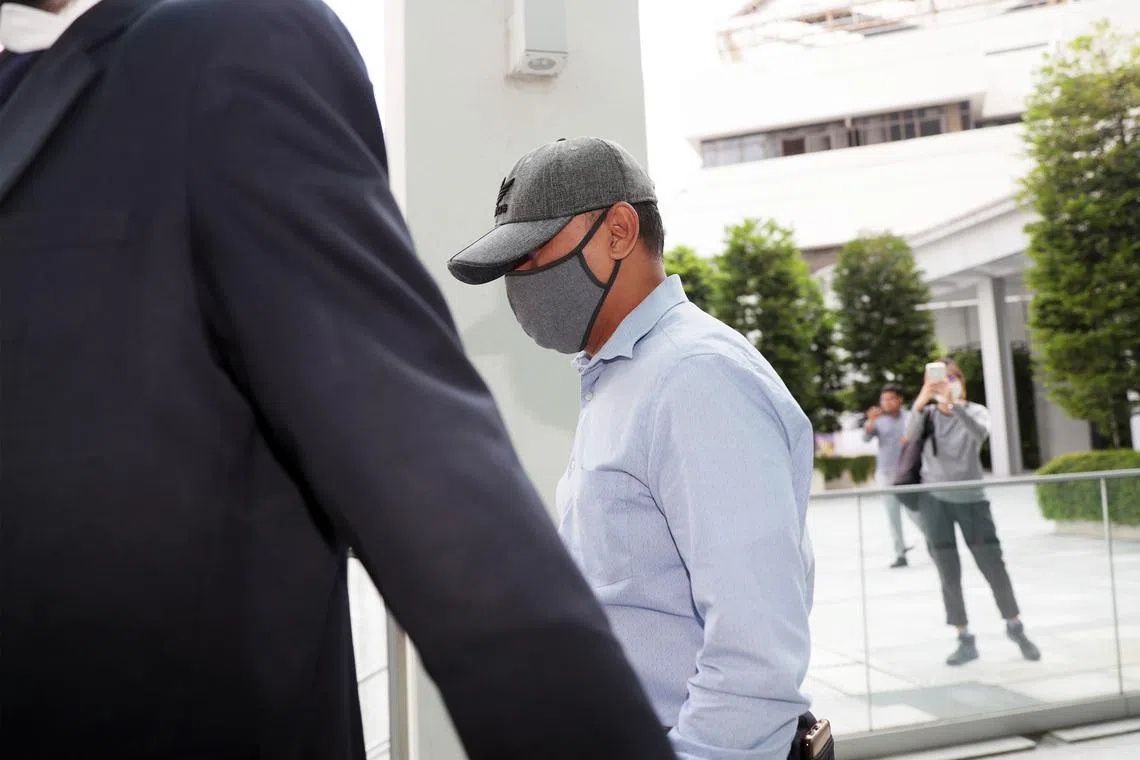
A 59-year-old former executive chairman of two prominent Singapore mosques received a 14-month prison sentence on Friday for corruption involving construction contracts valued at S$223,000. Abdul Rahim Mawasi, who held leadership positions at Darul Aman Mosque in Jalan Eunos and Sallim Mattar Mosque in MacPherson, was convicted in April following trial proceedings that exposed a scheme to unfairly advantage a longtime friend's construction company through privileged price information.
At the time of the offence, Mawasi served as a senior officer with the Islamic Religious Council of Singapore (MUIS), having joined the organisation in 2005. He was subsequently seconded to both mosques, where he chaired their respective management boards. This dual role placed him in a position of significant trust and authority over procurement decisions—a position he allegedly exploited for personal financial gain through a corrupt arrangement with his associate.
The scheme began in July 2018 when Mawasi proposed to Mohd Mustaqim Kam, also known as Kam Hock Beng, that they establish a travel company specialising in pilgrimage trips. Kam, then 66 years old, was a director at construction firm Zeal-Con Engineering. The two men, who had maintained a personal relationship spanning more than a decade, struck a remarkable agreement: Mawasi would contribute no capital to the venture but would instead provide assistance in securing construction contracts from the two mosques. Kam would then channel profits from these projects into the travel company as paid-up capital. This arrangement effectively transformed public sector opportunities into private equity stakes.
The corruption manifested through two separate contracts. When Darul Aman Mosque sought construction vendors for yard renovation work in 2018, Zeal-Con submitted competing quotes. The first quotation, dated August 20, came in at S$128,600. Following discussions between Mawasi and Kam—during which Mawasi provided what prosecutors described as crucial price indications—the company submitted a revised quote of S$118,000 on September 12. This lowered bid undercut the next closest competitor's submission of S$125,500. The mosque's management board awarded the contract to Zeal-Con for S$118,000 on September 26, unaware that the executive chairman had conducted extensive negotiations with Kam regarding the bidding strategy and pricing.
A parallel arrangement unfolded at Sallim Mattar Mosque. In September 2018, Zeal-Con initially quoted S$115,700 for renovation works encompassing the roof and reception area. By July 2019, the company had reduced its price to S$105,000 for identical work. The following month, the mosque awarded contracts to Zeal-Con based on the lower figure. Court evidence indicated that Mawasi had directly advised Kam to reduce the quotation to secure the contract award—guidance that constituted a direct abuse of his fiduciary position.
To obscure the corrupt scheme from regulatory scrutiny, the co-conspirators employed a concealment strategy. In November 2019, Kam converted an existing shell company into Amal Travel and Tour (ATT), capitalised with 100,000 shares and paid-up capital of S$100,000. Critically, Kam allocated 25,000 ATT shares, valued at S$1 each, to Mawasi's son in November 2019. This arrangement allowed Mawasi to maintain beneficial ownership of the enterprise while maintaining plausible deniability about his involvement. During trial, Mawasi denied any connection to ATT and confirmed he held no formal shareholdings—precisely the point of the deceptive structure.
Mawasi's co-conspirator, Kam, received a more lenient sentence of six months' imprisonment in February 2025, reflecting his status as the willing recipient rather than the architect of the corrupt arrangement. The disparity in sentencing recognises Mawasi's greater culpability stemming from his position of public trust and his role in engineering the scheme. As a MUIS officer entrusted with managing religious institutions' resources, Mawasi occupied a position fundamentally incompatible with self-dealing.
During sentencing proceedings, Mawasi's defence counsel, Satwant Singh Sarban Singh, sought leniency by emphasising his client's lack of previous convictions and requesting no more than six months' imprisonment. However, the court proceeded with a substantially longer sentence, signalling the seriousness with which Singapore's judiciary treats corruption involving religious and public institutions. The Deputy Public Prosecutor explicitly characterised the offence as a serious public sector corruption case motivated by financial gain, distinguishing it from lesser breaches of trust.
Notably, investigators found no evidence that either mosque sustained substantial financial losses from the arrangement. Zeal-Con's construction work was satisfactorily completed at the agreed prices, meaning the institutions received serviceable outcomes. However, this technical absence of direct financial harm did not mitigate the corruption conviction. Singapore's anti-corruption framework penalises the act of corruptly providing insider information and unfairly steering contracts, regardless of whether the procurement ultimately delivered value. The focus is on integrity of process rather than mere financial outcomes.
Mawasi's bail has been set at S$30,000, with his sentence commencing on July 10. His conviction carries broader implications for governance standards within Singapore's religious and community institutions. The case demonstrates that positions of stewardship over mosque resources and MUIS trust carry stringent accountability requirements. For Malaysian readers, the case offers instructive lessons about corruption risks within organisational structures where individuals juggle multiple governance roles across institutions. The sophisticated concealment mechanisms employed—shifting beneficial ownership to family members and converting informal relationships into corporate structures—reflect techniques that can occur across Southeast Asian governance contexts.

