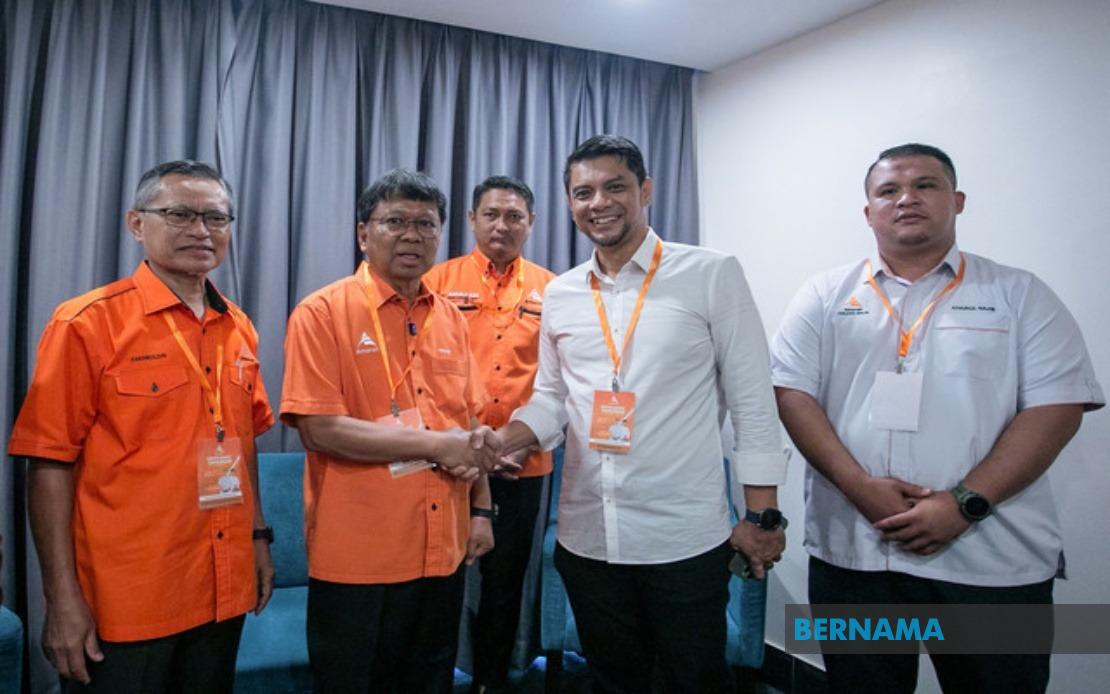
Former Titi Serong state assemblyman Hasnul Zulkarnain Abd Munaim has formally rejoined Parti Amanah Negara following an extended absence spanning nearly six years, marking another chapter in his evolving political trajectory. The readmission was formally sanctioned during the party's National Management Meeting and National Leadership Meeting held on June 18, according to Perak Amanah chairman Datuk Asmuni Awi, who announced the decision to members in Ipoh on June 21.
Hasnul Zulkarnain's return represents a broader strategic repositioning within Amanah's membership framework. Asmuni explained that while Hasnul Zulkarnain had previously indicated his desire to rejoin the party, the political climate and internal party circumstances had not previously aligned to permit a formal reconsideration of his application. The current leadership, however, has determined that conditions now favour reopening the party to returning former members, a policy shift that mirrors approaches adopted by several other Malaysian political parties seeking to consolidate support networks and rebuild organisational strength.
The significance of Hasnul Zulkarnain's reinstatement lies partly in his prior standing within Amanah circles. Before his departure, he held the position of state Amanah Youth chief, indicating he had cultivated meaningful relationships and demonstrated leadership capacity within the party structure. His return may therefore signal a calculated effort to restore experienced cadres to positions of influence rather than simply expanding membership rolls.
Asmuni characterised the readmission as potentially beneficial to Amanah's broader institutional health, noting that numerous former members who departed the party retain emotional and ideological affiliation with its core principles and political mission. By selectively reintegrating such individuals, Amanah appears to be gambling that past loyalty remains recoverable and that institutional memory of shared struggle can be weaponised to strengthen present-day political positioning. This approach acknowledges that party departures, particularly among figures with track records in elected office, do not necessarily indicate fundamental ideological rupture.
Hasnul Zulkarnain responded to his reinstatement by expressing gratitude to the party leadership, characterising their decision as a validation of his potential future contributions to Amanah's organisational objectives. His comments suggested an absence of lingering tension or unresolved disputes, potentially easing his reintegration into party structures.
Understanding Hasnul Zulkarnain's political journey illuminates the volatile nature of Malaysian state-level politics, particularly during periods of governmental transition. In March 2020, following the dramatic political realignment that birthed the Perikatan Nasional government in Perak, Hasnul Zulkarnain resigned from his original party affiliation to become an independent. This decision coincided with similar moves by two DAP assemblymen—Tronoh's Yong Choo Kiong and Buntong's A. Sivasubramaniam—suggesting a coordinated political recalibration during a period of heightened instability across Perak's legislative landscape.
His subsequent migration to Bersatu in July 2020 indicated a deliberate choice to align with the PN coalition structure, which at that moment possessed governing momentum at both state and federal levels. Bersatu appeared to offer clearer pathways to elected office and ministerial position compared to the opposition landscape of mid-2020. The transition from independent status to Bersatu membership therefore reflected rational political calculation rather than ideological conviction, suggesting that Hasnul Zulkarnain's political identity has been shaped substantially by pragmatic pursuit of electoral viability and access to state resources.
His current return to Amanah, after a Bersatu interlude, raises questions about the sustainability and direction of his political engagement moving forward. Whether his reaccession to Amanah represents a permanent realignment or constitutes merely another tactical repositioning within Malaysia's fluid coalitional environment remains uncertain. The six-year interval suggests that intervening political developments—shifts in Bersatu's fortunes, changes in PN's electoral prospects, or personal reassessment of party alignment—prompted reconsideration of his original departure from Amanah.
For Amanah specifically, the readmission reflects a party seeking to recover from organisational fragmentation and rebuild its standing in Perak, where its influence has progressively diminished relative to other opposition components. Welcoming back former members represents a lower-risk strategy for membership consolidation than fielding entirely new candidates, particularly given that Hasnul Zulkarnain carries established name recognition and prior assembly experience.
The episode also underscores a broader pattern in Malaysian politics whereby individual assemblymen and political operatives display substantial mobility between party structures, particularly during periods of coalition realignment or electoral uncertainty. The absence of institutional penalties for such migrations—whether in the form of party loyalty mechanisms, ideological gatekeeping, or electoral retaliation—has encouraged a culture wherein political personnel treat party affiliation as responsive to immediate strategic circumstances rather than as binding commitments.
Looking forward, Amanah's willingness to readmit Hasnul Zulkarnain may signal a broader opening toward former members across Malaysia, potentially facilitating additional rejoinings that could marginally strengthen the party's organisational footprint. However, the party's larger challenge remains establishing itself as a compelling political alternative in an increasingly crowded opposition space, where DAP, PKR, and other actors continue to dominate voter attention and resource allocation. Individual readmissions, while symbolically meaningful, cannot substitute for the fundamental competitive repositioning that Amanah requires to reassert relevance in Perak politics.

