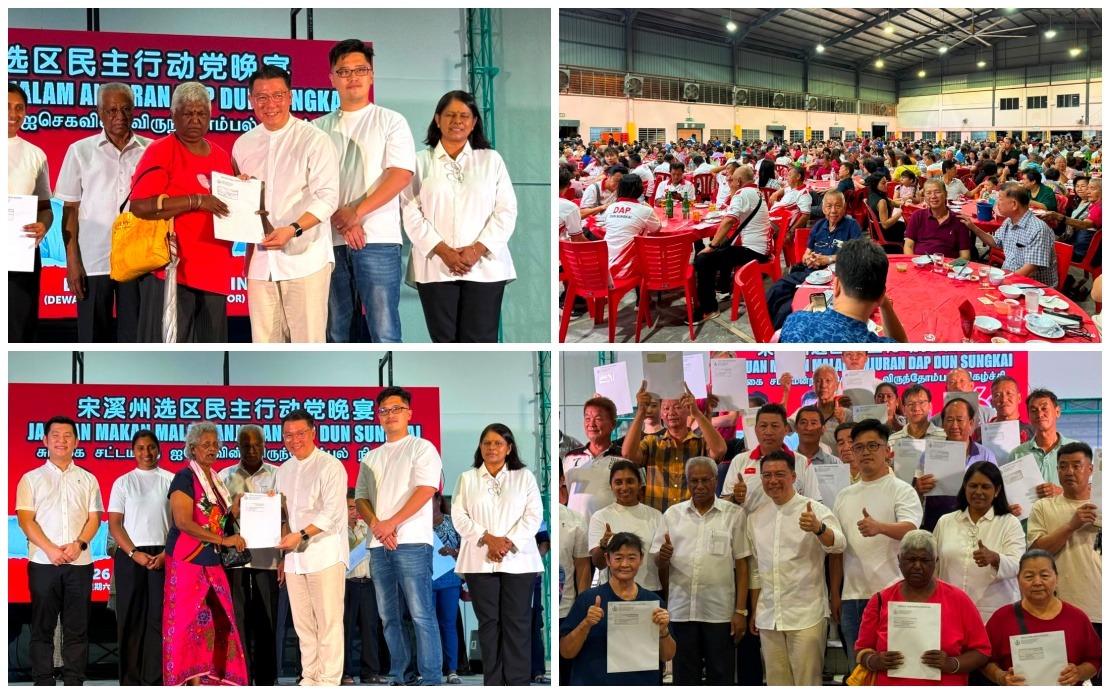
A protracted housing crisis spanning four decades has finally reached resolution in Perak's Sungkai and Kuala Bikam areas, where 120 families have now been awarded formal land grants. Housing and Local Government Minister Nga Kor Ming announced the development during a dinner event organised by the DAP Sungkai state constituency division, describing the grants as symbolic anchors for a more stable future extending to subsequent generations. The occasion drew over 1,200 attendees representing diverse community backgrounds, underscoring the significance of addressing such longstanding informal settlement issues in Malaysia's regional landscape.
The resolution of this four-decade-old problem carries particular weight within Malaysia's broader development agenda. Nga framed the achievement as a manifestation of the MADANI Government's foundational principle that no citizen, irrespective of ethnicity or socioeconomic standing, should experience marginalisation or exclusion from national progress. Such commitment holds relevance across Southeast Asia, where similar informal settlement patterns persist in urban and semi-urban zones across multiple nations. The government's intervention here demonstrates a deliberate policy pivot away from historical patterns of deferred action on vulnerable communities' housing needs, a dynamic that shapes public perception of institutional responsiveness.
Sungkai assemblyman Datuk A. Sivanesan, who chairs the state's Human Resources, Health, Indian Community Affairs and National Integration Committee, received ministerial commendation for his role in facilitating the resolution. Nga specifically acknowledged the contribution of civil servants whose sustained effort enabled the bureaucratic machinery to overcome whatever obstacles prolonged the matter previously. This recognition of behind-the-scenes administrative work highlights the often-invisible institutional scaffolding required to translate policy commitments into tangible community benefit, a dimension frequently overlooked in political discourse focused on ministerial pronouncements alone.
Beyond the immediate land grant announcement, the MADANI Government has positioned its engagement with the Indian community as comprehensive and multi-faceted. Nga cited specific allocations including RM20 million designated for Indian settlements nationwide, RM50 million earmarked for Tamil vernacular schools, and a substantial increase in MITRA funding to RM150 million. These figures collectively suggest an attempt to address systemic gaps in educational infrastructure, community amenities, and economic opportunity within a historically disadvantaged demographic segment. For Malaysian observers, such targeted resource deployment offers measurable benchmarks against which to evaluate whether political rhetoric translates into substantive material improvement.
The minister's broader commentary at the event touched upon Malaysia's political culture and the tension between performance-driven governance and perception-based politics. Nga urged citizens to assess government achievements objectively rather than allowing racial sentiment to distort evaluation of policy outcomes and implementation. This rhetorical positioning reflects growing frustration among certain political constituencies with what they characterise as identity-based political discourse that obscures comparative analysis of institutional performance. The appeal resonates particularly within urbanised, educated segments of the electorate increasingly sceptical of simplistic communal narratives.
Nga's framing of future politics as fundamentally rooted in unity, service delivery, and inclusive development represents a counter-narrative to what he described as outdated, destructive political frameworks. This language carries implications extending beyond Perak's boundaries, suggesting an attempt to establish new competitive terrain in Malaysian politics centred on material outcomes and institutional capacity rather than historical grievances or identity assertion. For regional observers, Malaysia's internal political evolution matters significantly given the nation's position as a plural society grappling with balancing competing claims and expectations.
The Sungkai resolution illuminates persistent challenges within Malaysia's housing and land administration systems. That informal settlement situations required four decades for resolution indicates substantial bureaucratic or political inertia, raising questions about what mechanisms prevented earlier action. The settlement patterns themselves likely reflect economic pressures, migration dynamics, and land access failures that merit deeper examination. Whether the current intervention establishes sustainable housing security or merely formalises existing arrangements without addressing underlying structural factors remains an important distinction for policy analysts.
The attendee list, which included Ipoh Timur MP Howard Lee Chuan How, Buntong assemblyman M. Thulsi, Malim Nawar assemblyman V. Bavani, and Astaka assemblyman Jason Ng Thien Yong, reflects cross-constituency coordination and suggests broader political backing for the initiative. This multistakeholder participation indicates that housing and settlement issues transcend partisan boundaries, or at minimum that all parties recognise electoral and institutional value in supporting such resolutions. The DAP Sungkai division's 60th anniversary framing provided organisational context for the announcement, embedding it within longer-standing community organising traditions.
For Malaysian residents, particularly those inhabiting informal settlements across urban and peri-urban zones, the Sungkai resolution offers both encouragement and cautionary lessons. The successful completion of a 40-year process demonstrates persistence can eventually yield formal recognition and property security; simultaneously, the duration itself suggests that systemic change proceeds incrementally and that vulnerable populations must often mobilise sustained pressure to extract government action. Housing security remains a foundational prerequisite for economic mobility, educational advancement, and social integration, making such resolutions consequential beyond their immediate participant populations.
The government's emphasis on inclusive development and the principle of leaving no citizen behind carries implications for how Malaysian policymaking addresses other legacy issues affecting marginalised communities. If the MADANI administration genuinely prioritises comprehensive inclusion regardless of ethnic or socioeconomic background, numerous other outstanding grievances and unmet needs across various communities potentially move higher on the agenda. The Sungkai precedent thus functions as a signalling device regarding institutional willingness to tackle deferred social questions, with downstream effects on political legitimacy and public confidence in government institutions.

