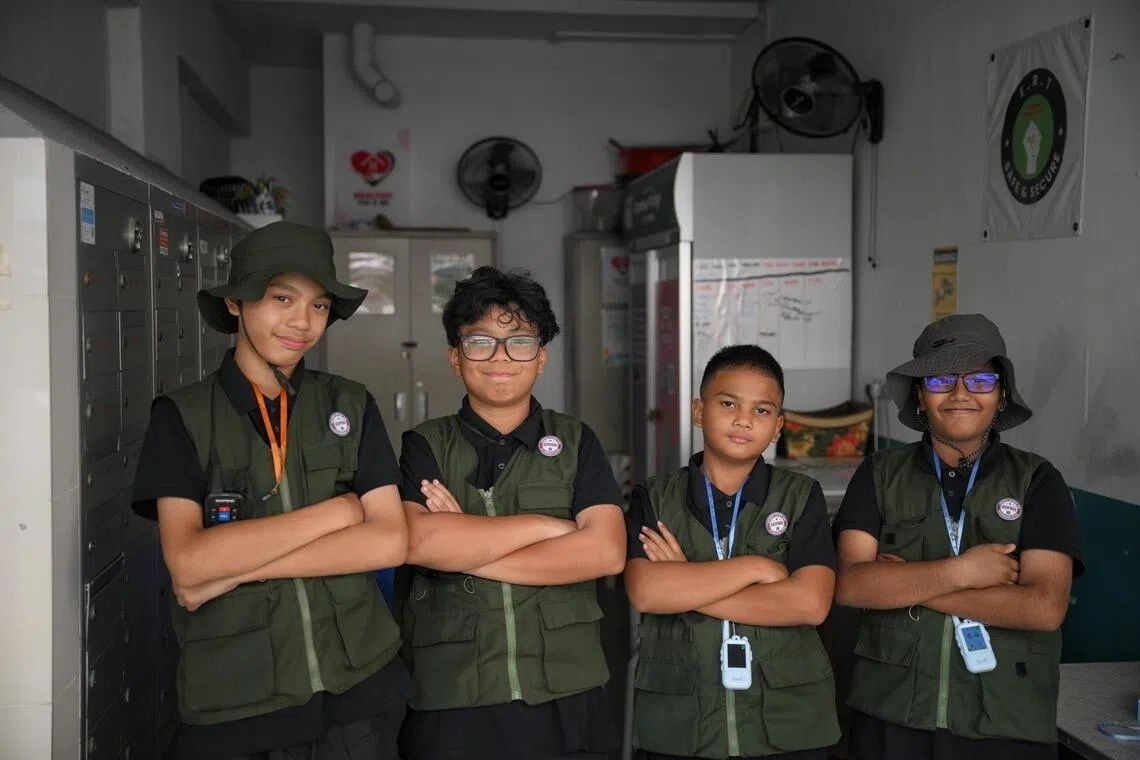
What began as one 12-year-old's determination to protect a community fridge stocked with free milk for low-income children has blossomed into a youth-led neighbourhood watch scheme that is now being celebrated at Singapore's highest public stage. Rafieq Sahin Rafizal, frustrated by the repeated depletion of provisions meant to help underprivileged families in the Lengkok Bahru estate, sought a solution that would protect the initiative without confrontation. Rather than standing guard himself, he and his mother Marlina Yased—a 48-year-old homemaker and social entrepreneur—pivoted to a broader vision: mobilizing young residents as community sentries for the entire neighbourhood.
The Emergency Response Team LB, which formalised in August 2025, now comprises four boys aged between 11 and 14, all pupils at Gan Eng Seng Primary School. Beyond safeguarding the unlocked fridge containing drinks and milk for schoolchildren, the team patrols up to six blocks daily after lessons, donning matching vests emblazoned with their names and the group's logo. Their remit extends across the spectrum of estate management: spotting indiscriminate dumping of bulky waste, identifying acts of vandalism, and flagging personal mobility devices being charged in common areas—a nascent fire risk in Singapore's densely packed public housing. The boys document these observations through photographs and report findings to Marlina, who liaises with estate management to ensure swift remedial action.
What distinguishes this initiative from conventional residents' associations or formal municipal oversight is its intergenerational dimension and the personal investment of children barely into adolescence. The team operates with military-style coordination, using walkie-talkies to maintain contact with Marlina and fellow volunteer Fahmidah Farihullah, 21, as they traverse their beats in pairs. The structure reflects Rafieq's admiration for Singapore's Emergency Response Team—the police unit tasked with high-risk interventions—demonstrating how civic consciousness can be instilled through emulation and mentorship rather than top-down governance. For residents accustomed to government-led public order management, the sight of primary school-aged children actively stewarding their own living space challenges conventional assumptions about citizen participation and neighbourhood stewardship.
Since launching their patrols, the boys have accumulated an impressive record of tangible community interventions. They have assisted an elderly resident with mobility limitations in transporting groceries, mediated disputes between neighbourhood children, and most significantly, detected early signs of a potential medical emergency. In early 2026, the team noticed a foul odour emanating from a flat in their patrol area. Acting on their instinct, they alerted Marlina, who contacted building cleaners and encouraged residents to notify police. What followed was the discovery of a deceased elderly man whose body had decomposed for some time—a scenario in which swift intervention potentially prevented further deterioration and enabled proper dignified handling of the deceased.
This particular incident illustrates the often-underappreciated role that neighbourhood-level social awareness can play in safeguarding vulnerable populations. Singapore's elderly face documented risks of social isolation and delayed medical intervention, particularly in low-income public housing estates. The ability of neighbourhood patrols to detect anomalies—unusual odours, lack of movement, absence of routine activity—creates an informal surveillance network that official systems frequently miss. The boys' success in this instance underscores how youth engagement in community care can generate protective outcomes far exceeding the scope of their formal mandate, while simultaneously building empathy and responsibility among participants.
The initiative has not been uniformly embraced by all residents. Initial scepticism from some community members reflected concerns about children patrolling unsupervised or suspicions regarding their efficacy in addressing structural housing and social challenges. However, as the team's work has become visible through consistent daily presence and documented outcomes, support has grown. Nasha Asrin, a 27-year-old Lengkok Bahru resident and mother of five, noted appreciation for the boys' engagement, contrasting their constructive contribution with stereotypical adolescent pastimes. This shift in perception demonstrates how demonstrable results and consistent visibility can reshape community attitudes towards unconventional governance models.
Beyond the immediate neighbourhood context, participation in the patrols has produced measurable effects on the boys themselves. Aaron Sarandev, 11, credits daily rounds with instilling discipline and perseverance, acknowledging the difficulty of maintaining routine on days when motivation flags. Didie Andiqa Muhaimin, 14, cited aimlessness as his initial motivation for joining, suggesting that structured community engagement offers alternative meaning-making for young people in resource-constrained environments. Marlina has observed substantive developmental changes in some team members, noting improved school attendance and enhanced concentration—outcomes that challenge simplistic notions of adolescent delinquency and suggest that authentic responsibility creates profound developmental leverage.
The broader Malaysian context renders this Singapore initiative particularly instructive. Southeast Asian societies grapple with questions of urban governance, community fragmentation, and youth engagement across varying economic contexts. While Singapore's public housing density and government capacity differ markedly from conditions in most Malaysian urban centres, the underlying principles—citizen participation, intergenerational collaboration, preventive community health monitoring—translate across regional contexts. Malaysian neighbourhoods could adapt similar frameworks through local residents' associations, schoolchildren's clubs, or faith-based community organisations, tailoring intensity and structure to existing social infrastructure.
Recognition of the Emergency Response Team LB has culminated in their selection to participate in Singapore's National Day Parade in August 2026, marking their first appearance in the nation's premier ceremonial event. The boys will feature as part of a segment honouring Singaporeans who contribute to nation-building at grassroots levels—a symbolic elevation of their work from neighbourhood footnote to national narrative. For children navigating the formative years between primary school and secondary education, participation in a parade of this magnitude represents validation of their contribution and reinforcement of civic identity.
The trajectory from Marlina's community fridge initiative to this formal recognition illustrates the potential of grass-roots social innovation to scale and attract institutional attention. The original team comprised seven members, now reduced to four, suggesting both sustainability challenges and the importance of maintaining genuine voluntarism rather than imposed participation. The boys' own articulation of their commitment—sacrificing one hour daily for community service while maintaining academic and social routines—demonstrates how civic engagement need not be framed as onerous sacrifice but as meaningful time allocation.
For readers across Southeast Asia observing developments in Singapore's urban governance, this initiative offers both inspiration and practical lessons. It demonstrates that neighbourhood safety and community cohesion need not depend entirely on formal police presence or top-down management schemes. Youth can be mobilised effectively when given genuine agency, appropriate mentorship, and visible community appreciation for their contributions. The emphasis on intergenerational collaboration—with Marlina guiding and Fahmidah supporting the boys—illustrates how formal institutional gaps can be bridged through creative voluntarism and family-centred activism.
As the Emergency Response Team LB marches in August's National Day Parade, they will represent not merely a local initiative but a model of community resilience adapted to contemporary urban challenges. Whether through elderly isolation, fire hazards from improper charging practices, or environmental degradation through indiscriminate dumping, the problems they address are neither uniquely Singaporean nor uniquely solvable through conventional municipal channels. Their success suggests that Southeast Asian communities might profitably invest in catalysing similar youth-led initiatives, recognising that neighbourhood stewardship conducted by residents themselves generates outcomes that transcend mere problem-solving to encompass social cohesion, youth development, and renewed civic participation across generational lines.

