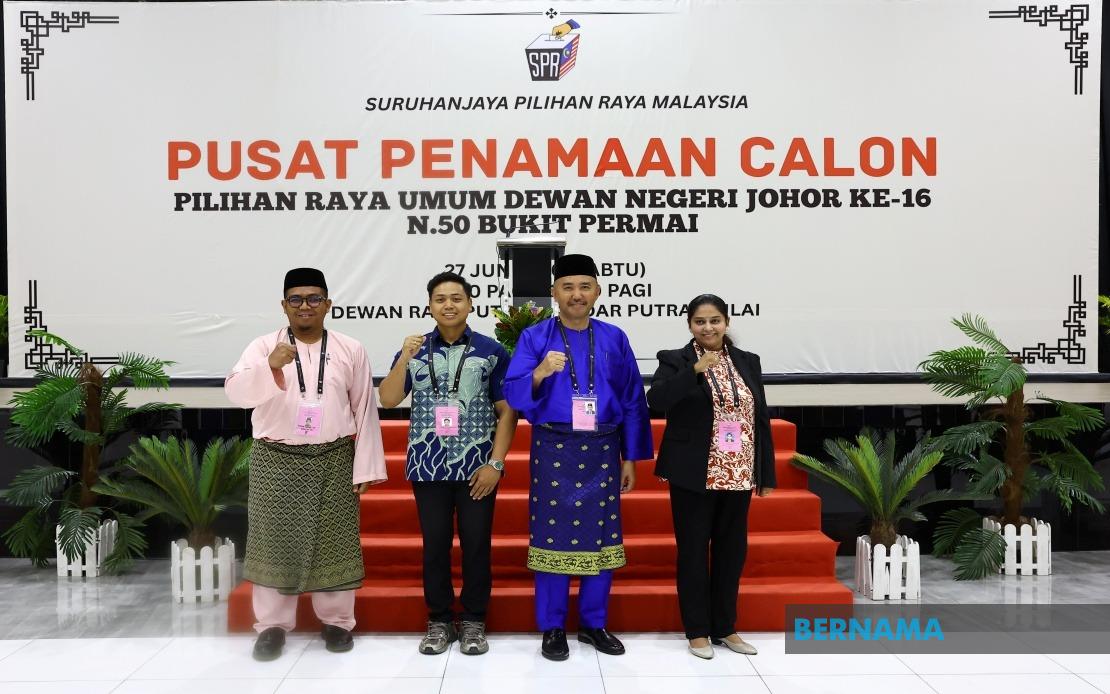
The Bukit Permai state constituency in Johor is shaping up as a closely contested battleground in the 16th state election, with incumbent Datuk Mohd Jafni Md Shukor of Barisan Nasional facing a four-way contest. The nomination centre at Dewan Raya Putra in Bandar Putra confirmed the field on June 27, with returning officer Afzan Azhari officially declaring the slate after nominations closed at 10 am.
Mohd Jafni's challengers represent a diverse political spectrum. Mohamad Shafwan Ani carries the colours of Pakatan Harapan, the opposition alliance that has enjoyed considerable support in peninsular Malaysia in recent years. M. Lina Manoh contests for Perikatan Nasional, the bloc that has garnered significant backing in several states. Completing the field is Muhammad Aidil Riduan Mohd Yusof from Parti Bersama Malaysia, the newer political outfit that has been positioning itself as an alternative to the traditional major coalitions.
The endorsement of Mohamad Shafwan by Johor DAP chairman Teo Nie Ching, who arrived at the nomination centre at 8.26 am to accompany the candidate, underscores the unity Pakatan Harapan is seeking to project in the state. This shows the coalition's determination to consolidate support behind a single candidate rather than fragment the opposition vote through multiple nominations.
Mohd Jafni enters the contest as a sitting assemblyman with an established track record in the constituency. In the previous Johor state election held in 2022, he secured victory with a comfortable majority of 4,755 votes despite facing a four-cornered fight even then. This suggests he has successfully built a personal political machinery and enjoys considerable support among the electorate, though the emergence of new challengers this time may complicate his path to re-election.
The four-way configuration of the race reflects the fragmentation currently visible in Malaysian state politics. Rather than a straight fight between government and opposition, voters in Bukit Permai will have three alternative choices to the incumbent. This dynamic typically favours incumbents who have established voter bases, but it can also create opportunities for opposition candidates if they can consolidate anti-incumbent sentiment or appeal to specific demographic blocs.
Pelikatan Nasional's presence in the race adds another layer of complexity. The coalition has made significant inroads in several states and has demonstrated capacity to attract voters seeking alternatives to both BN and PH. Its participation in Bukit Permai suggests a strategic effort to expand influence in Johor, a state traditionally viewed as crucial to any national political realignment.
The electoral schedule set by the Election Commission provides a compressed timeline for campaigning. Early voting has been scheduled for July 7, just four days before polling day on July 11. This relatively brief campaign period means candidates must move quickly to reach voters and differentiate themselves from competitors. For incumbents like Mohd Jafni, the compressed timeframe may advantage those with existing voter networks and campaign machinery already in place.
Bukit Permai's position within Johor's broader electoral landscape makes the constituency a potential bellwether for broader trends in the state. Johor has historically been a stronghold for BN, but recent political developments have seen increased competition across the state. The results in Bukit Permai could provide early signals about whether voters are moving away from the incumbent coalition or remain loyal to its governance record.
The emergence of Parti Bersama Malaysia as a contestant in Johor elections marks a notable shift in the state's political dynamics. As a newer entrant to electoral competition, the party's performance across various constituencies will provide insights into whether it can establish meaningful support or whether it remains a marginal force that splinters votes without translating that into meaningful representation.
For Malaysian and Southeast Asian observers, the Bukit Permai race encapsulates broader regional political trends: the fragmentation of electoral coalitions, the rise of alternative political players, and the persistent importance of incumbency advantages in state-level elections. How voters respond to the expanded choice in this constituency will offer clues about the trajectory of Malaysia's evolving political realignment.

