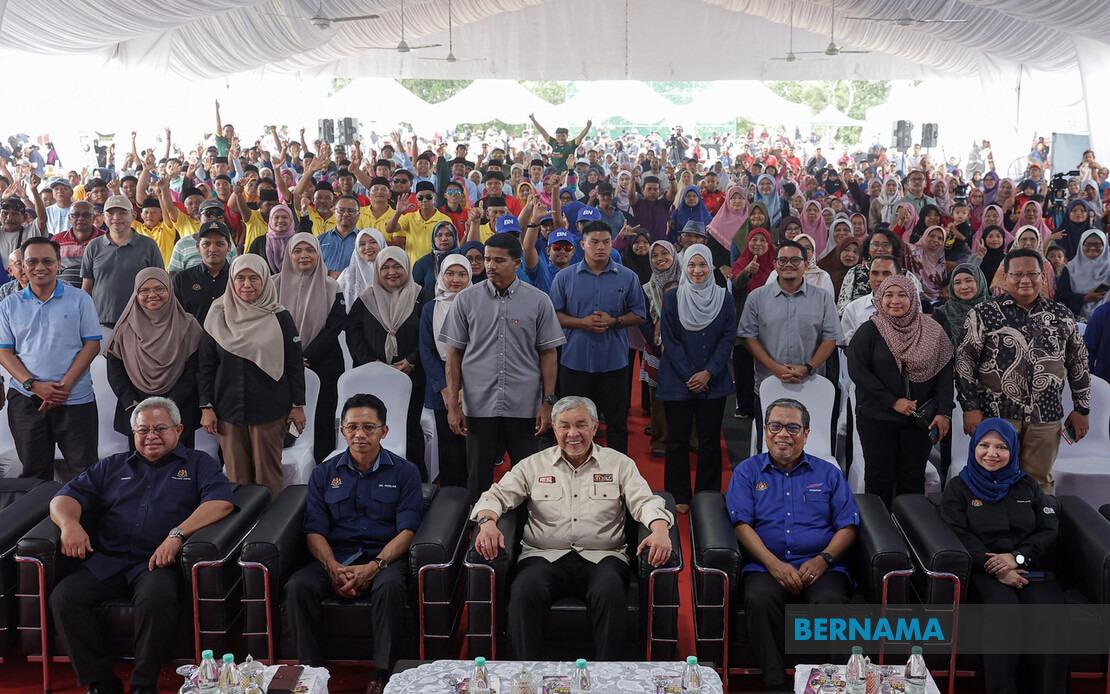
The shifting sands of Malaysian politics demand that all major parties rethink their strategies and forge new alignments to preserve governmental stability, according to Barisan Nasional chairman Datuk Seri Dr Ahmad Zahid Hamidi. Speaking at the Gema@KKDW 2026 programme in Palong 8 near Jempol, the senior BN leader acknowledged that the country's political terrain has become markedly more fluid and unpredictable, requiring careful recalibration of electoral and coalition approaches.
A critical test of this new thinking lies in the current Negeri Sembilan state election strategy. The working arrangement between Barisan Nasional and Perikatan Nasional for the 16th Negeri Sembilan state election represents more than a tactical manoeuvre—it signals a broader willingness to explore pragmatic cooperation across traditional dividing lines. Ahmad Zahid framed this understanding as a pilot project, with performance in the Negeri Sembilan contest serving as the primary indicator of whether similar approaches should be replicated in upcoming electoral cycles, most notably the Melaka state election and the consequential 16th General Election.
However, Ahmad Zahid was careful to clarify the precise nature of this political arrangement, emphasizing that it falls short of constituting a formal, binding coalition agreement. The understanding operates within narrower parameters, designed primarily to eliminate wasteful vote-splitting scenarios where competing BN and PN candidates might effectively hand victory to opposition parties in three-cornered contests. This distinction carries significant weight in Malaysian political discourse, where formal coalitions trigger accountability mechanisms, resource-sharing obligations, and longer-term commitments that neither party may wish to undertake at this juncture.
The pragmatic philosophy underlying this approach reflects deeper structural challenges within Malaysia's electoral system. When multiple parties contest the same seat without coordinated strategy, the divided anti-opposition vote frequently allows a single challenger to claim victory with a minority of votes cast. By establishing ground-level understandings that prevent such wasteful fragmentation, BN and PN aim to maximize their combined electoral advantage without surrendering autonomy or facing the political costs of formal merger. This represents a distinctly Malaysian response to coalition management—flexible, informal, and easily reversible.
For voters and political observers in Malaysia, this development suggests a period of considerable uncertainty and fluidity ahead. The absence of rigid, publicly declared coalitions means that electoral calculations remain uncertain even as campaign seasons approach. Political parties retain maximum flexibility to adjust strategies based on changing circumstances, opinion polling data, and regional political dynamics. This calculated ambiguity can work to advantage for parties seeking to maintain voter bases while pursuing strategic advantage, though it simultaneously creates unpredictability that may concern voters seeking clear choices at the ballot box.
The timing of Ahmad Zahid's remarks carries particular significance given the compressed electoral calendar. Early voting for the Negeri Sembilan state election is scheduled for July 28, with main polling day set for August 1. This imminent contest will provide crucial real-time feedback on whether informal cooperation mechanisms between BN and PN actually function as intended when put to practical test. The results will likely inform subsequent decision-making regarding similar arrangements in other states and crucially, in the approach to Malaysia's next general election, which represents the ultimate prize in the nation's political competition.
The emphasis on assessing Negeri Sembilan outcomes before committing to broader strategies reflects a cautious, evidence-based approach to coalition-building. Rather than announcing sweeping national-level arrangements that might prove unworkable at ground level, BN leadership has opted for incremental testing and evaluation. This methodology acknowledges the profound differences between federal, state, and local political dynamics, recognizing that strategies successful in one arena may prove counterproductive elsewhere. The diversity of ethnic composition, voter demographics, and historical political allegiances across Malaysia's thirteen states and federal territories demands contextual, rather than uniform, coalition approaches.
For Southeast Asian observers, Malaysia's evolving coalition patterns merit attention as a potential model for post-election stability management across the region. Many Southeast Asian democracies grapple with fragmented parliaments and the challenge of governing without single-party majorities. Malaysia's experience in constructing workable coalitions—whether formal or informal—may offer insights into bridging ideological divides and maintaining governmental functionality despite political diversity. However, the viability of informal arrangements ultimately depends on trust and predictability between participating parties, factors that cannot be taken for granted in any political system.
The broader context of Malaysian politics in 2026 and beyond involves considerable uncertainty regarding economic conditions, demographic shifts, and generational political preferences. Younger Malaysian voters, who increasingly comprise larger portions of the electorate, may demand greater clarity and transparency regarding coalition arrangements than older generations tolerated. Political parties must therefore balance the flexibility and tactical advantages of informal understandings against legitimate public expectations for predictability and accountability in governance. Ahmad Zahid's measured approach suggests BN leadership recognizes these tensions and is attempting to navigate them through cautious, evidence-based decision-making rather than ideological commitment to particular coalition models.

