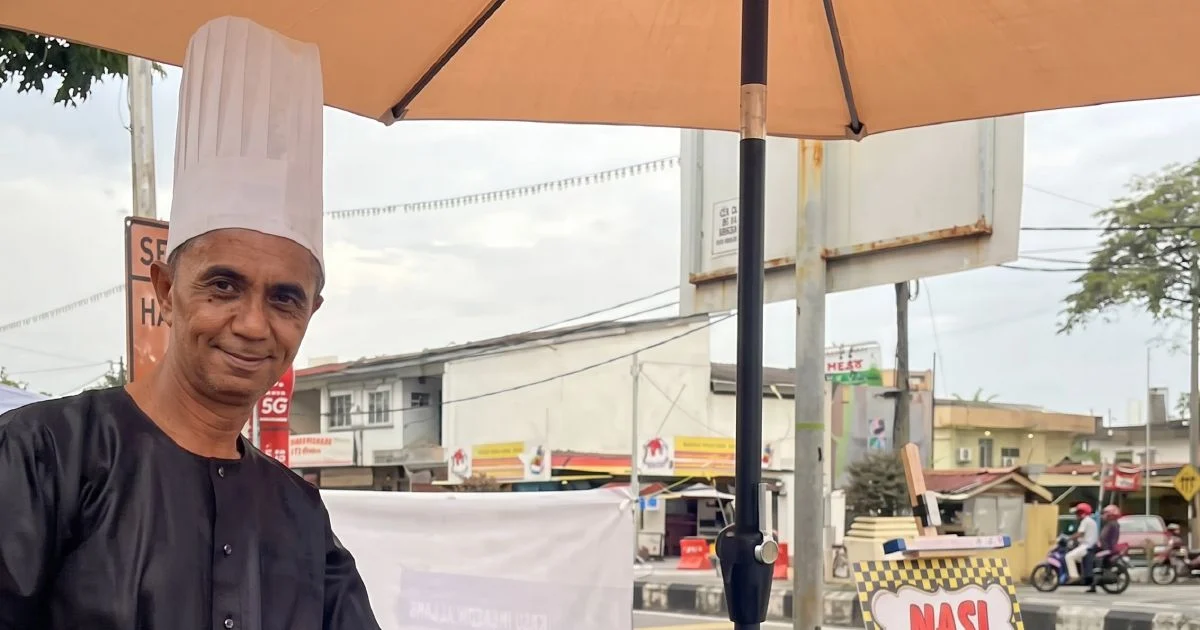
When disaster struck Jalan Atas Paloh in Kota Baru in 2021, one local merchant faced the loss of not just a dwelling but the security and stability that comes with a permanent home. Yet rather than surrendering to despair, he seized the moment to reimagine his future, channelling resilience into an unexpected entrepreneurial venture that would eventually define his new identity as a tireless purveyor of affordable Malaysian comfort food.
The transition from homeowner to street vendor might seem a step backward to many, but for this determined individual, it represented a fundamental shift in perspective. Where others might have pursued conventional recovery paths—insurance claims, relocation assistance, or traditional employment—he recognised an opening to build something entirely from his own hands. The decision to establish a nasi lemak operation, though modest in scale, offered both immediate income and the flexibility needed during a period of personal reconstruction.
Nasi lemak, Malaysia's unofficial national dish, carries profound cultural significance that extends far beyond its humble ingredients of rice, sambal, anchovies, and peanuts. For street vendors across the country, particularly in Kelantan where this seller operates, it represents an accessible entry point into self-employment requiring minimal capital outlay and maximum opportunity for word-of-mouth reputation building. By pricing each packet at just RM1, the entrepreneur made a deliberate choice to serve his community's most price-sensitive demographics, from schoolchildren to day labourers.
The RM1 price point warrants examination as a business strategy rather than mere charity. In contemporary Malaysia, where food inflation has eroded household purchasing power and traditional breakfast options have become increasingly costly, this pricing structure creates genuine accessibility. Yet maintaining profitability at such a marginal price demands exceptional efficiency, careful sourcing of ingredients, and the kind of operational discipline that transforms disaster survivors into accomplished merchants. Few casual observers recognise the mathematics and resourcefulness required to sustain such an operation.
Kota Baru, as Kelantan's largest city, provides both challenges and advantages for this vendor. The densely populated urban environment offers substantial daily footfall and clientele, but also intense competition from established food stalls with better locations and established customer bases. Nevertheless, the story of rebuilding after catastrophic loss resonates deeply in Malaysian culture, where narratives of perseverance against adversity command respect and patronage. Customers frequently become invested not merely in purchasing meals but in supporting someone's journey toward recovery.
The psychological dimensions of rebuilding after fire deserve consideration alongside the commercial aspects. A destroyed home represents not only financial loss but also the disruption of routines, social networks, and psychological security. By establishing a daily business that requires him to interact with customers, maintain consistent schedules, and achieve concrete results, the vendor engaged in what psychologists recognise as meaning-making and identity reconstruction. The nasi lemak business became as much a therapeutic practice as an income source.
Within Malaysia's informal economy, street food vendors occupy an ambiguous but vital position. They operate largely outside formal regulatory frameworks, yet provide essential services to millions of Malaysians who rely on affordable street meals for daily nutrition. The RM1 nasi lemak vendor becomes part of an essential infrastructure that supports working-class and middle-class Malaysians alike, enabling them to maintain busy schedules without depleting household budgets on meals consumed outside the home.
Community response to the vendor's story illustrates how Malaysian society continues to value tangible demonstrations of resilience and self-reliance. In an era of social media documentation and shared narratives, the journey from destruction to reconstruction becomes inspirational material that circulates through local networks and digital platforms. The decision to feature this story—including video documentation—reflects broader recognition that individual entrepreneurship, even at microscale, deserves celebration and amplification.
The implications extend beyond one vendor's personal recovery. The RM1 nasi lemak operation demonstrates how marginal economies function and persist within Southeast Asian cities. It shows how disaster survivors can mobilise existing cultural assets—traditional cooking knowledge, community networks, and products with stable demand—into viable livelihoods without requiring substantial external assistance or institutional support. This model replicates across Malaysia and the region wherever individuals face displacement and dislocation.
For Kota Baru specifically, the vendor represents part of the city's informal commercial ecosystem that generates employment, provides services, and sustains social cohesion. Food vendors, particularly those with compelling personal narratives, become cultural ambassadors for their communities, attracting customers who value both affordability and authenticity. The simplicity of a RM1 nasi lemak packet masks the complexity of the operation, the skill required in food preparation, and the determination required to maintain consistency across hundreds of daily transactions.
The long-term sustainability of such operations raises important questions about informal sector protections, business development support, and disaster recovery frameworks within Malaysia. While this individual succeeded through personal determination, systemic barriers—lack of formal business training, limited access to capital for equipment upgrades, vulnerable work conditions—challenge countless other informal sector workers. His success story, celebrated through social media coverage, also implicitly critiques the absence of comprehensive support systems for disaster-affected entrepreneurs.
As the vendor continues serving Kota Baru residents from his modest stall, his journey encapsulates broader truths about Malaysian entrepreneurship, urban survival, and the remarkable capacity for ordinary individuals to transform catastrophe into opportunity. The RM1 price, maintained against inflationary pressures and rising ingredient costs, represents not just a pricing strategy but a commitment to serving his community with dignity and affordability. In Kota Baru's busy streets, this nasi lemak vendor has become an unsung hero of resilience.

