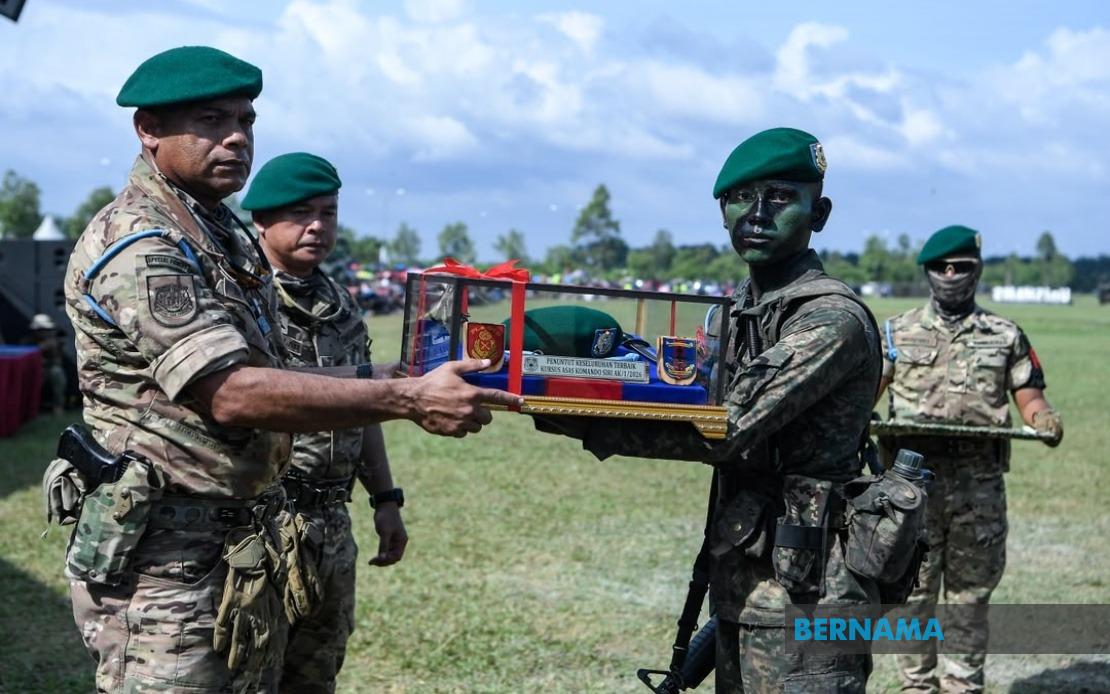
Second Lieutenant Muhammad Fadli Jamalluddin's journey to becoming the top commando trainee in Malaysia's Basic Commando Course Series AK/1/26 was anything but straightforward. The 24-year-old officer from Ampang, Kuala Lumpur, demonstrated extraordinary perseverance by not only bouncing back from an initial failed attempt at the demanding three-month programme, but also narrowly escaping elimination during the current iteration before ultimately capturing the Best Overall Trainee award at a ceremony held at Universiti Sultan Abdul Halim Mu'adzam Shah in Kuala Ketil.
The commando course represents one of the most prestigious and physically demanding achievements within Malaysia's military establishment. For officers, the bar is set even higher, requiring not merely exceptional physical conditioning but also mental fortitude, tactical acumen, and leadership capacity. Muhammad Fadli's path to success reflected this multifaceted challenge. He had initially enrolled in the Basic Commando Course Series 3/2024 but failed to complete it, a setback that could have discouraged many aspirants from attempting the gruelling programme again. Instead, the outcome steeled his determination to persevere through one of the military's most elite training regimes.
His military aspirations germinated during his secondary education and subsequently crystallised into concrete action when he enrolled at the National Defence University of Malaysia (UPNM). Upon graduation, he joined the Royal Malay Regiment in 2024, bringing fresh credentials including a Bachelor's degree in Global Policing and Intelligence with Honours. His career progression accelerated when he volunteered for the 21st Special Service Group (21 GGK), one of Malaysia's most specialised operational units, where commando selection and training form the gatekeeping mechanism for entry.
The current course proved equally challenging, particularly during the eighth week when Muhammad Fadli encountered another potential washout point. Having already endured over 100 kilometres of punishing endurance marches and multiple demanding training exercises, he failed an assessment that threatened to force him to restart the entire programme from scratch. The psychological impact was profound. He openly acknowledged that failure at that juncture prompted emotional breakdown, confronting the possibility that months of sacrifice and suffering might prove fruitless. Colleagues and mentors counselled him against repeating the course given the extreme physical and mental toll involved, yet he refused the path of least resistance.
This decision to persevere despite the odds reflects deeper motivations beyond personal ambition. Muhammad Fadli framed his commando aspirations partly as tribute to his father, who suffered a severe stroke more than a year prior. The achievement holds profound family significance, representing both personal vindication and a meaningful gesture toward a parent facing serious health challenges. The fact that his father could not attend the closing ceremony ceremony added poignant weight to his accomplishment, though he expressed hope that the achievement itself might provide emotional and motivational sustenance to his family.
The distinction of receiving Best Overall Trainee from Colonel Nordin Abu, Commandant of the Special Warfare Training Centre (PULPAK), underscores that Muhammad Fadli's excellence transcended mere physical survival of the programme. The commando course, he explained, demands integration of bodily resilience with intellectual sharpness. Modern special operations rarely hinge solely on strength and endurance; they require meticulous planning, sophisticated decision-making under pressure, and adaptive leadership when circumstances deviate from initial projections. These cognitive dimensions explain why commando officer training remains particularly gruelling compared to selection of enlisted personnel.
The course cohort that completed Series AK/1/26 comprised five officers and 33 other ranks, a success rate reflecting the stringent selection criteria and dropout rates inherent to commando training pipelines globally. Malaysia's commando programmes have long maintained reputation for toughness, with dropout and washout rates typically exceeding 50 per cent, even among candidates pre-screened for basic military competency. That Muhammad Fadli triumphed despite experiencing failure in previous iterations makes his achievement statistically and practically significant within the small universe of Malaysian commando-qualified personnel.
His narrative carries implications extending beyond individual military advancement. In an era where armed forces worldwide struggle with recruitment and retention, particularly among officer cohorts, Muhammad Fadli's demonstrated resilience offers a counterpoint to assumptions that contemporary youth lack perseverance or grit. His willingness to absorb failure, weather ridicule or discouragement, and recommit to an objectively punishing training regimen suggests psychological qualities increasingly recognised as valuable across institutional hierarchies. The military context amplifies these considerations, given that commando operations frequently demand precisely these attributes when deployed in high-risk, ambiguous operational environments.
The prominence accorded to Muhammad Fadli's achievement within Malaysian military communications also reflects institutional investment in celebrating exemplary personnel. The Special Warfare Training Centre's public recognition of his accomplishment, through formal presentation ceremonies and media coverage, reinforces cultural messaging about military values and aspirational leadership models. This publicity mechanism serves recruitment purposes while simultaneously acknowledging that elite unit qualification represents legitimate grounds for institutional pride and public acknowledgment.
Looking forward, Muhammad Fadli's transition from commando trainee to operational member of the 21st Special Service Group will test whether his demonstrated resilience and training excellence translate into field performance. Commando-qualified officers assume demanding roles characterised by elevated responsibility for personnel safety, operational planning, and mission execution under constraints. His intellectual credentials, combining formal education in policing and intelligence with commando-level tactical training, position him well for such responsibilities, particularly if Malaysia continues deepening counter-terrorism and regional security specialisation across its special operations community.
The broader Southeast Asian context adds relevant perspective. Regional armed forces increasingly prioritise elite unit development and special operations capability as counterbalance to asymmetric security challenges and expanded maritime duties. Malaysia's commando programmes sit within this regional trajectory, competing implicitly with equivalent formations in neighbouring states while maintaining distinct doctrinal and cultural characteristics. Personnel like Muhammad Fadli, combining educational attainment with combat specialist qualification, represent precisely the officer cadre such regional security environments demand.

