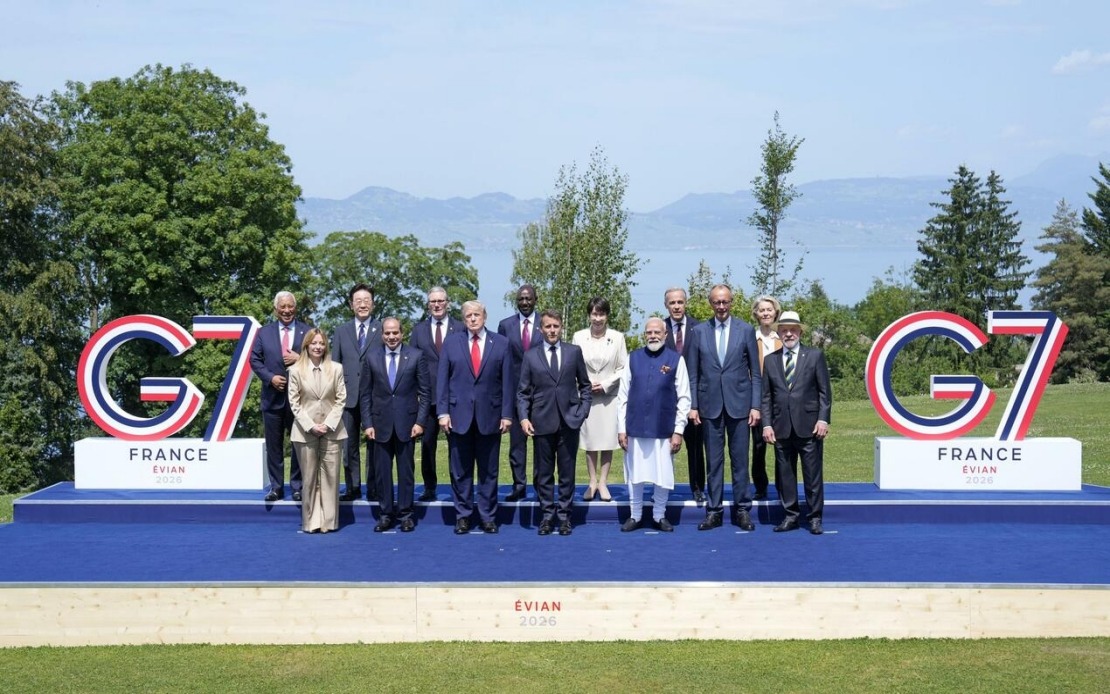
The Group of Seven emerged from their annual summit in Evian-les-Bains, France, with a public display of unity on Ukraine, yet beneath the surface lay significant fault lines between the United States and its European allies over how to approach the protracted conflict and other strategic concerns. During Tuesday's session, the world's major industrialised democracies reaffirmed their commitment to supporting Kyiv in pursuit of what they termed a "just and lasting peace," but the framing of that commitment and the pathway toward it revealed contrasting visions among the allies.
President Donald Trump's emphasis on pushing Russia toward the negotiating table marked a notable recalibration in American messaging. Speaking to reporters after the G7 session, Trump declared that Russia should "make a deal," acknowledging the enormous human toll the conflict has exacted on both sides. This formulation suggested the US administration viewed military stalemate rather than Ukrainian victory as the realistic endpoint, a stance that diverges from European capitals that have generally maintained stronger backing for Kyiv's maximalist position. Trump's apparent willingness to conditionally ease sanctions on Russia—contingent on the success of his Iran negotiations—introduced further uncertainty into the strategic calculus that has underpinned Western support for Ukraine since the February 2022 invasion.
The mechanism Trump appeared ready to exploit was the recent preliminary agreement with Iran to reopen the Strait of Hormuz, which the US president credited with stabilising global oil markets. By suggesting that lifting sanctions on Russia could proceed "soon" because "the oil is now flowing," Trump introduced an economic interdependency argument that complicates the traditionally security-focused rationale for maintaining Russian isolation. For Southeast Asian economies dependent on stable energy supplies and uninterrupted shipping through critical maritime chokepoints, the prospect of a fundamentally different US approach to Russia—one calibrated around oil prices rather than purely geopolitical considerations—carries significant implications for regional stability and predictability.
Ukrainian President Volodymyr Zelenskyy's participation in the summit was strategically significant, as it allowed him to address the G7 directly about Kyiv's immediate needs. His emphasis on strengthening air defences and advancing diplomatic initiatives reflected a realistic assessment that Ukraine requires both enhanced military capabilities and a credible peace process framework. Notably, Zelenskyy's framing positioned peace as something that Russia must choose to make, rather than something Ukraine would accept on unfavourable terms. This rhetorical distinction became crucial in light of Trump's more transactional approach to conflict resolution, which appeared focused on achieving any settlement rather than one aligned with Ukrainian national interests.
Japanese Prime Minister Sanae Takaichi articulated concerns that extended beyond the immediate Ukraine question, voicing alarm at deepening military cooperation between Russia and China as well as expanding Russia-North Korea security ties. Her warnings about unilateral changes to international status quo by force signalled awareness that the great power competition unfolding around Ukraine carried implications far beyond Eastern Europe. For Asian observers, Takaichi's intervention highlighted the interconnectedness of security challenges across regions and the dangers posed by Russia's pivot toward closer partnerships with Asian powers, a geopolitical realignment with long-term consequences for the balance of power in the Indo-Pacific.
The consensus on development finance reform that emerged during the latter portion of the summit addressed a different but equally pressing challenge for the developing world. Recognising that traditional official development assistance has become inadequate to meet the scale of investment needed in emerging economies, the G7 and their invitees from the Global South committed to creating more reciprocal partnerships that blend development support with strategic interests. This acknowledgement represented a subtle but important shift, explicitly recognising that pure charity-based aid has become unsustainable and that future cooperation frameworks must acknowledge the mutual benefits accruing to both donor and recipient nations.
France's leadership on development finance reform, coupled with its presidency of the G7 during a period of unusual diplomatic turbulence, reflected Paris's attempt to steer the grouping toward substantive outcomes even as transatlantic tensions mounted. The inclusion of non-G7 leaders from Brazil, Egypt, India, Qatar, South Korea, and the United Arab Emirates expanded the diplomatic engagement beyond the traditional club, a recognition that resolving twenty-first century challenges requires broader coalitions. For Malaysia and other middle-income Southeast Asian nations, this expansion of the G7's dialogue circle—even if Malaysia itself was not represented—signalled that future international development architecture would increasingly reflect multi-stakeholder approaches rather than decisions handed down by a small group of wealthy democracies.
The working lunch on West Asian affairs illustrated how the Iran negotiations had become a gravitational centre around which the G7's entire strategic outlook was organising itself. The preliminary US-Iran deal to reopen the Strait of Hormuz, perhaps the world's most critical maritime chokepoint for energy shipments, had immediate ramifications for global oil markets and by extension for energy-dependent economies throughout Asia. The G7's emphasis on ensuring "free and safe navigation" in the strait acknowledged that even preliminary progress toward regional de-escalation required international reassurance about commercial shipping and energy security, concerns that resonated strongly with trading nations dependent on uninterrupted passage through that waterway.
Yet the summit's focus on the Iran negotiations and Trump's apparent pivoting of US diplomatic resources toward that conflict raised questions about the sustainability of Western commitment to Ukraine. If the Trump administration viewed the Iran settlement as a foreign policy victory that legitimised reducing diplomatic attention to other conflicts, the implications for long-term allied coordination on Ukraine could be significant. European leaders, particularly those representing frontline NATO states worried about Russian intentions, recognised this danger and sought to reinforce collective commitments while Trump signalled his preference for rapid conflict resolution through negotiated settlement rather than indefinite military support.
The carefully worded joint declaration on development finance reform, which emphasised "mutually beneficial partnerships" and "strategic interests," reflected a pragmatic acknowledgement that the post-Cold War consensus around development assistance had fundamentally shifted. Countries now expected partnerships that served their own strategic objectives alongside humanitarian or development goals, a departure from the earlier model of unilateral aid. This reframing has particular relevance for Southeast Asia, where China's Belt and Road Initiative and other non-traditional sources of development finance have fundamentally altered the landscape, forcing traditional Western donors to articulate clearer value propositions for their engagement.
The three-day summit's combination of reaffirmed Ukraine support, nascent US-Russia peace diplomacy, expanded global stakeholder engagement, and reformed development partnership frameworks created a complex picture of a G7 attempting to navigate multiple concurrent crises while maintaining coherence. For regional observers in Southeast Asia, the summit demonstrated both the continued relevance of Western coordination mechanisms and the serious strains now appearing within the alliance structure. Trump's emphasis on dealmaking, France's efforts toward diplomatic renewal, and Europe's concern about Russian intentions created a dynamic in which old certainties about allied consensus had given way to tactical maneuvering and strategic uncertainty, patterns likely to persist throughout the remainder of this new geopolitical era.
The fundamental tension evident at Evian-les-Bains was whether the G7 could adapt its institutional framework and strategic outlook to address great power competition, regional conflicts, and development challenges simultaneously, or whether these multiple demands would fragment the group's coherence. For countries throughout Southeast Asia monitoring these developments, the stakes extended beyond academic interest in Western cohesion to immediate practical concerns about their own security, economic prosperity, and diplomatic space in a world where traditional alliances showed signs of strain and new alignments remained uncertain.