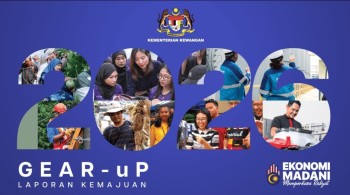
Malaysia's major government-linked investment companies are accelerating their domestic capital mobilisation under the GEAR-uP initiative, deploying RM20.3 billion in 2025—a threefold increase from the RM6.6 billion deployed in 2024. The Government-Linked Enterprises Activation and Reform Programme, now in its third year, represents a strategic shift in how Malaysia channels its accumulated wealth toward tangible socioeconomic outcomes, according to the latest progress report released by the Ministry of Finance.
Prime Minister Datuk Seri Anwar Ibrahim framed the initiative as a departure from capital management focused solely on financial returns, instead emphasising investment mobilised for national strategic purposes. The programme, launched in 2024, targets RM120 billion in deployment across five years to catalyse industrial transformation and strengthen Malaysia's economic resilience amid persistent global volatility. This acceleration in spending reflects the government's confidence that foundational reforms implemented in 2023 have stabilised the economy sufficiently to absorb and benefit from larger-scale institutional investment.
Six anchor institutions drive the GEAR-uP framework: Khazanah Nasional Bhd, the Employees Provident Fund, Permodalan Nasional Bhd, Kumpulan Wang Persaraan (Diperbadankan), Lembaga Tabung Angkatan Tentera, and Lembaga Tabung Haji. Their expanded deployment reflects both increased confidence in domestic opportunities and a deliberate policy to ensure gains from economic growth reach ordinary Malaysians. The performance metrics bolster this rationale—the portfolio of participating companies delivered an 8.0 per cent total shareholder return in 2025, signalling that capital preservation accompanies growth objectives.
Infrastructure expansion underpins much of the capital deployment. Tenaga Nasional Bhd continues expanding its electricity grid under Regulatory Period 4, escalating investment from RM12 billion in 2025 toward RM15 billion by 2027, aligned with Malaysia's target of 70 per cent renewable energy in installed capacity by 2050. Malaysia Airports is executing a five-year, RM11 billion modernisation initiative, with Kuala Lumpur International Airport's expansion plan positioning the hub to accommodate over 100 million passengers annually. These long-duration commitments anchor investor confidence while positioning Malaysia as a regional connectivity and energy hub.
Technology and digital infrastructure represent another substantial allocation avenue. Kumpulan Wang Persaraan's backing of Google's Selangor data centre expansion is projected to add 320 megawatts of capacity and generate 26,500 employment opportunities through 2026 and 2027. Parallel investments through Empyrion Digital's phased Johor development indicate a coordinated strategy to decentralise technological capabilities beyond Kuala Lumpur. These initiatives address Malaysia's competitive positioning in Southeast Asia's digital economy, where regional rivals have already established significant cloud and data processing infrastructure.
Capital market deepening features prominently in the deployment strategy. Dedicated GLIC funding vehicles—Dana Impak, Dana Perintis, Dana Pemacu, and Ekuinas—facilitate progression of domestic companies from venture-stage through growth phases. Khazanah's planned Dana Ciptawan will contribute an additional RM200 million specifically targeting Bumiputera enterprises and mid-tier Malaysian firms, addressing a historical gap in equity access for these segments. These mechanisms acknowledge that Malaysia's industrial transformation depends not merely on large-scale manufacturing or infrastructure, but on developing an ecosystem of growing companies across sectors.
Government-linked companies remain on track to accumulate RM100 billion in additional market value by 2028, with the MY Value Up initiative extending performance and governance discipline to Malaysia's 88 largest listed companies. This systematic approach recognises that public companies' health underpins broader market confidence. The Capital Market Masterplan's aspiration to achieve RM5.8 trillion to RM6.3 trillion in market capitalisation by 2030 depends on this pipeline of improved valuations and new listings materialising as intended—a targets that remains achievable if execution continues at current momentum.
Bumiputera wealth creation has been deliberately integrated into GEAR-uP's framework. Ten Bumiputera-linked companies are targeted for listing during 2026-2027, complementing the ten Bumiputera Champions Programme working to scale participating firms toward sustainable growth. Zakat Wakalah, a faith-based investment vehicle, is projected to reach RM100 million by 2026, up substantially from RM28 million in 2025, demonstrating that Islamic finance mechanisms increasingly channel institutional resources into productive enterprise. This diversification of wealth-building pathways recognises Malaysia's plural society and the importance of ensuring economic gains are distributed across communal lines.
Finance Minister II Datuk Seri Amir Hamzah Azizan contextualised GEAR-uP's purpose as preventing capital from merely transiting through Malaysia without establishing enduring productive capability. He reframed success metrics beyond traditional financial returns, emphasising living wages, graduate employment in quality positions, Bumiputera firm scaling, and locally anchored supply chains. This articulation reflects growing recognition that capital markets and institutional investment outcomes ultimately matter only insofar as they translate into improved material circumstances for working Malaysians—a standard that imposes accountability beyond conventional investor returns.
The expansion of deployment alongside Malaysia's navigation of external economic turbulence underscores the confidence institutional investors maintain in domestic medium-term prospects. While global volatility and trade reshaping persist, Malaysia's earlier macroeconomic stabilisation and institutional reforms have created sufficient foundation for large-scale capital activation. The MADANI Economy framework provides the conceptual anchoring—raising both economic ceiling and floor simultaneously rather than permitting growth to benefit narrow segments while others stagnate.
Looking toward 2026 and beyond, GEAR-uP's trajectory suggests institutional capital mobilisation will continue accelerating if current deployment absorbs effectively into productive channels. The momentum extending into early 2026 indicates planning cycles and project development sufficiently advanced to sustain elevated deployment levels. However, success ultimately hinges on whether these investments generate employment at living standards, develop indigenous champions capable of regional competition, and establish supply chains that retain value domestically rather than serving as conduits for resource extraction or low-value assembly.
Malaysia's regional competitors—Singapore, Thailand, Indonesia, and Vietnam—are simultaneously intensifying their own institutional investment and industrial policy initiatives. GEAR-uP's acceleration therefore reflects not merely domestic development ambitions but competitive positioning within Southeast Asia's ongoing economic reconfiguration. Whether the RM20.3 billion deployed in 2025 translates into sustainable competitive advantage depends on execution quality across infrastructure, technology, talent development, and firm capability building during the coming two years.

