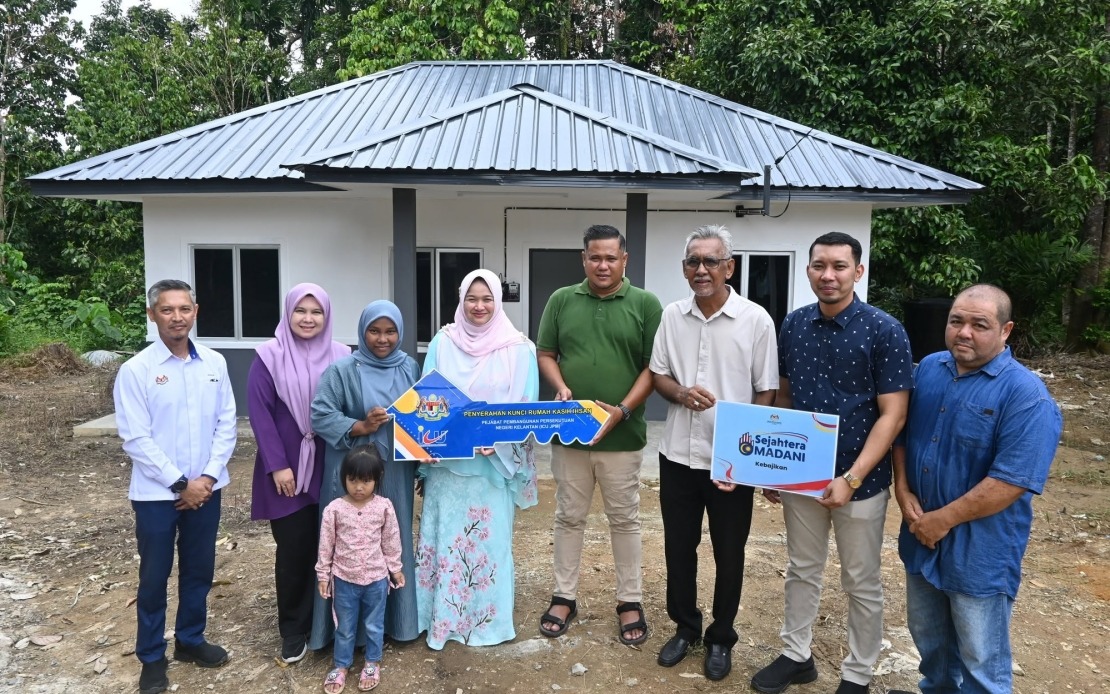
Prime Minister Datuk Seri Anwar Ibrahim's administration has deepened its push to elevate household living standards by delivering two residential units through the Rumah Kasih Ihsan initiative in Jeli, Kelantan, marking another milestone in the government's structured approach to addressing housing inequality in rural Malaysia. The handover ceremony, coordinated by the Kelantan Implementation Coordination Unit (ICU) operating under the Prime Minister's Department (JPM), reflects the administration's strategy of embedding federal oversight mechanisms within state-level delivery systems to ensure consistent programme execution across all 13 states.
The housing initiative targets families living in precarious conditions, recognising that inadequate shelter remains a significant barrier to socioeconomic mobility in rural communities. Yusof Mohamed Nawawi, a resident of Kampung Renyut, received formal approval to construct a replacement dwelling, signalling the government's commitment to phased infrastructure development rather than sudden displacement. Simultaneously, Shamsul Bahri Che Musa received full occupancy of his completed residence, demonstrating the programme's capacity to deliver finished units alongside those still under construction. Such staggered delivery models allow beneficiary families to plan transitions gradually, reducing the disruption often associated with rapid relocation.
The Kelantan ICU JPM, operating under director Dr Wan Nur Ibtisam Wan Ismail, coordinated the formal proceedings with the PMX Coordination Team, a mechanism designed to synchronise central government policy with on-ground implementation. This institutional arrangement reflects lessons learned from previous housing schemes that struggled with coordination between federal and state authorities. By establishing dedicated units within state-level governance structures, the current administration aims to reduce bureaucratic friction and accelerate project timelines, particularly in states like Kelantan where infrastructure investment has historically lagged behind wealthier regions.
Beyond the structural transfer of housing assets, both recipients were provided with food baskets, a symbolic gesture acknowledging the multidimensional nature of poverty. This approach recognises that families transitioning to new homes often face immediate consumption challenges, particularly during construction phases or relocation periods. The complementary provision of provisions demonstrates policy sophistication, moving beyond simplistic asset transfers toward holistic household welfare enhancement. For Malaysian development practitioners, this layered intervention model offers a replicable template for targeting vulnerable populations elsewhere, particularly in Sabah, Sarawak, and other economically marginalised districts.
The programme's underlying philosophy, articulated through official communications, emphasises that residential adequacy transcends mere shelter provision. According to the Kelantan ICU JPM documentation, secure housing functions as a psychological and economic foundation enabling families to pursue education, employment, and asset accumulation. This perspective aligns with international development research demonstrating correlations between housing security and human capital formation, particularly among children in low-income households. By framing housing as a development catalyst rather than a terminal welfare benefit, the government positions the Rumah Kasih Ihsan scheme within broader poverty reduction strategy rather than reactive assistance.
Kelantan's selection as an implementation focal point carries particular significance for regional equity. As one of Malaysia's economically disadvantaged states, Kelantan has experienced persistent infrastructure deficits and lower per-capita income than peninsular averages. Prioritising housing delivery in districts like Jeli signals federal commitment to spatial redistribution, addressing long-standing regional disparities that have contributed to internal migration pressures. Over recent decades, inadequate rural housing has driven youth emigration to urban centres, depleting provincial labour supplies and weakening local economic ecosystems. Housing improvements that enable families to remain in their home communities have indirect multiplier effects on rural development.
The institutional architecture supporting Rumah Kasih Ihsan warrants examination by Malaysian policymakers evaluating programme effectiveness. The ICU model, which embeds federal coordinators within state administrative structures, represents an organisational innovation addressing coordination failures that plagued earlier initiatives. However, sustainability depends on maintaining adequate staffing, ensuring consistent budget allocation, and preventing political fluctuations from destabilising implementation. Kelantan's history of alternating state administrations means that such programmes require institutional resilience transcending electoral cycles.
From a comparative Southeast Asian perspective, Malaysia's targeting of rural housing represents a distinctive development pathway. While Thailand and Indonesia have implemented similar schemes, Malaysia's reliance on federal-state coordination mechanisms reflects the constitutional division of powers unique to its federal system. The PMX Coordination Team model potentially offers instructive lessons for other federalised nations managing spatially dispersed development priorities. Vietnam's more centralised approach, by contrast, achieves rapid scalability but sometimes sacrifices local responsiveness.
Quantifying programme impact requires longitudinal data collection extending beyond immediate handover metrics. Genuine welfare measurement should track recipient household outcomes across multiple dimensions: children's school attendance rates, parental labour force participation, health facility utilisation, and asset accumulation patterns. Without such data infrastructure, programmes risk celebrating beneficiary numbers without verifying transformative impacts. The government's emphasis on measuring benefits through population experience rather than infrastructure statistics suggests openness to rigorous outcome evaluation, though implementation remains inconsistent across federal initiatives.
Looking forward, scaling Rumah Kasih Ihsan nationally presents logistical and fiscal challenges. Kelantan's programme covers two households in a single district; extrapolating to all districts requires exponentially greater resource allocation, skilled implementation personnel, and supply chain coordination for construction materials. The government's capacity to maintain delivery velocity while expanding geographic coverage will significantly influence the scheme's credibility and developmental impact. Regional variations in land availability, construction costs, and household preference require adaptive programme design rather than standardised templates.
The Jeli handovers underscore the government's positioning of housing security as foundational to broader social cohesion objectives. As Malaysia navigates demographic ageing, internal migration pressures, and regional development imbalances, targeted housing interventions address multiple policy objectives simultaneously. They provide immediate welfare support, signal government responsiveness to rural constituents, reduce urbanward migration pressures, and establish asset bases enabling intergenerational wealth accumulation. Whether these intentions translate into sustained implementation across all districts and states will substantially determine the initiative's long-term developmental significance.

