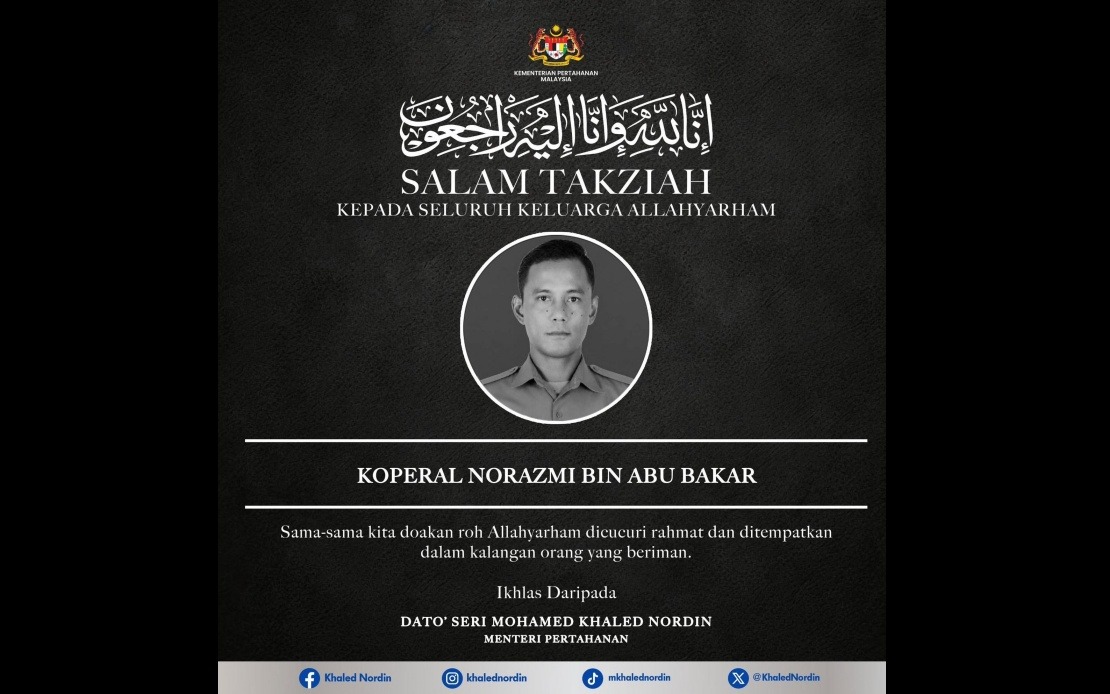
Two members of the Malaysian Armed Forces lost their lives in a fatal training accident in Kedah on June 16, prompting expressions of sympathy from the government and Defence Ministry leadership. Corporal Norazmi Abu Bakar, attached to the 6th Battalion of the Royal Malay Regiment, and Private Siti Khadijah Sungip from the 1st Squadron of the Royal Army Engineers Regiment, were killed during a grenade-throwing exercise at Hobart Camp firing range in Gurun. Both personnel sustained critical injuries in the blast that occurred at 10.57 am and died en route to Sultan Abdul Halim Hospital in Sungai Petani.
Defence Minister Datuk Seri Mohamed Khaled Nordin issued a statement expressing the ministry's profound sorrow at the incident, acknowledging the loss to the military community and the bereaved families. Through a social media post released that evening, the minister conveyed that both the Defence Ministry and the broader government apparatus stand in solidarity with the families during their time of grief. He called for prayers and spiritual support, invoking religious sentiments to convey the depth of the nation's sympathy for those affected by this tragic event.
In his remarks, Mohamed Khaled Nordin sought to provide comfort by requesting that Malaysian citizens join in prayer for the deceased and their families. His statement reflected the customary protocol observed by the ministry when addressing the loss of military personnel, balancing formal acknowledgment of the tragedy with expressions of national mourning. The minister's words underscored the government's commitment to supporting the families through what would inevitably be a profoundly difficult period of adjustment and grief.
The Malaysian Army subsequently confirmed the identities of the two victims and initiated formal procedures for investigating the circumstances surrounding the explosion. Army Chief General Tan Sri Azhan Md Othman directed that a comprehensive investigation be undertaken to establish the root causes of the incident. Such inquiries are standard protocol following fatal accidents within the armed forces, serving both to honour the memory of the deceased and to identify any systemic issues that may have contributed to the tragedy.
Training exercises involving explosives and live ammunition represent inherently high-risk activities within any military organisation. While comprehensive safety protocols are typically in place at dedicated firing ranges such as Hobart Camp, accidents can still occur due to various factors ranging from equipment malfunction to human error or unforeseen circumstances. The investigation initiated by the Army Chief will likely examine all such variables to determine what led to this particular incident and whether procedural or safety enhancements should be implemented.
The death of Private Siti Khadijah Sungip holds particular significance as it represents the loss of a female member of the Royal Army Engineers Regiment, an increasingly integrated branch of the Malaysian military. The inclusion of women in combat and combat-support roles has been a gradual but important evolution within the Malaysian Armed Forces, and the loss of any female soldier underscores the equal risks that all personnel, regardless of gender, undertake when serving in these challenging environments.
For the families of both victims, the loss represents not only personal tragedy but also the sudden disruption of their lives and futures. Military families face unique circumstances, often characterised by pride in service alongside the ever-present awareness of occupational risks. The condolences extended by government and defence leadership, while important symbolic gestures, cannot fully address the profound grief and adjustments that bereaved families must navigate in the aftermath of such losses.
The incident at Hobart Camp serves as a sobering reminder of the dangers inherent in military training and operational activities. Even with rigorous safety measures, training exercises involving explosives carry inherent risks that personnel accept as part of their professional commitment. The broader military community would be monitoring the investigation's findings closely, both to understand what transpired and to assess whether any lessons might be applied to enhance safety protocols across the Malaysian Armed Forces.
As investigations proceed, the focus for the Defence Ministry and the military hierarchy will extend beyond determining immediate causes to considering whether systemic improvements might be warranted. This might encompass equipment maintenance and inspection procedures, training protocols, supervision arrangements, or medical response capabilities at training facilities. Such reviews, while sometimes occurring behind the scenes, represent an important commitment to preventing future tragedies and honouring the sacrifice of fallen personnel by ensuring that lessons learned translate into tangible safety improvements for those who remain in service.