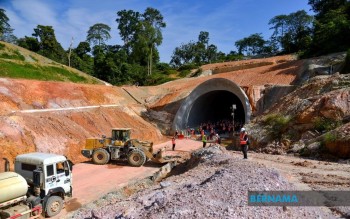
The Malaysian government has committed RM207.2 million to transform Pasir Puteh, a parliamentary constituency in Kelantan, through a coordinated portfolio of 46 development initiatives scheduled for 2026. The investment strategy represents a deliberate attempt to position the region as a regional economic powerhouse by capitalising on its proximity to the East Coast Rail Link (ECRL) cargo handling facility, a critical piece of infrastructure that opened new opportunities for inland connectivity along Malaysia's eastern seaboard.
Deputy Economy Minister Datuk Mohd Shahar Abdullah outlined the government's vision during a parliamentary oral question-and-answer session, emphasising that the approved initiatives extend beyond mere construction projects. The plan encompasses systematic land preparation and comprehensive infrastructure development targeting the Pasir Puteh downstream industrial zone, with explicit coordination under the ECRL Integrated Land Use Master Plan framework. This approach reflects a departure from siloed project implementation, instead weaving together multiple development strands to maximise economic spillovers within the constituency.
The strategic positioning of Pasir Puteh as a dual-function logistics and industrial nexus rests on geographical advantage. The ECRL station itself will operate as both a passenger transport hub and a cargo and logistics facility, a dual mandate that opens multiple revenue streams and economic activity channels. Critically, the station's location near the Tok Bali Supply Base creates a natural synergy between rail infrastructure and port operations, positioning the area to capture regional supply chain traffic and value-added manufacturing activities.
Mohd Shahar articulated the broader economic logic underpinning the investment, noting that the convergence of rail and port infrastructure creates conditions for substantial private sector participation. This magnetic pull for investment capital translates into direct employment opportunities, particularly in warehousing, logistics coordination, light manufacturing, and value-added processing sectors. The government's vision extends beyond job creation alone; planners anticipate that clustering logistics and industrial operations around the ECRL station will generate spillover demand for ancillary services, accommodation, and worker amenities, thereby stimulating grassroots economic activity throughout the surrounding region.
The question posed by Datuk Dr Nik Muhammad Zawawi Salleh of Pasir Puteh, a Perikatan Nasional representative, underscored political attention to the development gap between the prosperous Klang Valley and northern Peninsular Malaysia. Kelantan, historically characterised by lower income levels and higher unemployment, has struggled to attract major manufacturing or logistics investments compared to more developed states. This intervention signals recognition within the federal government that regional inequality requires targeted infrastructure investment and deliberate economic positioning to compete for private capital.
The alignment with the 13th Malaysia Plan (13MP), which runs through 2030, positions Pasir Puteh's development within the broader national economic strategy. Mohd Shahar confirmed that implementation commences this year, with rolling execution over the remainder of the planning horizon. Rather than front-loading all spending, the staggered approach allows for adaptive management and learning from early-phase projects before scaling successful models. This measured tempo also spreads fiscal impact across budget cycles, providing flexibility as macroeconomic conditions evolve.
An instructive dimension of the government's approach involves emphasising locality-specific comparative advantages. Rather than imposing a uniform development template across all constituencies, the 13MP directs resources toward sectors where each location demonstrates existing capability or natural endowment. In Pasir Puteh's case, that sector is logistics and downstream industrial activity; in neighbouring areas, tourism or agriculture might take priority. This differentiated strategy potentially yields higher returns on development spending than generic projects that ignore regional realities.
Monitoring and transparency mechanisms form another layer of the development framework. Projects will be tracked through the MyRMK system, with periodic reporting to the Dewan Rakyat ensuring parliamentary oversight and public accountability. This institutional commitment to transparency reflects lessons learned from earlier development programmes where implementation slippage or cost overruns went undetected until substantial resources had been squandered. Regular parliamentary updates create pressure for timely delivery and efficient execution.
For Kelantan specifically, the implications are substantial. The state has long struggled with economic diversification and infrastructure development relative to more urbanised peninsular regions. By anchoring major logistics and industrial activity around the ECRL station in Pasir Puteh, the government creates a potential catalyst for broader regional development. Successful implementation could serve as a template for similar port-rail integration projects elsewhere on the east coast, potentially benefiting Terengganu and southern Pahang as well.
The Pasir Puteh intervention also reflects the federal government's growing recognition that transport infrastructure alone yields limited returns without complementary land-use planning and industrial zoning. The ECRL itself represents one of Malaysia's largest modern infrastructure investments, but without coordinated downstream development efforts, the line operates at submaximal capacity. By deliberately building industrial and logistics clusters around key stations, planners ensure that the ECRL becomes a true economic development engine rather than merely a transport facility.
Regionally, the Pasir Puteh strategy holds lessons for ASEAN peers grappling with uneven development. Countries like Indonesia and the Philippines face similar challenges of concentrating economic activity in primate cities while peripheral regions languish. Malaysia's explicit use of transport infrastructure and targeted industrial zoning to redistribute growth offers a potentially replicable model, though execution quality ultimately determines outcomes. The MyRMK monitoring system and parliamentary accountability mechanisms represent institutional innovations that merit study by regional policymakers.
Looking forward, the success of the Pasir Puteh initiative will hinge on private sector response. Government can construct physical infrastructure and clear regulatory pathways, but absent investor confidence in logistics demand and profitability, the downstream industrial zone risks becoming a monument to optimistic planning rather than a functioning economic hub. The government's emphasis on synergy between rail and port facilities suggests confidence that market fundamentals support profitable operations, but this assumption merits validation through transparent project appraisal and performance monitoring as implementation proceeds over the coming years.

