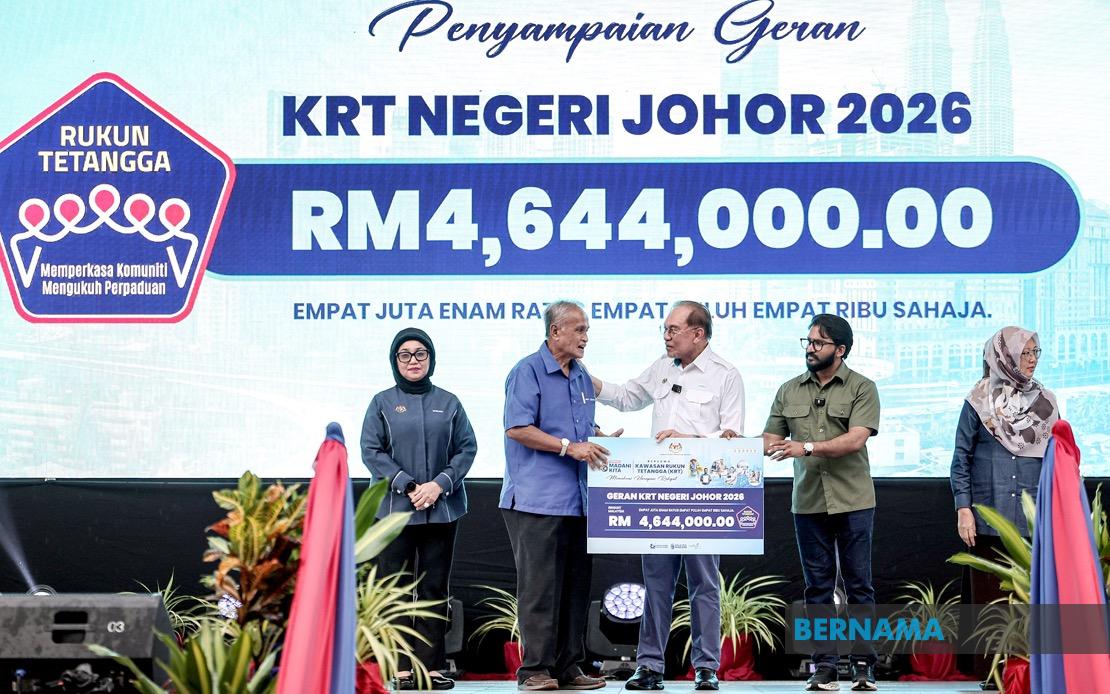
Prime Minister Datuk Seri Anwar Ibrahim has approved a significant boost to neighbourhood security funding, announcing at an event in Segamat that the annual grant for Neighbourhood Watch Areas (KRT) will rise to RM10,000 from the existing RM6,000. The enhanced allocation will commence on January 1, 2027, representing the first adjustment to the scheme in a decade and reflecting recognition of grassroots community policing's expanding demands.
The decision to elevate funding comes at a moment when local security organisations play an increasingly vital role in maintaining public order and addressing community concerns. The RM4,000 increment, though modest in absolute terms, represents a 67 percent increase that acknowledges the institutional strain accumulated over ten years of frozen budgets. Officials accompanying the Prime Minister to the event in Johor included Deputy Minister of National Unity R. Yuneswaran and Deputy Minister of Domestic Trade and Cost of Living Datuk Dr Fuziah Salleh, underscoring the government's commitment to the initiative.
The stagnation of KRT funding at RM6,000 annually since the mid-2010s had become untenable given rising operational costs and the expanding scope of neighbourhood security work. Community watch groups depend on these allocations to maintain patrols, conduct safety awareness campaigns, and coordinate with official security agencies. The absence of inflationary adjustments over a decade meant that the real value of each grant had deteriorated significantly, constraining the ability of these volunteer-driven organisations to function effectively across Malaysia's urban and rural communities alike.
Anwar's remarks at the MADANI KITA Programme highlighted the broader strategic importance of KRT organisations beyond simple crime prevention. He characterised these groups as custodians of social cohesion, emphasising their capacity to reinforce democratic values and foster consensus-building at the neighbourhood level. This framing situates KRT not merely as security auxiliaries but as institutional pillars supporting national unity and interfaith harmony, themes that resonate particularly strongly in Malaysia's multicultural context.
The Prime Minister took the opportunity to reinforce the government's position on national diversity, stating unequivocally that Malaysia's foundational strength derives from its ability to preserve harmony among racially, religiously and culturally distinct populations since independence. His assertion that differences should be celebrated rather than weaponised for social division reflects broader policy direction toward inclusive governance. Within this framework, KRT organisations serve as frontline institutions where these principles are translated into daily community interaction and informal dispute resolution.
Beyond the KRT announcement, the government committed additional resources to infrastructure development in Johor. An immediate allocation of RM3.205 million was approved for sixteen basic infrastructure repair and upgrade projects at Islamic educational institutions throughout the state, encompassing religious schools, madrasahs, study centres and Quranic memorisation facilities across districts including Batu Pahat, Muar and Segamat. This complementary investment reflects the administration's broader commitment to strengthening institutional infrastructure supporting religious education and community welfare.
The funding for Islamic educational facilities addresses longstanding maintenance backlogs and facility deficiencies that have constrained learning environments. By targeting religious schools alongside secular institutions, the government signals investment in knowledge transmission across all educational domains. For Malaysian readers, particularly those in Johor and other states with significant religious educational networks, this funding carries implications for educational accessibility and the quality of learning spaces available to students pursuing Islamic studies at various levels.
Simultaneously, the government earmarked RM1.0 million for urgent and critical repairs at Royal Malaysian Police quarters in Johor, recognising that officer welfare directly influences security force effectiveness and morale. The interconnection between facility quality, personnel wellbeing and operational capability remains a persistent challenge in Malaysian law enforcement. Investment in police housing infrastructure addresses not only immediate comfort but also retention and recruitment dynamics within the force, essential considerations for maintaining adequate security coverage across the state.
The bundling of these three announcements—KRT funding, religious education infrastructure and police facilities—within a single event suggests a coordinated approach to strengthening grassroots governance structures and the institutional ecosystem supporting them. Rather than isolated expenditures, these allocations form part of a deliberate strategy to fortify the multiple layers through which government authority, community participation and security provision intersect at the local level.
For Malaysian readers, the KRT grant increase holds practical significance for neighbourhood security in their own communities, though the delayed implementation timeline until January 2027 allows the government a transition period for budgetary planning. The decision simultaneously carries symbolic weight, confirming that decade-long funding freezes are being addressed across various institutional sectors. Implementation success will depend on efficient disbursement mechanisms and ensuring that grants reach active KRT organisations capable of deploying resources toward genuine community benefit.
Looking forward, the raising of KRT allocations may catalyse broader examination of other frozen grants and subsidies across Malaysia's governance apparatus. The ten-year absence of adjustment had become increasingly difficult to justify, and the current decision opens questions about similar funding structures requiring inflationary recalibration. Southeast Asian readers observing Malaysian administrative practice may note this instance of budgetary reorientation as governments across the region grapple with optimising limited resources across competing institutional demands.
The announcement also reflects Anwar Ibrahim's positioning on community security and grassroots empowerment, themes central to the MADANI framework guiding current governance philosophy. By elevating investment in volunteer-driven security organisations, the government reinforces a particular model of public order maintenance that emphasises community participation over purely state-centric approaches. This decentralised security philosophy has both advocates and critics within Malaysian civil society, with supporters valuing community agency and detractors raising concerns about accountability and consistency of standards across different KRT organisations.

