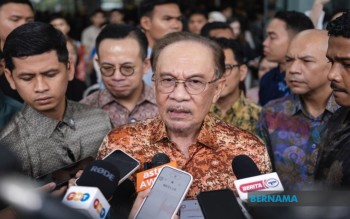
Prime Minister Datuk Seri Anwar Ibrahim has drawn a clear line on taxation policy, declaring the government will not entertain a return to the Goods and Services Tax despite ongoing discussions about consumption tax reform. Speaking after the TikTok Shop Summit 2026 here, Anwar, who concurrently holds the Finance Minister portfolio, emphasised that while the administration remains receptive to refining the current Sales and Service Tax framework, reintroducing GST's fundamental structure remains off the table. The categorical stance reflects the MADANI government's foundational principle of shielding the nation's poorest citizens from heightened tax burdens.
The reaffirmation comes amid persistent debate about Malaysia's tax architecture. Since abandoning GST in 2018 following widespread public resistance over cost-of-living concerns, the country has operated under the SST regime. Recent months have witnessed renewed discussions about potential consumption tax overhauls, with various stakeholders proposing solutions ranging from digital payment transaction taxes to broader-based revenue mechanisms designed to bolster government coffers and meet fiscal objectives. Some economists and business groups have suggested that a modernised GST could improve tax efficiency, yet political sensitivity around the issue remains acute given the backlash that precipitated the 2018 switch.
Anwar's comments reveal a nuanced position that separates wholesale rejection from tactical flexibility. While the Prime Minister ruled out GST's core characteristic—a sweeping tax applied across the entire population including the poorest segments—he signalled openness to selective components of the system. This distinction is significant for policymakers and analysts tracking Malaysia's fiscal direction. The government could potentially adopt targeted GST elements such as improved compliance mechanisms or streamlined registration processes without reverting to the broad-based model that triggered public outcry eight years ago. Such a hybrid approach would allow revenue enhancement without triggering the political consequences of full GST reintroduction.
The SST framework, which focuses taxation on specific goods and services rather than applying uniformly across all transactions, has proven less politically volatile but also less efficient as a revenue generator. Since 2018, Malaysia has grappled with constrained fiscal space as government expenditures have grown while the less comprehensive tax base has struggled to keep pace. This structural mismatch has informed recent discussions about consumption tax modernisation. Officials have highlighted the potential for electronic payment transaction taxation as an alternative mechanism to broaden the revenue base without imposing regressive burdens on lower-income households who rely more heavily on cash transactions.
For Malaysian readers, Anwar's position carries several implications. First, it provides reassurance that any near-term taxation changes will not dramatically increase costs for ordinary families already navigating inflationary pressures. Second, it signals that the government remains committed to progressive taxation principles—adjusting policy to protect vulnerable populations rather than shifting burdens downward. Third, it acknowledges that some form of consumption tax evolution appears inevitable given fiscal pressures, even if GST specifically remains politically untenable. The government appears to be seeking middle-ground solutions that enhance revenue without triggering the social friction that GST generated.
Regionally, Malaysia's approach differs from several neighbouring economies. Singapore maintains a robust GST framework at seven percent, while Thailand and Indonesia operate value-added tax systems. These comparison points inform ongoing Malaysian policy discussions, though the distinct political contexts make direct comparison problematic. Malaysia's particular sensitivity stems from the 2018 experience, where GST introduction under the previous government became emblematic of governance issues and contributed to electoral outcomes. That historical shadow ensures any similar broad-based tax proposals face significant headwinds.
The timing of Anwar's clarification matters for business planning and investor confidence. The TikTok Shop Summit provided an appropriate venue for affirming tax stability to digital commerce stakeholders concerned about operating cost uncertainty. By explicitly ruling out GST while indicating flexibility on SST implementation, the Prime Minister provided sufficient clarity for medium-term business projections while leaving room for incremental policy adjustments. Companies operating in Malaysia can proceed with confidence that dramatic tax regime overhauls are unlikely, even as minor modifications remain possible.
The MADANI government's stated emphasis on protecting the poorest segment reflects both principled commitment and pragmatic politics. Economically, regressive taxation disproportionately impacts consumption patterns among lower-income households, potentially dampening domestic demand when broader growth is needed. Politically, the 2018 GST experience demonstrated that taxation perceived as unfairly burdening ordinary Malaysians can rapidly erode electoral support. By anchoring policy firmly to this principle, Anwar signals continuity with campaign commitments while maintaining flexibility for technocratic adjustments that do not violate the core redistribution objective.
Future taxation discussions will likely centre on how Malaysia can improve fiscal revenues without reverting to GST or imposing regressive burdens. Electronic payment taxes, enhanced SST administration, improved tax compliance through digital means, and potential wealth or property taxation represent alternative directions the government might explore. Anwar's framework suggests these conversations will proceed within parameters that explicitly protect lower-income populations. This boundary condition shapes the feasible policy space while still permitting meaningful reform.
The broader fiscal context underscores why consumption tax modernisation remains prominent in policy discussions. Malaysia's aging population will increase healthcare and pension expenditure over coming decades, creating structural pressure on government budgets. Simultaneously, global economic uncertainty and evolving trade dynamics complicate revenue projections. Within these constraints, policymakers must identify sustainable funding mechanisms. Anwar's position suggests the search will continue for tax solutions that are both progressive in design and adequate in yield—a challenging combination that explains why simple GST return remains politically unviable despite its theoretical administrative advantages.

