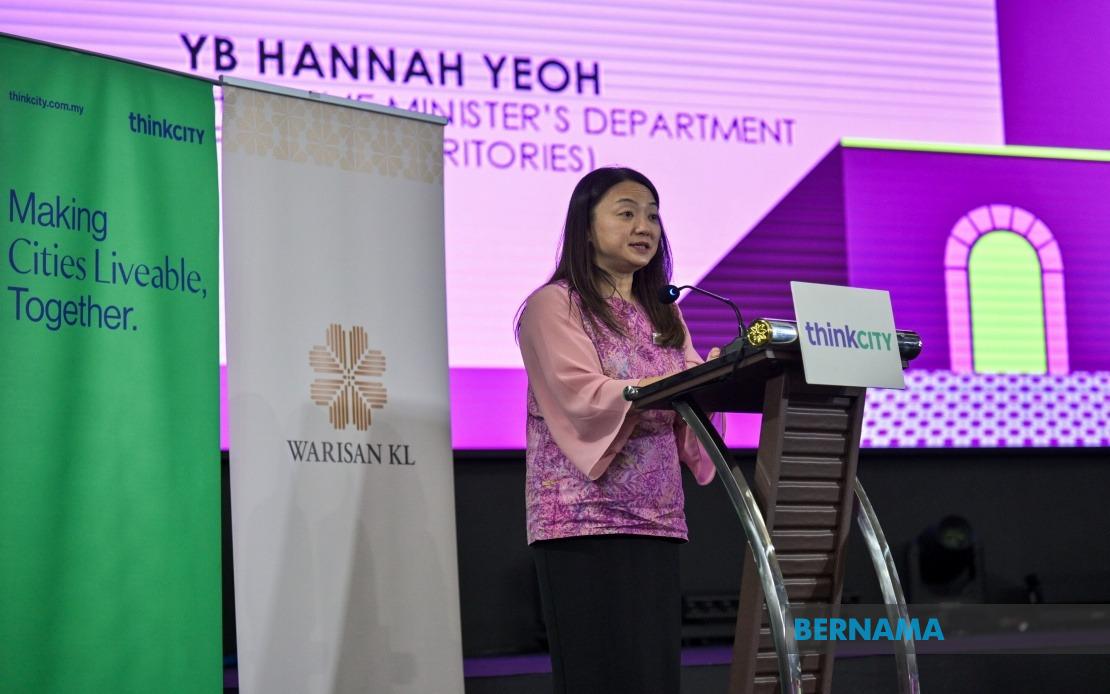
The federal government has committed RM1 million towards revitalising the heart of Kuala Lumpur through a dedicated grants scheme targeting heritage preservation and community-driven development. Hannah Yeoh, Minister in the Prime Minister's Department (Federal Territories), unveiled the Downtown Kuala Lumpur Grants Programme 2026 during a ceremony in the capital, signalling a strategic pivot towards cultural and economic renewal in the city centre.
The initiative distributes funding in tranches ranging from RM30,000 to RM100,000 per approved project, designed to benefit local entrepreneurs, community groups, and creative practitioners operating within the downtown precinct. This tiered approach allows for flexibility in project scale, from small grassroots cultural initiatives to larger heritage conservation undertakings, reflecting recognition that urban revitalisation requires interventions at multiple levels.
Yeoh articulated a broader vision for Kuala Lumpur's future during the launch, emphasising that the city's prosperity hinges not merely on architectural newness but on its ability to retain residents, attract investment, and foster continuous habitation and engagement. Her framing positions heritage and cultural vitality as economic assets rather than nostalgia-driven preservation efforts, a distinction that carries particular weight for Southeast Asian cities navigating rapid modernisation pressures.
The programme draws funding from the Ministry of Finance and operates with explicit recognition of Kuala Lumpur's UNESCO Creative City designation—a status conferring formal international acknowledgement of the city's cultural significance. This positioning underscores how cultural credentials translate into tangible economic benefits through tourism attraction, job creation, and sectoral development. For Malaysia's creative economy aspirations, the grant scheme represents federal-level commitment to translating soft power designations into sustainable economic pathways.
Think City, designated as the strategic partner administering the programme, will shortly release detailed eligibility criteria governing application processes. This partnership with an independent implementation agency introduces procedural distance between political leadership and funding decisions, potentially enhancing transparency and reducing perception of patronage—a consideration material for public confidence in devolved spending mechanisms.
Yeoh's remarks reflect evolving discourse within Malaysian governance regarding municipal administration. Her explicit commitment to transforming Kuala Lumpur City Hall (DBKL) from perceived obstruction into enabling facilitator acknowledges long-standing frustration among business operators and residents regarding regulatory impediments and bureaucratic friction. By framing her ministerial role partly as municipal culture-change, she signals responsiveness to stakeholder concerns whilst leveraging the grants programme as practical demonstration of this reorientation.
The Downtown KL initiative arrives amid broader Southeast Asian trends towards cultural quarter development and experiential urban economies. Regional cities from Bangkok to Singapore have increasingly pursued heritage-anchored rejuvenation strategies, recognising that authenticity and cultural narrative function as differentiation mechanisms in competitive metropolitan markets. Malaysia's comparable initiative positions Kuala Lumpur within this regional conversation whilst directing resources toward domestic creative practitioners.
From an economic perspective, heritage-focused grants programmes typically generate multiplicative effects extending beyond immediate beneficiaries. Successful projects attract foot traffic, supporting adjacent retail and hospitality sectors; they enhance neighbourhood ambience, potentially triggering property value adjustments and tax base expansion; and they create employment in cultural production and tourism services. For downtown Kuala Lumpur specifically, where decades of peripheral development have sometimes overshadowed older commercial districts, targeted stimulus addresses documented challenges in central commercial district vitality.
The programme's emphasis on fresh ideas and emerging practitioners signals openness to innovative approaches rather than purely conservative preservation. This inclusive framing may appeal to younger entrepreneurs and social enterprises seeking to blend cultural stewardship with viable commercial models—from heritage-themed cafés to digital cultural documentation projects to experimental performance venues. Such flexibility potentially catalyses more dynamic urban renewal than conventional heritage management alone.
Yeoh's invitation to interested parties, particularly those with novel concepts, frames application as invitation to collaborative governance. This rhetorical positioning acknowledges that municipal revitalisation succeeds through stakeholder participation rather than top-down directive, though realising this aspiration depends substantially on Think City's implementation approach and the actual reception applications receive. The programme's ultimate success will therefore reflect not merely funding availability but the responsiveness and support systems surrounding it.
For Malaysian readers and stakeholders, the initiative merits attention as exemplification of how cultural policy intersects with economic development, municipal governance, and regional positioning. As Southeast Asian cities increasingly compete for talent, investment, and tourism through lifestyle and cultural amenities, downtown revitalisation programmes become strategic economic infrastructure rather than luxury expenditure. Kuala Lumpur's approach suggests federal-level recognition of this calculus, potentially presaging comparable initiatives in other major Malaysian cities.

