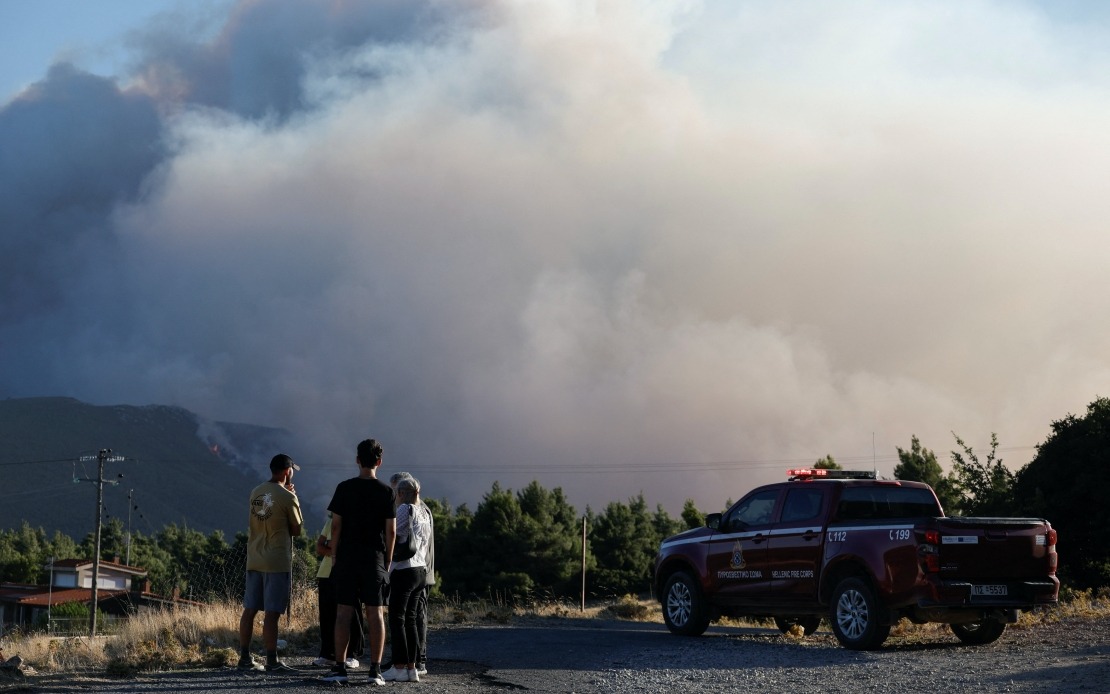
Greece's firefighting services were stretched thin on Sunday as a massive wildfire ravaged the Kithairon Mountains region west of Athens, forcing the mobilisation of hundreds of emergency personnel and international assistance to prevent the flames from reaching populated areas. The intensity and speed of the blaze, fuelled by strong winds sweeping across the western outskirts of the capital, demonstrated the growing challenge posed by seasonal wildfires across the Mediterranean—a concern that extends to neighbouring countries throughout Southeast Asia's rapidly warming climate zone.
The scale of the emergency response underscored the severity of the situation. At least 500 firefighters were deployed across the affected zones, working throughout Sunday night in dangerous conditions with support from military vehicles, volunteer crews, and heavy equipment. As daybreak approached, firefighting aircraft and helicopters resumed aerial operations, providing crucial support to ground teams who had fought the blaze through the darkness. The collaborative effort extended beyond Greece's borders, with specialised crews from Romania and France joining the battle—a reflection of the mutual assistance protocols European nations maintain during natural disasters.
The particular vulnerability of the Veniza and Psatha areas highlighted how topography and weather patterns can concentrate wildfire risk. These communities, situated in the Kithairon Mountains' terrain, proved especially susceptible to rapid flame advancement. By Sunday, the fire's eastward progression had brought it to within several kilometres of Megara, a city approximately 50 kilometres west of Athens. The proximity of such a major urban centre to active flames raised immediate concerns about potential evacuation orders and the broader implications for the Athens metropolitan region's suburban populations.
Wind patterns played a decisive role in determining fire behaviour. Meteorological conditions favouring rapid spread forced firefighting crews to adopt adaptive strategies, with operations adjusted continuously based on shifting wind direction and intensity. This meteorological factor proved critical in determining whether the blaze would be contained within sparsely populated mountainous terrain or advance toward Megara and surrounding residential zones. The unpredictability of wind-driven wildfires represents a persistent challenge for emergency management systems across the Mediterranean and increasingly in other regions experiencing extended drought periods.
The authorities took a firm stance on the human dimension of the crisis. Nationwide investigations resulted in 13 arrests on charges of negligent arson, signalling that law enforcement was pursuing potential criminal culpability alongside natural firefighting efforts. This dual approach—simultaneously combating the blaze while investigating its origins—reflected Greek authorities' determination to address both immediate and root causes of the disaster. The arrest figures suggested that human carelessness, rather than natural causes alone, may have contributed to the outbreak or spread of the fire.
The broader wildfire situation across Greece extended beyond the Kithairon Mountains threat to Athens. The island of Cephalonia experienced its own major fire, though state broadcaster ERT indicated that no towns faced immediate danger at the time of reporting. This simultaneous outbreak on multiple fronts illustrated a regional vulnerability to wildfire risk during summer months, when conditions become particularly conducive to rapid fire spread. The geographic dispersal of Greece's wildfire challenges complicated resource allocation and recovery planning.
Crete's experience provided some measure of relief amid the broader emergency. Wildfires that had burned across the large island had largely been extinguished by Sunday, though not before prompting evacuation orders for several communities. Media estimates suggested that up to 200 homes had been destroyed on Crete, though official confirmation remained pending. The destruction of residential properties underscored the social and economic costs of uncontrolled wildfires, displacing families and destroying decades of accumulated wealth in mere hours.
The accumulated environmental damage from the current fire season was staggering in scope. A meteorologist cited by news portal Protothema estimated that approximately 10,000 hectares of land in the north-western and western zones adjacent to Athens had been destroyed. This vast acreage—equivalent to roughly 14,000 football fields—represented irreplaceable forest cover, wildlife habitat, and productive land removed from the landscape. The long-term ecological implications of such extensive burning included soil degradation, increased erosion risk, and delayed forest regeneration across years or decades.
For Malaysian and Southeast Asian observers, Greece's wildfire emergency offered sobering lessons about climate-related disaster preparedness. While Southeast Asia faces distinct environmental threats centred on tropical storms and flooding, the accelerating frequency and intensity of Mediterranean wildfires reflected broader patterns of climate change affecting fire regimes globally. Greece's investment in aerial firefighting capabilities, international coordination mechanisms, and rapid mobilisation procedures provided potential models for regional adaptation and disaster response enhancement.
The convergence of multiple simultaneous fires across Greek territory in a single season suggested that traditional approaches to wildfire management might require fundamental restructuring. The need to maintain standing armies of firefighters, pre-positioned equipment, and international cooperation agreements represented substantial fiscal commitments that many nations—particularly developing economies—struggle to sustain. Greece's experience highlighted the escalating costs of climate adaptation in fire-prone regions and the economic calculus underlying disaster preparedness investments.
Looking forward, the incident raised questions about urban planning and settlement patterns in fire-vulnerable regions. The proximity of Megara to the advancing flames illustrated how suburban expansion into fire-prone landscapes created civilian exposure to natural hazards. Similar tensions between development pressure and environmental risk exist throughout the Mediterranean and increasingly in Southeast Asia's growing urban centres, where rapid urbanisation frequently encroaches upon forests and other natural fire-prone ecosystems.

