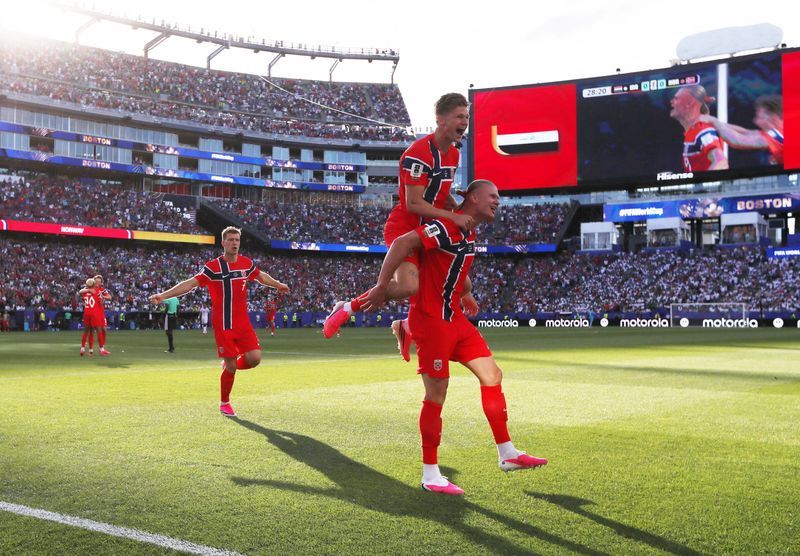
Erling Haaland announced himself on football's grandest stage with characteristic ruthlessness on Tuesday, scoring twice in Norway's emphatic 4-1 demolition of Iraq. The prolific striker's brace represented yet another milestone in a career studded with breakthrough moments, as Haaland extended an impressive record of scoring on debut across Europe's elite competitions. Whether in the German Bundesliga, English Premier League, or European club football's most prestigious tournament, the Norwegian has proven adept at announcing himself with goals. Now, with two finishes at the World Cup finals, he has added international football's ultimate competition to that exclusive list.
Haaland's influence on the match transcended mere statistics, despite Norway's performance containing troubling elements beneath the surface of victory. The side committed numerous errors in possession and struggled at times to exert the dominance one might expect from a team that would ultimately score four goals. Yet the striker's presence proved sufficiently transformative that such shortcomings remained largely academic. When the opening arrived in the first half, Haaland was positioned to punish Iraq's defensive vulnerabilities with the efficiency of a predator sensing weakness in wounded prey.
The forward's opening goal exemplified classical poaching instinct—a sharp movement to meet David Moller Wolfe's measured delivery across the box, typical of the finishing that has made Haaland one of world football's most lethal operators. His second, however, showcased a different facet of his game: aggressive pressure applied to Iraq's backline forced a hurried pass toward the goalkeeper, whose attempted clearance Haaland blocked, the ball ricocheting into the net. It was the kind of goal born from relentless intensity rather than pure technical refinement, highlighting why opposing defenders find him so difficult to contain.
Norway's path to this moment carried profound symbolism for a nation that had endured a 28-year absence from the World Cup stage. The last time Norwegians experienced their team competing at a men's World Cup was 1998, before many current supporters were born. That lengthy drought added emotional weight to Tuesday's contest, transforming what might ordinarily be a qualifying-round fixture into something far more significant for the national football consciousness. The return carried expectations and pressure that only a prolonged absence can generate.
Manager Stale Solbakken's tactical approach appeared built around a simple principle: create opportunities for Haaland to capitalise on them. Norwegian Prime Minister Jonas Gahr Stoere had articulated this philosophy the day before, noting that while individuals score goals, teams win matches. This philosophy was evident throughout Norway's approach, with much of the side's attacking design oriented toward positioning their talismanic forward for clear sight of goal. However, the execution proved inconsistent, with several players failing to deliver the calibre of service their team's primary attacking weapon required.
Captain Martin Odegaard, Norway's playmaking fulcrum in midfield, experienced an unusually subdued performance, failing to impose the creative influence typically associated with his role. Simultaneously, the back line demonstrated concerning lapses in concentration, most evident when Iraq seized upon one such moment to level temporarily through Aymen Hussein's goal. These defensive vulnerabilities suggested that for all their attacking prowess, Norway harbours defensive concerns that superior opponents might exploit far more ruthlessly than Iraq managed.
Despite the victory's comfort level, Haaland himself recognised that his side must elevate their performance substantially. The 4-1 scoreline masked a game in which Norway rarely controlled proceedings with the authority their status as returning World Cup competitors might suggest. Iraq proved sufficiently resilient to create problems, and had the Norwegian finishing been less clinical or their defence less fortuitous, the result could have developed very differently. Against the tournament's more formidable opponents, such inconsistency would prove punished.
Norway's position atop their group following the opening round owes much to goal difference, with France occupying the same three-point haul after their 3-1 victory over Senegal. This situation means that even with maximum points from their opening fixture, the Scandinavians remain vulnerable to displacement. The group's competitive nature became apparent immediately, suggesting that Haaland and his teammates cannot afford to coast on initial success. Future matches will demand the focused excellence that remains a work in progress.
For Haaland himself, the World Cup represented new territory despite a resume already glittering with firsts. His ability to perform on debut across multiple elite platforms had become almost expected, yet expectations at football's world championship carry different weight and significance. By delivering immediately, he has eased pressure on himself while simultaneously placing additional responsibility on his shoulders as the nation's primary attacking weapon. In the coming weeks, how comprehensively Norway can build on their opening performance will likely depend substantially on whether Haaland can maintain this early momentum while his teammates develop the consistency his finishing deserves.
The striker's post-match mood reflected the peculiar mix of satisfaction and recognition of incompleteness that victory-yet-imperfect-performance generates. Haaland acknowledged the relief of avoiding what might be termed "banana skins"—unexpected stumbles that can prove costly in tournament football—while his grin suggested genuine delight at Norway's return to the world stage. Whether supporters across Norway were indeed partying as the striker hoped remains a matter of national celebration, but the genuine possibility of extended tournament participation has undoubtedly been restored to national conversation after nearly three decades of absence.