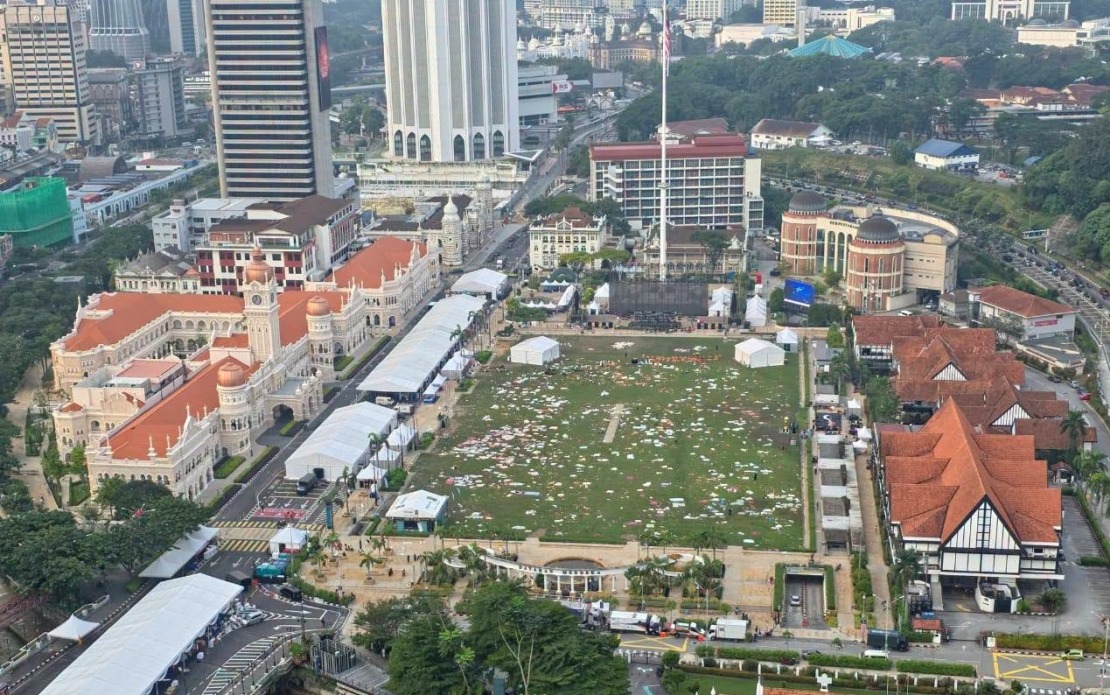
Federal Territories Minister Hannah Yeoh has publicly acknowledged the dedication shown by Kuala Lumpur City Hall (DBKL) workers in restoring Dataran Merdeka to acceptable condition following significant littering after a public screening of the 2026 FIFA World Cup final. Rather than focusing solely on criticism, Yeoh used the occasion to reflect broader themes about civic engagement and national stewardship, positioning the incident as a teaching moment for Malaysian society.
The cleanup operation at the historic venue became necessary after crowds attending the outdoor screening left considerable amounts of rubbish scattered across the grounds. While such events typically generate waste, the scale of the mess prompted the minister to examine underlying attitudes towards shared public spaces. Yeoh's response transcended routine administrative acknowledgment, instead framing the situation within the context of Malaysia's national development philosophy and values.
In her statement, Yeoh emphasised that whilst taxpayers rightfully expect competent public services and DBKL has delivered on its obligations, the relationship between citizens and public infrastructure cannot be entirely one-directional. She articulated the principle that disposing of rubbish in designated bins represents a fundamental civic duty that should not require external enforcement or rely entirely on sanitation workers. This perspective challenges a common assumption in developing societies where public cleanliness is often treated as exclusively the government's domain.
The minister's framing draws a crucial distinction between rights and responsibilities within the social contract. She argued that access to well-maintained public services does not automatically translate to the right to delegate all associated duties to government employees. This reasoning extends beyond simple sanitation practices to address deeper questions about how citizens view their relationship with shared spaces and communal infrastructure.
Yeoh highlighted the historical and symbolic significance of Dataran Merdeka itself, describing it not merely as an event venue but as a repository of national identity and a manifestation of Kuala Lumpur's standing as a capital city. This contextualisation elevates the conversation from routine littering concerns to matters of national pride and collective stewardship. The suggestion that Malaysians should take personal ownership of preserving such spaces reflects an aspiration for cultural evolution beyond basic compliance with regulations.
The minister's statement also referenced the Malaysia MADANI framework, the government's overarching development vision. She positioned individual civic responsibility as integral to this agenda, arguing that national progress cannot be measured solely through infrastructure development and economic indicators. Instead, she contended that a truly developed nation requires citizens who actively demonstrate respect for public environments and contribute meaningfully to their maintenance.
Yeoh's invocation of Prime Minister Datuk Seri Anwar Ibrahim's earlier pronouncements on national progress underscores how senior government figures are attempting to reshape public discourse around development. The emphasis on cultural and behavioural change alongside physical development suggests recognition that Malaysia's advancement depends not just on what authorities build, but on how populations interact with those creations.
The metaphor Yeoh employed—comparing the nation to a shared home that citizens should not expect others to clean—carries particular resonance in the Malaysian context. It appeals to the family-oriented values prevalent across the country's diverse communities whilst making the argument readily comprehensible. The statement implicitly criticises the mentality whereby public spaces are treated as impersonal zones where individual accountability diminishes.
This incident and the official response reflect broader challenges facing Southeast Asian cities attempting to balance rapid urbanisation with environmental and civic consciousness. Similar issues persist across the region, where high footfall events and crowded public spaces frequently result in excessive waste. DBKL's willingness to acknowledge and publicly address the problem, coupled with the minister's measured yet firm stance on collective responsibility, offers a model for other municipal authorities wrestling with comparable concerns.
The timing of this statement during Malaysia's ongoing nation-building efforts suggests that government leadership recognises clean, well-maintained public spaces as essential infrastructure for both practical governance and the cultivation of national identity. By framing the issue through the lens of responsibility rather than blame, Yeoh has attempted to foster dialogue rather than defensiveness, inviting Malaysians to reconsider their relationship with communal environments.
Looking forward, this incident and accompanying ministerial commentary may influence how Malaysian authorities approach post-event cleanup and public communication strategies. Rather than silently managing consequences, making civic responsibility a matter of public discourse could gradually shift behavioural norms around treatment of shared spaces. Such cultural evolution, though gradual, would represent meaningful progress toward the Malaysia MADANI vision of a developed society characterised by shared values and mutual respect.

