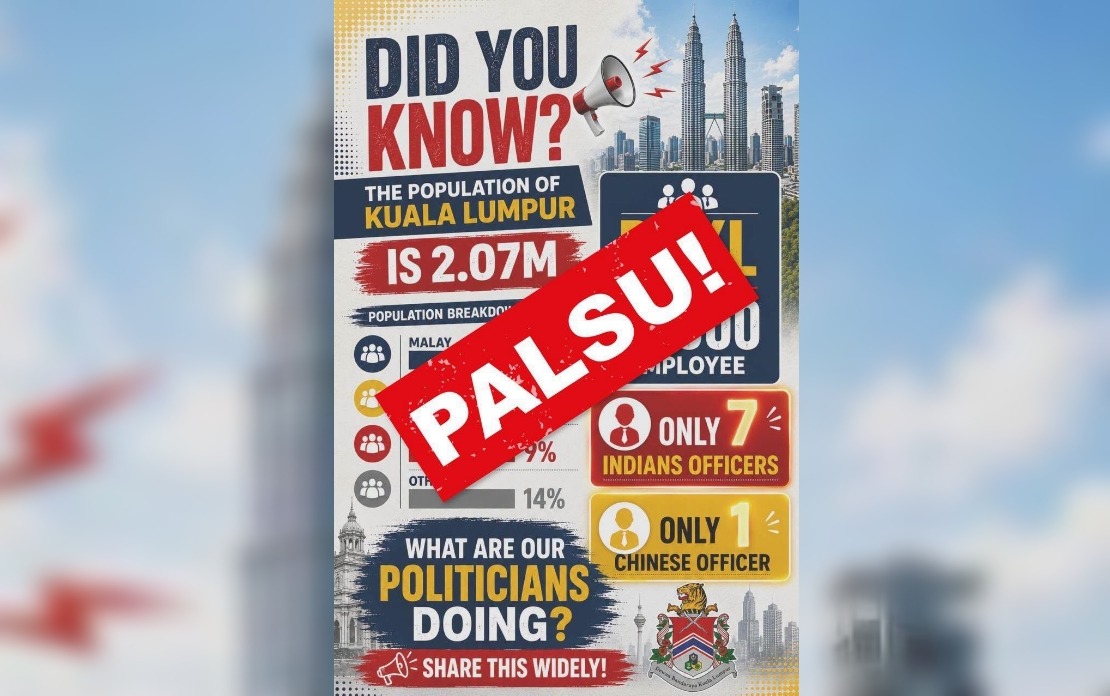
Malaysia's Minister in the Prime Minister's Department for Federal Territories, Hannah Yeoh, has moved to counter what she characterised as deliberate misinformation regarding the ethnic makeup of Kuala Lumpur City Hall's workforce, warning the public against being swayed by inflammatory online posts that have circulated on messaging platforms during the ongoing election campaign period.
Yeoh addressed a WhatsApp poster that made sweeping and inaccurate claims about DBKL's staff composition, alleging the municipal authority employed only seven Indian employees and a single Chinese worker. The minister pointedly rejected these figures as fundamentally misrepresentative of reality, emphasising that such narratives risked inflaming communal tensions at a particularly sensitive political moment. Her public response reflects growing concern among federal leadership about the spread of unverified claims through social media during electoral cycles, a phenomenon that has become increasingly prevalent across Southeast Asia.
According to official records as of July 1, 2026, DBKL's actual headcount stands at 9,131 employees across all categories and grades. Within this cohort, the city hall employs 490 staff members of Indian ethnicity and 22 of Chinese ethnicity—figures substantially higher than those circulated in the misleading poster. When examining professional and managerial positions specifically, DBKL maintains 10 Indian officers and two Chinese officers, indicating representation across higher echelons of the organisation, though Yeoh acknowledged this distribution warrants further examination.
The minister's acknowledgement that diversity and representation within DBKL "can still be improved" represents a measured but significant concession. Rather than dismissing concerns outright, she signalled receptiveness to legitimate grievances while firmly rejecting the particular false claims being weaponised for political purposes. This nuanced positioning allows her to acknowledge systemic gaps without validating the distorted narrative propagated through the viral poster—a distinction crucial in Malaysia's delicate communal landscape where perceptions of unfair treatment in public sector recruitment can rapidly escalate tensions.
In response to the broader issue, Yeoh has instructed DBKL to undertake a comprehensive review spanning multiple dimensions of its human resources management. The directive encompasses examination of recruitment data to identify patterns, evaluation of hiring practices and their potential blind spots, scrutiny of promotion protocols to uncover any implicit biases, and assessment of job advertisement channels to ensure opportunities reach diverse candidate pools. This multilayered approach suggests recognition that improving diversity requires systemic change rather than superficial adjustments, addressing potential barriers at multiple stages of the employment pipeline.
The minister's insistence that all improvements be implemented transparently, fairly, and on a strictly merit-based foundation reflects Malaysia's constitutional principles and the civil service's formal commitment to equitable treatment. By explicitly invoking merit-based criteria, Yeoh attempted to preempt accusations that any diversity initiatives might constitute reverse discrimination—a sensitive political argument in Malaysian discourse. The emphasis on transparency serves a dual purpose: reassuring minorities that the process will be genuinely inclusive while signalling to majority communities that no group will receive preferential treatment.
Yeoh's appeal to all political and community actors to resist exploiting the issue for partisan advantage represents a call for responsible civic conduct during elections. Her specific plea against weaponising workplace demographics to "sow racial discord" acknowledges the potency of communal narratives in Malaysian politics and the responsibility of leadership figures to model restraint. This framing positions genuine reform as distinct from inflammatory rhetoric, offering political actors an opportunity to address legitimate concerns without stoking divisiveness.
The controversy surrounding DBKL's workforce composition reflects broader questions about representation in Malaysia's public sector that periodically surface during electoral contests. Local authorities like DBKL occupy a distinctive position in the governance structure, simultaneously serving as targets for political mobilisation based on ethnic and religious identity while functioning as essential service providers accountable to all residents regardless of background. The tension between these roles often becomes most acute during election seasons when such institutions become focal points for identity-based political messaging.
For Southeast Asian observers, the incident illustrates how false information about public sector employment can rapidly proliferate through encrypted messaging platforms, outpacing official rebuttals and creating persistent public misperceptions. The speed with which misleading claims spread on WhatsApp poses particular challenges for fact-correction efforts, as corrective information often reaches audiences fragmented across competing information ecosystems. Malaysia's experience here mirrors challenges confronted across the region where diverse linguistic and ethnic communities increasingly rely on mobile messaging platforms as primary news sources.
Yeoh's intervention also reflects broader federal government concerns about electoral integrity and the quality of public discourse during campaign periods. The decision to have a cabinet-level minister personally address workforce statistics—rather than leaving the matter to administrative channels—signals that misleading claims about communal representation in public institutions warrant high-level political attention. This priority reflects recognition that perceptions of unfair ethnic treatment in government employment can undermine institutional legitimacy and public confidence in meritocratic systems.
Moving forward, the outcomes of DBKL's human resources review will warrant close monitoring, as they may establish precedents for diversity initiatives across other federal agencies. Malaysian political constituencies have become increasingly attentive to questions of representation in public institutions, and how DBKL implements any resulting reforms could influence both administrative practice and electoral politics in future cycles. The municipality's response will also test whether transparency commitments translate into substantive changes or remain largely symbolic gestures.
The broader lesson for Malaysian governance appears to be that even categorical denials of misinformation require accompanying commitment to systemic review and improvement. Yeoh's dual approach—simultaneously rejecting false claims while ordering institutional self-examination—acknowledges that public scepticism about government institutions often contains kernels of legitimate concern beneath layers of inflammatory rhetoric. Managing this distinction responsibly remains essential for maintaining both electoral integrity and communal harmony throughout Malaysia's plural society.

