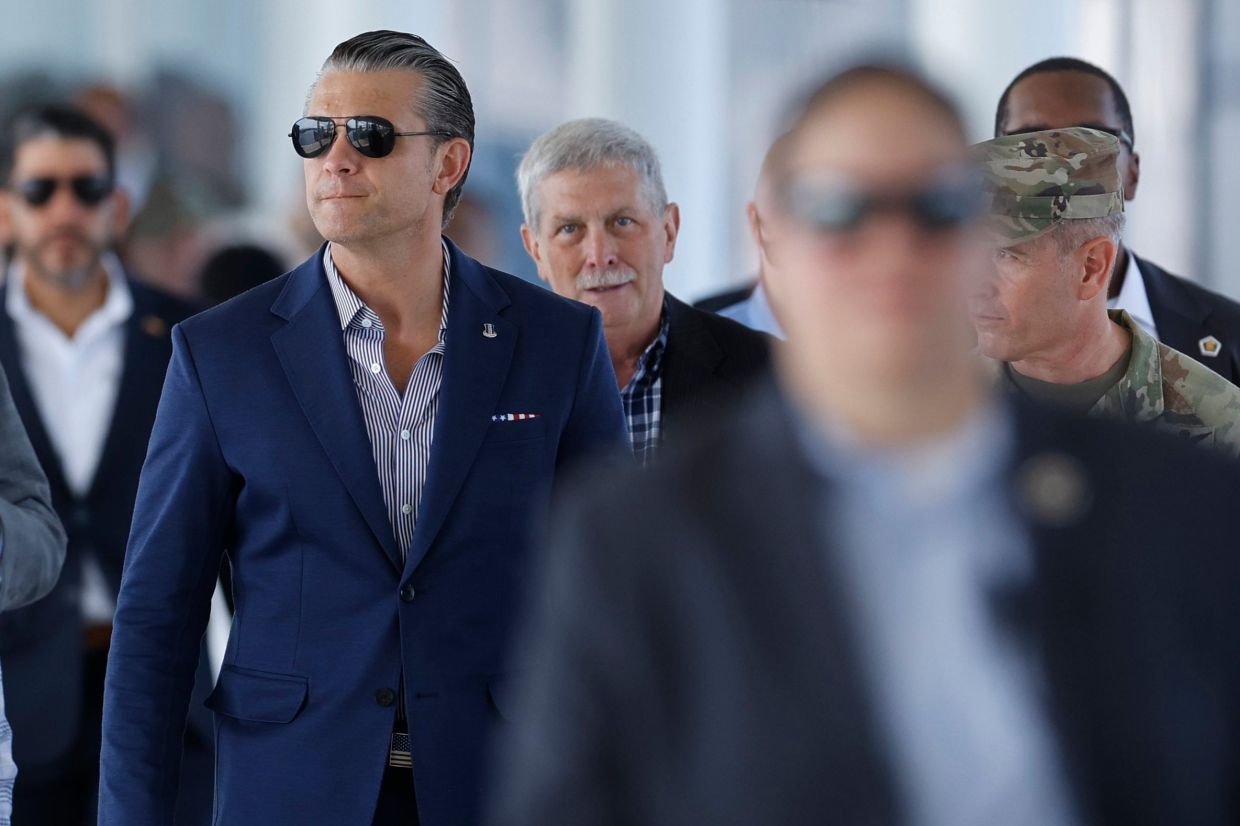
Pentagon leadership instability threatens to unravel a carefully constructed improvement in military relations between Washington and Beijing, according to insiders tracking the administration's defence posture. Sources speaking anonymously have characterised Defence Secretary Pete Hegseth as being "on the verge of losing his job", citing protracted disagreements over Iran strategy combined with sustained negative media attention. The timing of this potential upheaval raises serious questions about continuity in one of the most sensitive diplomatic relationships in the Indo-Pacific region, where any signal of weakness or inconsistency can reverberate across defence planning and strategic alignment.
The improvement in US-China military engagement represents a notable reversal from years of escalating tensions and fractious exchanges. Since President Donald Trump and Chinese leader Xi Jinping convened in Beijing in May, defence establishments on both sides have progressively normalised their interactions. Military-to-military contact has reportedly occurred at virtually every operational level during Trump's second term, with observers characterising the relationship as stronger than it has been for more than a decade. Hegseth himself acknowledged this trajectory weeks after the Beijing summit, telling defence officials that relations had become "better than they've been in many years" and that the military dimension of Trump and Xi's agreement to build a constructive bilateral relationship was yielding tangible progress.
The substance of this improvement became evident when senior American defence officials, including Alvaro Smith, the deputy assistant defence secretary overseeing China, Taiwan and Mongolia portfolios, met with Chinese vice-minister for foreign affairs Ma Zhaoxu in Washington last month. Smith publicly credited Hegseth's leadership for actively restoring what had been a severely damaged military communication channel, emphasising that steady progress was being achieved despite historical animosity. These meetings underscore how dependent current progress is on institutional consistency and the personal relationships that Hegseth has cultivated with his Chinese counterpart, Admiral Dong Jun, including notable engagements in Malaysia and during Trump's Beijing visit.
Analysts studying the Pentagon's strategic direction warn that Hegseth's potential departure could disrupt the institutional memory and personal relationships that underpin current military cooperation. Zhao Minghao, a professor at Fudan University's Institute of International Studies, observed that removal of Hegseth would necessitate rebuilding foundational relationships between defence establishments, a process that could take months and risk reintroducing unnecessary friction. The professor also suggested that Trump might engineer a cabinet reshuffle to assign responsibility for the contentious Iran situation, a tactic historically common ahead of American midterm elections. However, Zhao simultaneously noted that if Hegseth's replacement came from the existing Pentagon hierarchy, particularly if Deputy Assistant Defence Secretary Ely Ratner, known as Colby, retained his position, institutional continuity might be preserved despite leadership transitions at the cabinet level.
Colby's potential staying power appears especially relevant to Beijing's calculus. Chinese officials have reportedly expressed confidence in Colby's approach to military relations, particularly his previous statements characterising Taiwan as not constituting a vital existential interest for the United States. This nuanced positioning, while controversial in Washington policy circles, appears to have created a foundation of mutual understanding with Beijing. The prospect of Colby remaining at the Pentagon even if Hegseth departs suggests that Chinese planners may have already identified an institutional anchor for future engagement, reducing the disruption that might otherwise occur from defence secretary turnover.
The broader context of US-China defence relations extends beyond bilateral military coordination to encompass critical agreements on strategic stability. Trump and Xi's May summit produced a commitment to building relations grounded explicitly in strategic stability, which participants understand to encompass restoration and strengthening of defence exchanges across multiple operational domains. Working-level military contacts have resumed beyond the cabinet level, creating a multiplicity of engagement channels that provide resilience against disruption at any single point. These expanded communication networks represent a deliberate strategy to institutionalise cooperation across numerous relationship nodes rather than concentrating it in the hands of a single official, a lesson learned from previous periods of volatility.
For Southeast Asian readers and regional observers, this Pentagon uncertainty carries practical implications. The stability of US-China military relations fundamentally shapes the security environment across the Indo-Pacific, influencing everything from naval operations in contested waters to cyber defence protocols and intelligence sharing arrangements. Malaysia itself has hosted significant military engagements between American and Chinese officials, positioning the country as a neutral venue for dialogue. Any deterioration in bilateral military relations would likely increase tensions in regional maritime disputes and complicate efforts by middle-power nations to maintain balanced relationships with both superpowers.
US officials quoted anonymously have sought to moderate alarm, suggesting that Hegseth's potential exit would not necessarily derail the trajectory of military cooperation if his successor approaches the relationship with pragmatism rather than ideological rigidity. One source characterised current military-to-military contacts as "very good right now" and suggested that a new defence chief would have minimal impact unless chosen specifically for hostile views toward China. This assessment reflects confidence within the Pentagon's working bureaucracy that institutional interests in maintaining stability transcend individual cabinet officers' tenures. The Pentagon's professional military corps, accustomed to serving multiple administrations, appears determined to preserve channels that senior leadership has explicitly endorsed.
Zhao's analysis suggests that continuity in military exchanges will persist largely because Trump has personally invested political capital in this relationship agenda. The anticipated state visit by Xi to Washington next month will ostensibly offer opportunity to reinvigorate the military dimension of bilateral ties and demonstrate mutual commitment to defence cooperation. This high-level summit may effectively insulate ongoing military engagements from disruption caused by Pentagon personnel changes, as both leaders have reputational interest in demonstrating progress on defence stabilisation regardless of who occupies the defence secretary's chair. The timing of Xi's visit could actually serve to firm up military cooperation commitments before any potential transition in American defence leadership takes place.
The paradox underlying current uncertainty is that both Chinese and American defence establishments have perhaps moved beyond dependence on any single official for relationship continuity. The multiplication of contact points, the explicit strategic agreements on stability, and the bureaucratic investment in military normalisation all suggest that the relationship has acquired sufficient institutional weight to survive personnel transitions that might have derailed it in earlier periods. Yet this institutional resilience should not obscure the real costs of leadership turnover: lost momentum, delayed decisions, and the psychological signals that American commitment may be more fragile than Beijing has been led to believe. For Malaysia and the broader region watching this dynamic, the lesson is that even seemingly solid diplomatic advances require sustained political attention to survive the inevitable churn of government transitions.

