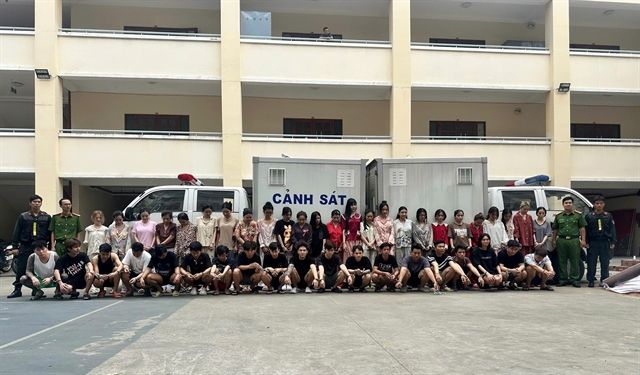
A major law enforcement operation in Ho Chi Minh City has dismantled a sophisticated drug trafficking network that concealed an illegal anaesthetic within flavoured electronic cigarettes, resulting in 49 arrests including four foreign nationals. The operation, announced by the city's drug-related crime investigation police division on Wednesday, represents a significant breakthrough against a criminal enterprise that deliberately targeted young people by disguising toxic substances as trendy vaping products.
The substance at the centre of the investigation is etomidate, a short-acting sedative reserved exclusively for surgical anaesthesia and administered only under strict medical supervision by qualified specialists. Vietnamese authorities moved to restrict this compound by placing it on the government's controlled substances list in January, transforming its illicit distribution into a serious criminal matter. The addition represented a policy response to emerging evidence of misuse within underground recreational drug markets, particularly among younger demographics unaware of the extreme health risks involved.
Investigators discovered that the network had disguised etomidate by mixing it into sweetening compounds added to electronic cigarette pods, then marketing the products under deceptively innocuous brand names designed to appeal to youth culture. Labels such as "chill pod", "relaxation pod", "sleep-well pod" and "fly pod" created an illusion of harmless recreational products. The trafficking infrastructure deliberately positioned these items in venues frequented by young people, including bars, karaoke establishments, and rental apartments where social consumption occurs, maximising exposure to vulnerable demographic groups.
The breakthrough originated when authorities received intelligence regarding a street-level distributor operating under the nickname Ba Giá along An Duong Vuong Street in An Lac Ward. Investigators subsequently identified this individual as Nguyen Huu Huan, a 28-year-old from Dong Thap Province in the southern Mekong Delta region. Huan and his wife, Ngo Thi Kim Chi, 30, were apprehended on June 25 after attempting to sell etomidate-laced vapes to Tran Phuc, a 31-year-old Ho Chi Minh City resident, establishing the crucial foundation for the broader investigation that followed.
Further enforcement action revealed the existence of multiple parallel supply chains feeding the retail distribution network. One operation was controlled by Huynh Ngoc Thuy Nhu, 26, working alongside Hua Tuong Vy, 20, both based in Ho Chi Minh City. A second major supplier group was led by Le Quoc Duy, 40, from An Giang Province, who orchestrated a smuggling operation that imported contraband vapes across the Cambodia-Vietnam border through remote crossing points before transporting them northward to Ho Chi Minh City for distribution. Officers recovered 37 vape pods from Duy's location, alongside 200 grams of ketamine and 200 grams of methamphetamine, indicating diversification into multiple drug categories. A third supplier network involved Han Kiat, a Cambodian national, and three additional foreign accomplices who specifically targeted expatriate communities residing in Ho Chi Minh City.
The overall enforcement action resulted in seizure of 1,670 vape pods containing illicit substances. This substantial quantity underscores the considerable scale of the enterprise and the volume of contaminated products that potentially circulated through Ho Chi Minh City's youth entertainment venues before law enforcement intervention. Among the four foreign nationals arrested, two were identified as South Korean nationals, while the remaining two comprised one Chinese national and one Cambodian national, illustrating the transnational character of the trafficking operation.
The health implications of etomidate inhalation represent a critical public health concern that distinguishes this case from conventional drug enforcement matters. When inhaled through vaping devices, etomidate bypasses normal absorption mechanisms and enters the bloodstream directly via pulmonary tissue, reaching the brain within seconds and producing effects dramatically faster than oral or nasal routes. Initial sensations may seem benign, manifesting as light-headedness or mild visual hallucinations that create a deceptive impression of safety. However, acute exposure can trigger severe neurological consequences including neurotoxicity, profound drowsiness, involuntary muscle contractions, and complete loss of consciousness. Particularly alarming is the potential for fatal respiratory arrest, a risk magnified substantially when users combine etomidate with alcohol or other central nervous system depressants—a highly probable scenario given the social settings where these products are consumed.
A critical vulnerability exploited by traffickers involves the detection capabilities available to consumers and casual enforcement personnel. Standard rapid test kits sold commercially detect traditional controlled substances including heroin, cannabis, and methamphetamine, but prove entirely ineffective against etomidate due to its distinct molecular structure. Criminals deliberately leveraged this detection gap, advertising the vapes as "undetectable" or "100 per cent negative" on rapid tests, falsely reassuring potential buyers that the products would avoid triggering typical screening mechanisms. Only sophisticated forensic laboratory systems operated by police and specialised agencies possess the analytical capability to accurately identify etomidate, creating a dangerous asymmetry where ordinary consumers and even law enforcement operating with portable equipment cannot distinguish contaminated products from legitimate nicotine vapes.
The Ho Chi Minh City case carries significant implications for regional drug enforcement and public health authorities across Southeast Asia. The operation demonstrates the rapid evolution of trafficking methodologies, with criminal networks exploiting emerging technologies and chemical compounds to circumvent traditional regulatory frameworks and consumer awareness. The cross-border dimension, particularly the smuggling corridor from Cambodia through An Giang Province, suggests the existence of broader regional supply networks that may extend beyond Ho Chi Minh City. Malaysian authorities and enforcement agencies in other ASEAN nations should monitor for similar operations, as the same distribution model could feasibly be replicated in other urban centres with substantial expatriate populations and active nightlife sectors.
Law enforcement's ability to dismantle the network relied on community intelligence and systematic follow-the-supply-chain methodology, tracing retail distribution back through intermediate wholesalers to international smuggling operations. The identification of multiple independent supply networks operating within the same geographic market suggests significant unmet demand, indicating that police interventions target only a portion of the broader market. The apparent sophistication of the marketing strategy—including selection of appealing product names and strategic venue placement—suggests professional criminal enterprise rather than opportunistic street-level dealing.
Authorities have emphasised prevention and community awareness as essential components of the response strategy. Police warnings specifically cautioned young people against consuming e-cigarettes of unknown origin and against believing online marketing claims regarding product safety. The enforcement messaging highlighted the particular vulnerability of youth who may view vaping as safer than traditional smoking or be drawn to products marketed as fashionable and trendy. Educational efforts must contend with the sophisticated marketing capabilities of criminal networks that exploit social media and peer influence mechanisms far more effectively than conventional public health communications.
The case underscores a fundamental challenge confronting Southeast Asian governments: the rapid pace of innovation within illicit drug markets outpaces regulatory and enforcement responses. Etomidate was added to Vietnam's controlled substances list only in January, yet evidence suggests trafficking had already become organised and widespread by June when authorities initiated arrests. Regional cooperation mechanisms, intelligence sharing among ASEAN law enforcement agencies, and harmonisation of substance control listings will become increasingly necessary to address transnational trafficking operations that exploit regulatory gaps and jurisdictional boundaries. For Malaysian readers, the Ho Chi Minh City case provides instructive evidence of sophisticated drug networks operating in the region and the types of novel products and marketing strategies likely to appear in local markets if preventive measures are not implemented proactively.

