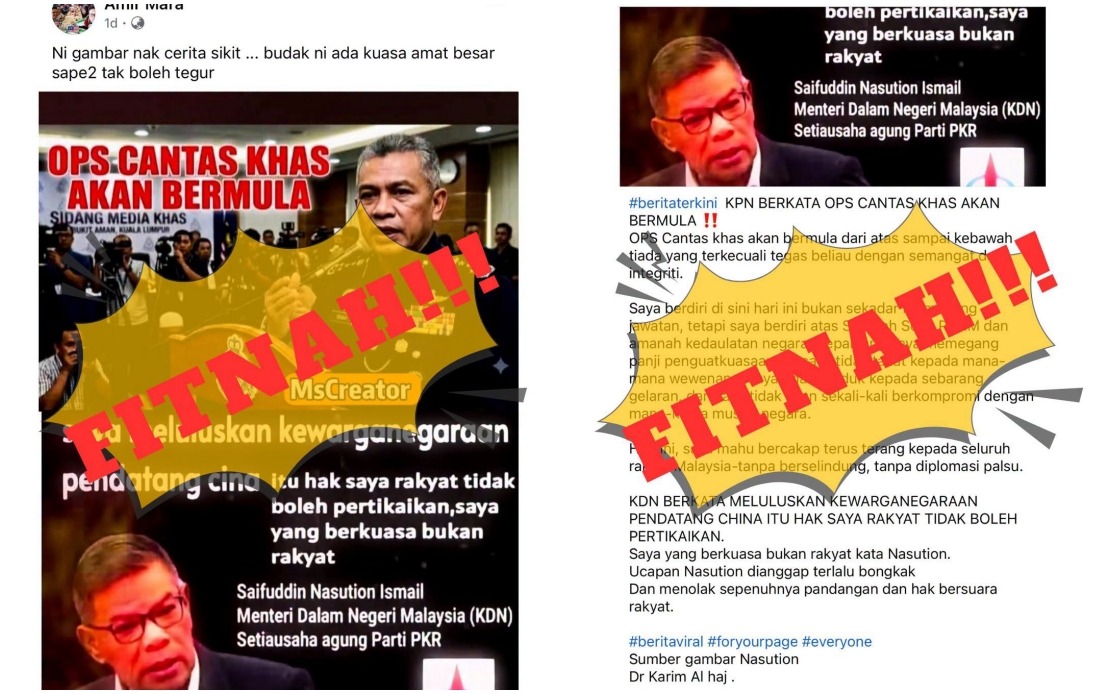
Home Minister Datuk Seri Saifuddin Nasution Ismail has categorically denied allegations that the Home Ministry (KDN) facilitated mass citizenship grants to foreign nationals, rejecting claims that 1.2 million Chinese nationals have unlawfully remained in the country. Speaking in Putrajaya on August 19, the minister stressed that he has addressed these charges repeatedly through official channels and supported statements with documented data.
The denial comes amid a resurgence of social media content circulating unfounded claims about citizenship irregularities. Saifuddin characterised the ongoing spread of such narratives as a deliberate strategy to mislead the public, noting that identical accusations have been previously debunked and corrected through official government communications. The minister expressed frustration that despite his repeated clarifications, certain groups continue to repurpose outdated videos, posters and talking points to revive these discredited allegations.
Saifuddin emphasised that the misinformation carries serious consequences beyond reputation damage. He warned that the dissemination of such false claims erodes public confidence in government institutions, a critical concern in a diverse, multi-racial society where institutional credibility underpins social stability. The minister further noted that deliberately spreading unsubstantiated claims about citizenship and foreign nationals risks igniting communal tensions and fuelling racial animosity—particularly sensitive matters in Malaysia's complex demographic landscape.
The minister's statement reflects broader concerns about how misinformation weaponises sensitive national issues. By conflating immigration policy with racial demographics, these false narratives tap into existing anxieties about population composition and national identity. In the Malaysian context, where citizenship and belonging remain emotionally charged topics, such claims can rapidly gain traction among communities already concerned about demographic change. Saifuddin's intervention suggests the government views this particular misinformation campaign as sufficiently corrosive to warrant direct ministerial response.
Calling for greater public responsibility in information consumption and sharing, Saifuddin urged citizens to verify claims through official sources before accepting or disseminating them. He highlighted the distinction between facts and narratives, stressing that data derived from government records cannot be overridden by unsubstantiated allegations circulating on digital platforms. This appeal reflects the growing challenge governments worldwide face in combating misinformation in the social media age, where unverified content can spread faster and more widely than official clarifications.
The minister's statement also implicitly addresses the political dimension of the misinformation. He cautioned against exploiting sensitive issues for political advantage or social media engagement, suggesting that the recycled claims serve tactical purposes for certain actors. This framing positions the citizenship allegations within a larger pattern of weaponised misinformation designed to mobilise political constituencies rather than genuine substantive debate about immigration or naturalisation policy.
Saifuddin's emphasis on institutional credibility reflects Malaysia's experience with communal tensions. Public confidence in state institutions—particularly those handling sensitive matters like citizenship and security—remains foundational to maintaining social cohesion in a multiethnic democracy. When misinformation targets these institutions, it potentially undermines not just the agencies involved but the broader legitimacy of government operations. The minister's repeated assertions that official data contradicts these claims represent an attempt to restore faith in institutional integrity.
The Home Ministry's position illustrates the difficulty governments face in countering persistent misinformation, particularly when false narratives address underlying public anxieties about demographic and social change. Even when officials provide factual rebuttals, such responses may reach only fraction of audiences who encounter the original claims. The viral nature of social media ensures that refutations often struggle to match the reach and emotional resonance of emotionally charged allegations.
For Malaysian readers, this controversy underscores the importance of media literacy and critical engagement with online content. Claims about immigration, citizenship and demographic composition merit scrutiny, particularly when they circulate without substantiation from official sources. As digital platforms continue shaping political discourse, individual responsibility in verifying information before sharing becomes increasingly critical to maintaining informed democratic participation and preventing the weaponisation of sensitive communal issues.

