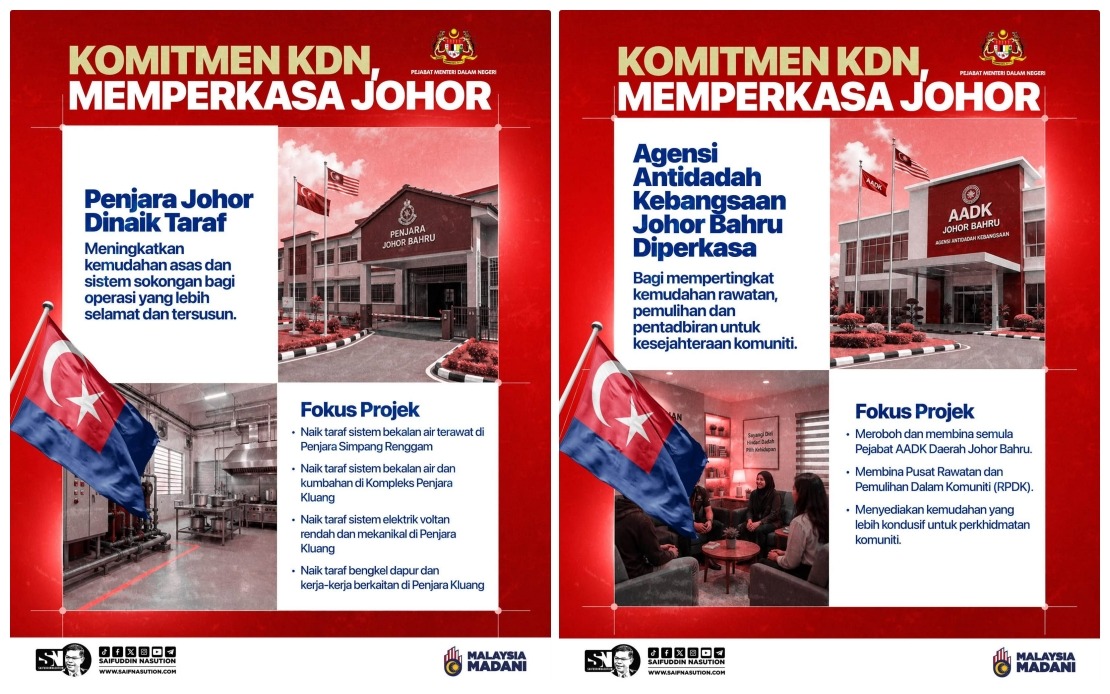
The Home Ministry has signalled a comprehensive push to modernise Johor's security infrastructure and public service capacity through a slate of coordinated development projects spanning multiple agencies. Datuk Seri Saifuddin Nasution Ismail, the Home Minister, emphasised that the state's geographic and strategic importance as a gateway to Malaysia and a regional security hub demands sustained investment in both operational facilities and personnel support.
Johor's significance extends beyond its position as Malaysia's southernmost peninsula state. The region serves as a crucial junction for immigration flows, international trade corridors, and maritime operations along the Straits of Johor. This strategic location necessitates robust institutional capacity across the agencies responsible for border management, law enforcement, and public order. The Home Ministry's portfolio includes responsibility for coordinating these disparate services, making Johor a test case for integrated security governance in Malaysia's most dynamic trading zone.
The Royal Malaysia Police component of the programme addresses long-standing infrastructure gaps. The construction of dedicated district police headquarters in Segamat and Pengerang represents an effort to decentralise operational capacity and reduce response times in these peripheral areas. Complementing these new facilities are planned maintenance and upgrade works for existing police quarters and lift systems across the state, initiatives that speak to personnel welfare and workplace safety standards. For a force managing one of Malaysia's highest-traffic land borders, adequate infrastructure translates directly into operational effectiveness.
Immigration facilities occupy a prominent place in the ministry's Johor strategy, reflecting contemporary pressures on Malaysia's borders. The Sultan Iskandar Building and Sultan Abu Bakar Complex, both critical nodes in the state's immigration administration, are slated for comprehensive upgrades designed to enhance processing efficiency and service quality. These facilities handle millions of cross-border movements annually, from daily commuters to commercial traffic. Modernisation of these facilities addresses both capacity constraints and the need to project professional border management standards consistent with international norms.
The National Registration Department's planned office in Batu Pahat extends the ministry's reach into civilian services. Identity documentation and registration remain foundational to state capacity and public service access. A dedicated district office in Batu Pahat, an area of growing residential expansion, anticipates demographic pressures and reduces administrative burden on existing facilities. This mirrors broader patterns of administrative decentralisation across Malaysia's local government structures.
Prison system upgrades at Kluang and Simpang Renggam address systemic challenges within Malaysia's detention infrastructure. Basic systems improvements suggest attention to operational fundamentals—sanitation, power supply, security systems—that underpin humane and secure custodial environments. These facilities serve not only Johor but also neighbouring regions, making their capacity and standards matters of regional consequence. Investment in these facilities reflects both professional prison management standards and recognition of rehabilitation infrastructure needs.
The National Anti-Drugs Agency components of the programme indicate sustained commitment to the ministry's broader public health and security agenda. Drug enforcement and treatment capacity remain critical policy priorities across Malaysia, particularly in states with active trafficking routes. The redevelopment of AADK offices and treatment centres in Johor suggests a shift toward integrated service delivery combining enforcement with treatment and rehabilitation pathways.
Maritime operations received particular emphasis through the planned upgrades to jetty and building infrastructure at Abu Bakar Maritime Base. The Malaysian Maritime Enforcement Agency operates within Johor's waters, managing fishing jurisdiction, smuggling interdiction, and maritime security. Enhanced facilities for personnel and modern operational bases strengthen Malaysia's capacity to enforce maritime sovereignty across crucial sea lanes and fishing grounds. This dimension of the ministry's programme reflects growing regional competition for maritime resources and security challenges.
Coordinating these diverse projects across multiple agencies presents genuine operational challenges. The Home Ministry's approach of centralising planning and resource allocation across PDRM, the Immigration Department, JPN, the Prisons Department, AADK, and MMEA represents an attempt to achieve integrated governance within a fragmented institutional landscape. Success depends on sustained funding, interagency coordination mechanisms, and clarity regarding maintenance responsibilities post-completion.
The announcement's timing, arriving as Johor prepared for state elections with approximately 2.7 million registered voters choosing 56 state assemblymen, invites scrutiny regarding political motivation. Infrastructure announcements by federal ministers addressing state-level constituencies inevitably intersect with electoral politics. However, the specific projects outlined reflect genuine infrastructure gaps and operational necessities. The substantive question is whether these initiatives represent long-term institutional commitment or temporary campaign positioning.
For Malaysian readers and businesses dependent on Johor's security and administrative functions, the announced projects signal federal priority accorded to the state's development. Improved police responsiveness, immigration efficiency, and maritime enforcement create tangible benefits for commerce, travel, and public safety. The ministry's framing—emphasising that allocations deliver direct benefits to both personnel and the public while strengthening preparedness—reflects an integrated approach to institutional development.
Regionally, Johor's security infrastructure improvements carry implications extending beyond Malaysian territory. As a gateway state managing cross-border flows with Singapore and serving as a transit point for regional commerce, improvements in Malaysian institutional capacity affect the entire Straits Region. Enhanced border management, maritime surveillance, and law enforcement coordination contribute to wider regional stability and facilitate legitimate economic activity.
The Home Ministry's commitment to ongoing Johor development reflects recognition that security and public service infrastructure require sustained investment rather than episodic attention. Whether these announced projects materialise on schedule and within budget will determine their actual impact on operational capacity and public service delivery. For Johor's residents and businesses, the practical test of institutional improvement lies not in announcements but in measurable enhancements to security, efficiency, and service accessibility.

