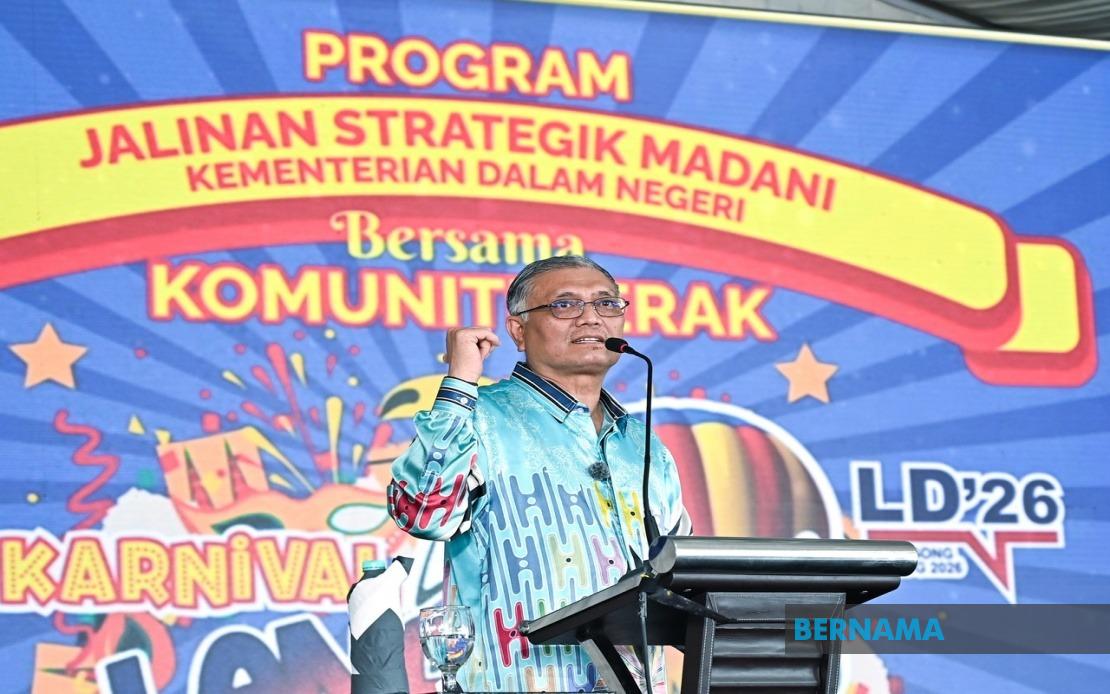
The Home Ministry's MADANI Strategic Partnership Programme has demonstrated the government's commitment to decentralising public services and fostering meaningful dialogue between federal agencies and grassroots communities. The two-day initiative, which unfolded at Dataran Lenggong in Perak, exemplified a deliberate shift towards making bureaucratic processes more accessible and responsive to citizens outside major urban centres, a significant priority for the MADANI framework that emphasises inclusive governance and community participation.
Deputy Home Minister Datuk Seri Dr Shamsul Anuar Nasarah, who also serves as Lenggong's Member of Parliament, officially inaugurated the programme with the explicit aim of dismantling barriers between security agencies and the populations they serve. His remarks underscored a fundamental principle underlying the initiative: government institutions must venture beyond their offices to meet citizens where they live and work. By positioning the event at a public gathering space, organisers created an environment where residents could engage with officials on familiar ground, reducing the intimidation or formality often associated with government interactions.
The programme structure reflected careful planning to blend entertainment with functionality, recognising that community engagement requires more than transactional service delivery. Religious talks, children's colouring competitions, and creative performances created an inclusive atmosphere that encouraged family participation and made the occasion feel like a genuine community celebration rather than a sterile administrative exercise. This approach acknowledges that public trust in government institutions grows when citizens experience them as responsive human organisations rather than distant bureaucracies.
Operational aspects of the initiative proved particularly valuable for residents. The various service counters staffed by Home Ministry agencies—including the Royal Malaysia Police, the Immigration Department of Malaysia, and the National Anti-Drugs Agency—enabled people to accomplish administrative tasks that would normally require travel to distant offices or navigation of complex appointment systems. The strong engagement these counters received indicates genuine public demand for decentralised government services, a pattern that should inform future policy development regarding service accessibility across Malaysia.
The programme's emphasis on two-way communication represents an important dimension often overlooked in conventional government outreach. By framing the event as a platform for dialogue rather than merely information dissemination, the Home Ministry signalled willingness to listen to community concerns about security, drug abuse, and grassroots safety issues. This consultation approach strengthens the evidence base for policy decisions and builds public confidence that citizen perspectives shape institutional priorities.
The inclusion of sporting activities, specifically a Fun Ride and Fun Run involving approximately 1,190 participants organised by the People's Volunteer Corps and the National Anti-Drugs Agency, served multiple objectives simultaneously. Beyond promoting physical fitness and healthy living, the activities generated outdoor engagement in Lenggong's distinctive landscape, leveraging the area's status as part of the Lenggong Valley UNESCO World Heritage Site. This strategic integration of heritage awareness with community health promotion demonstrates sophisticated event planning that combines messaging about government priorities with celebration of local assets.
Lenggong Valley's recognition as a UNESCO World Heritage Site adds cultural significance to the programme's location choice. By situating government engagement activities within a space already designated for its historical and archaeological importance, organisers highlighted the connection between contemporary governance and long-standing community identity. This geographical strategy reinforces to residents that their region merits attention from federal institutions and resources, countering perceptions that benefits and opportunities concentrate exclusively in Kuala Lumpur and other major cities.
The programme's focus on community-agency collaboration carries particular relevance for Southeast Asia's broader security and public health landscape. Drug trafficking, transnational crime, and irregular migration remain pressing regional challenges requiring sustained community cooperation with enforcement agencies. By establishing trust and dialogue mechanisms at grassroots level, initiatives like MADANI create foundations for intelligence gathering, community reporting, and coordinated prevention efforts that centralised approaches cannot achieve.
For Malaysian residents, the decentralised service delivery model demonstrated in Lenggong offers practical benefits that should expand regionally. Eliminating the need for long-distance travel to update records, seek counsel, or lodge formal complaints reduces transaction costs and administrative friction, particularly for lower-income populations with limited mobility. This accessibility dimension addresses inequality in government service quality between urban centres and peripheral regions, a persistent challenge in Malaysia's federal system.
The programme's integration of volunteer bodies and community organisations, evidenced by RELA's participation, reflects recognition that government capacity alone cannot sustain continuous community engagement. By building partnerships with civil society groups, the Home Ministry extends its operational reach and taps local knowledge networks that bureaucracies struggle to develop independently. This collaborative approach strengthens civil society-government relationships essential for social cohesion in diverse, complex societies.
Moving forward, the MADANI programme's apparent success in Lenggong suggests potential for replication across other Malaysian communities, particularly in states where government engagement remains sporadic or limited. However, sustainability requires sustained resource allocation and genuine commitment to incorporating community feedback into policy adjustments. If the programme devolves into episodic events without institutional follow-up or genuine incorporation of citizen input, its long-term credibility and impact will diminish, undermining the trust-building objectives it currently advances.
The Lenggong initiative ultimately reflects broader MADANI framework ambitions to reshape government-citizen relations around accessibility, transparency, and shared problem-solving. Whether similar programmes across Malaysia can consistently deliver these outcomes while managing implementation challenges remains an open question, but the strong community response in Perak provides an encouraging foundation for expansion and refinement of this decentralised engagement model.

