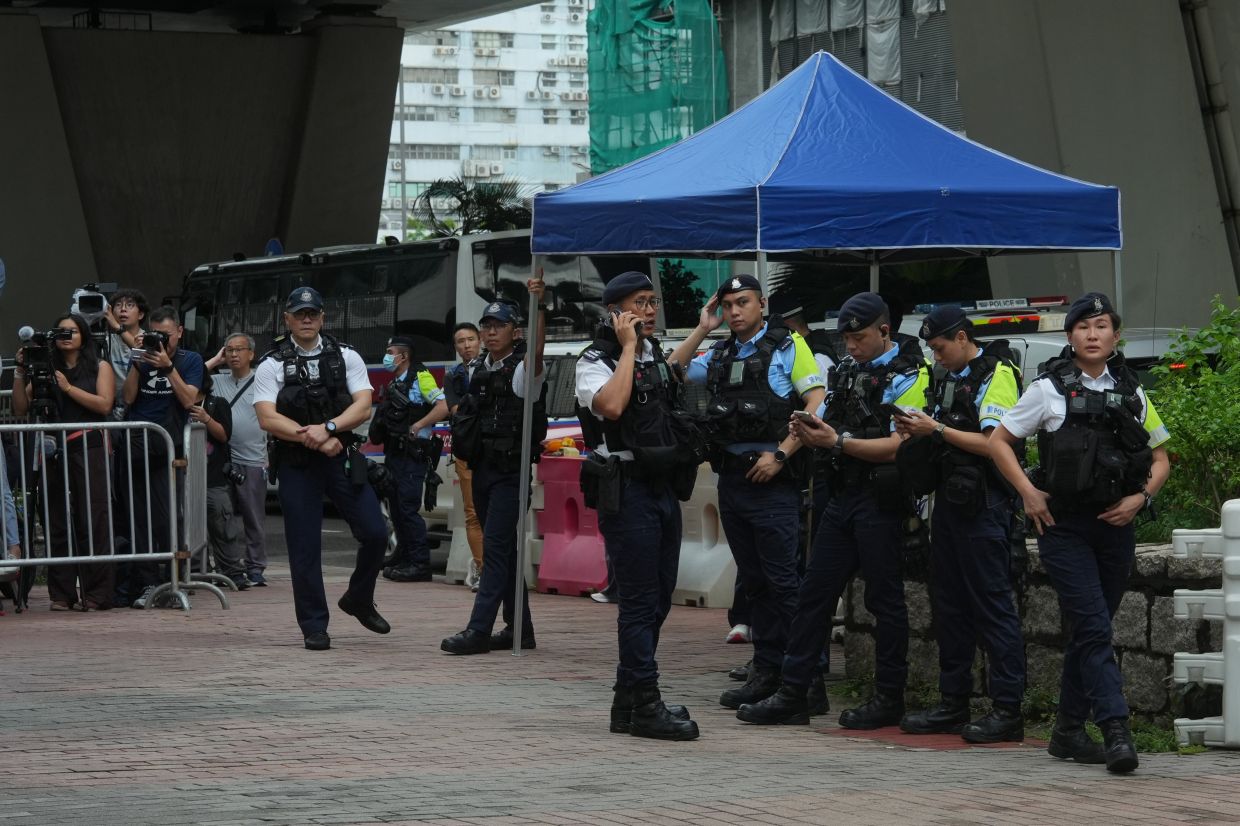
Hong Kong police have detained a woman accused of wearing a seditious T-shirt outside West Kowloon Court, marking another flashpoint in the city's intensifying enforcement of national security legislation. The arrest occurred last week on suspicion of disorder in a public place, obstructing police, and acting with seditious intention, the force announced Monday night. Police provided minimal detail about the operation, stating only that it was designed to "ensure public safety and order" without elaborating on the specific circumstances or evidence surrounding the case.
The timing of the arrest proved particularly significant, unfolding mere hours before judges handed down guilty verdicts against two prominent pro-democracy figures: Lee Cheuk‑yan, former chairman of the Hong Kong Alliance in Support of Patriotic Democratic Movements of China, and Chow Hang‑tung, the alliance's former vice-chairwoman. The detention occurred in the early morning darkness, shortly after 5am on Friday, as more than 50 individuals gathered outside the courthouse to hear or cover the landmark judgment. Eyewitnesses present at the scene described a plain-clothes officer approaching the detained woman and escorting her into a police vehicle in what observers characterised as a targeted action amid the broader crowd.
Accounts from those at the courthouse suggest the woman had been wearing a black T-shirt bearing Japanese characters, though the precise nature of the alleged seditious content and the reasoning behind the arrest remain opaque. Media personnel who captured the incident on camera reported that officers subsequently directed journalists to leave the scene as the woman was removed. The episode reflects an increasingly assertive approach by authorities toward public expressions of dissent, regardless of how oblique or ambiguous such expressions might appear to observers unfamiliar with the symbols or language involved.
The arrests and convictions must be understood within the context of Hong Kong's evolving legal landscape under the national security law, implemented in 2020 following the pro-democracy protests of 2019. Lee, Chow, and the Hong Kong Alliance faced prosecution for inciting subversion after calling for an end to "one-party dictatorship" in mainland China—a position that authorities determined crossed legal thresholds under the security legislation. The alliance itself has since been disbanded, and the organisation's dissolution removes one significant institutional channel through which pro-democracy advocacy had historically been organised.
The High Court's 216-page ruling, delivered by three judges, articulated a sweeping interpretation of what constitutes subversion under the law. The judges held that any attempt to overthrow or undermine the Communist Party of China's leadership could satisfy the definition of subversion, and crucially, that the Chinese constitution as interpreted by authorities does not permit Western-style democracy. This reasoning essentially forecloses certain categories of political speech and activism that might be tolerated in other jurisdictions, creating a landscape where even historical democratic aspirations become legally precarious.
Lee Cheuk‑yan, who previously served as a lawmaker, and Chow Hang‑tung, a practising barrister, have both been held in custody for nearly five years awaiting trial and verdict. Their extended pre-conviction detention raises concerns about due process and the pace of judicial proceedings in national security cases. A fourth defendant, Albert Ho Chun‑yan, the alliance's former vice-chairman, has endured detention for more than four years and remains awaiting sentencing after entering a guilty plea in January, adding another layer to the evolving legal consequences facing key figures in the pro-democracy movement.
For Malaysian observers, these developments carry particular resonance given the region's own complex relationship with free expression, assembly, and national security legislation. While Malaysia has not adopted legislation as extensive as Hong Kong's national security law, the region faces recurring tensions between security imperatives and democratic freedoms. The Hong Kong experience demonstrates how security frameworks, once enacted, can expand significantly in scope and interpretation, with courts providing expansive readings that move beyond their ostensible original purpose.
The incident involving the woman's T-shirt exemplifies how enforcement of such laws has become proactive and expansive, potentially reaching everyday clothing choices and symbolic expressions. The decision to arrest someone based on unclear messaging on a garment, coupled with minimal disclosure about the grounds for detention, suggests authorities are operating within a framework that grants substantial discretion in determining what constitutes seditious content. This approach contrasts sharply with legal traditions that require clarity about prohibited conduct and proportionality in enforcement.
The convergence of the woman's arrest with the timing of the verdicts also suggests a deliberate strategy by authorities to establish control over the courthouse environment and suppress visual symbols of dissent during high-profile proceedings. By removing individuals wearing potentially provocative clothing before the verdict delivery, police may have aimed to prevent the emergence of powerful visual narratives that could undermine the message the verdicts were intended to convey. Such tactical deployment of law enforcement around significant political trials raises questions about the instrumentalisation of criminal law for broader political management objectives.
As Southeast Asian governments grapple with their own national security challenges and consider legislative responses, the Hong Kong situation offers cautionary lessons about how security frameworks can metastasise and reshape the legal terrain around political expression. The region's democracies and hybrid political systems must reckon with the tension between genuine security requirements and the preservation of meaningful political participation and dissent. Without clear legal boundaries and consistent judicial interpretation, security laws risk becoming tools for suppressing legitimate opposition and debate.
The cases of Lee, Chow, and Ho represent a definitive moment in Hong Kong's post-2020 trajectory, marking the successful prosecution of figures who operated within what had previously been understood as established parameters of political activism. Their convictions signal that those parameters have shifted dramatically, and that even long-standing democratic practices now carry legal jeopardy. For activists, political organisations, and ordinary citizens across the region, the implications extend beyond Hong Kong's borders, prompting reflection on how security legislation shapes political possibilities and constrains the expression of dissent.

