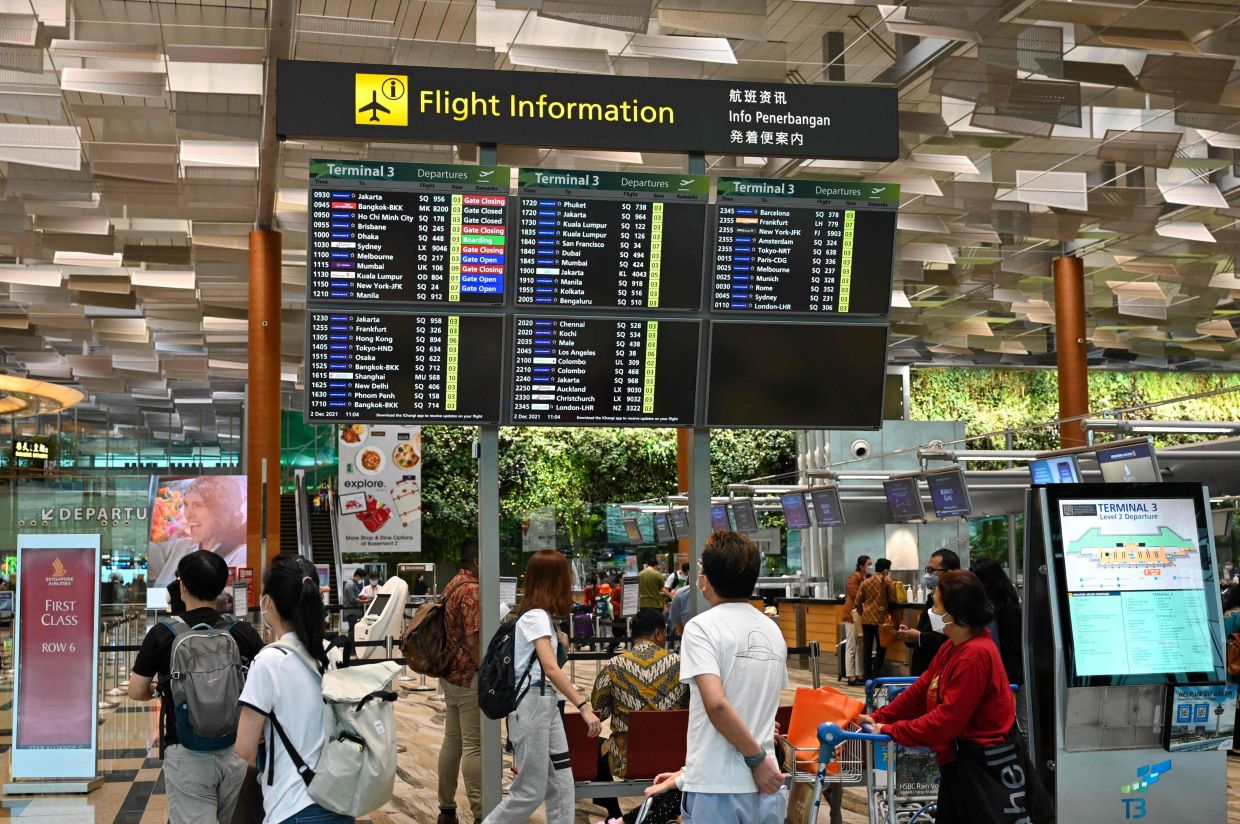
A Singapore court has imposed prison sentences on a Hong Kong mother and her adult son for their involvement in a violent confrontation at Changi Airport that resulted in injuries to both a civilian bystander and a police officer. Chan Sui-kwan, aged 65, received a six-month jail term for voluntarily causing hurt to a public servant with the intent to obstruct his duties, while her son, Chan Wing-kwan, aged 42, was sentenced to ten days imprisonment for causing hurt. The convictions concluded a legal process that stretched nearly eighteen months from the time of the incident in June 2024 to the final sentencing.
The altercation unfolded in the afternoon of June 30, 2024, within Singapore's Changi Airport Terminal 3, an incident that would involve multiple escalations across different areas of the facility. The initial trigger stemmed from what court documents indicate was a misunderstanding on the son's part—he became visibly agitated after forming the mistaken belief that nearby passengers were mocking him. This emotional reaction led him to direct physical aggression toward his own mother, kicking her as tensions mounted within the terminal.
When a 69-year-old bystander noticed the disturbance and approached to offer assistance to the injured woman, his intervention introduced a second party into the conflict. The mother responded by instructing him to step away, while simultaneously her son adopted an overtly hostile posture, aggressively inviting the man to engage in a physical fight. What began as an intra-family conflict was rapidly transforming into a broader public safety concern affecting airport operations.
The situation deteriorated sharply when the confrontation relocated to another floor within Terminal 3's complex layout. There, the son assaulted his mother again with another kick, escalating the physical violence. When the concerned bystander attempted to summon police assistance by making a call, the son's response was immediate and aggressive—he rushed toward the man in an apparent attempt to prevent him from contacting authorities. This action set off a violent scuffle between the two men.
During their struggle, the son unleashed a series of punches directed at the bystander, inflicting significant injuries. The civilian sustained a head haematoma—a potentially serious condition involving pooled blood beneath the skin—in addition to abrasions on his knees and bruising to his fingers. The accumulated injuries painted a picture of sustained and deliberate violence rather than a momentary loss of control.
Initial police response to the incident saw officers arrive at Terminal 3 and conduct preliminary investigations. The authorities recorded the passport details of both the mother and son but, at that stage, returned their travel documents without taking further immediate action. This decision would prove consequential in the events that followed.
However, the situation remained unresolved when police encountered the pair again later that same afternoon in the airport's departure hall. At this juncture, the mother refused to surrender her passport to authorities and began causing a disturbance, leading officers to place her under arrest. Her response to lawful police authority was to resist physically, resisting officers with significant force. During this resistance, she bit a police officer on his right forearm, penetrating through the fabric of his uniform to leave a one-centimetre mark and visible bruising on the officer's skin—an act that would form the basis of one of the more serious charges against her.
The legal proceedings that followed were complicated by delays and procedural matters. The mother did not appear in court until November 18, 2024, a gap of nearly five months after the incident. Her son faced charges that were formally laid on April 24 of the previous year, indicating an extended investigation period. Most significantly, both individuals failed to appear on their scheduled court date of July 22, which triggered the issuance of an arrest warrant and indicated that locating and apprehending them had presented challenges to Singapore authorities.
The convictions were ultimately entered on July 29, with sentencing delivered the following Monday. The mother's six-month sentence reflected the severity of resisting a police officer and causing injury to him while attempting to obstruct his official duties—charges that carry greater weight in Singapore's legal framework than simple assault between private citizens. The son's lighter ten-day sentence, while still resulting in custody, acknowledged that his primary offense involved the assault on the bystander rather than direct resistance to police authority.
This incident underscores the serious consequences that can result from uncontrolled behavior in high-traffic public spaces such as major airports. Changi Airport, one of Southeast Asia's busiest aviation hubs, serves hundreds of thousands of passengers monthly and operates under strict security and safety protocols. Violent altercations within its terminals pose risks not only to the individuals involved but to the broader traveling public and to airport security personnel.
For Malaysian travelers and residents, the case serves as a reminder of the importance of maintaining composure in airport environments and the serious legal jeopardy that can follow from assaulting police officers or resisting lawful arrest across the region's borders. Singapore's courts have demonstrated consistent willingness to impose custodial sentences for airport violence, particularly when public servants are injured in the line of duty.
The extended timeline from incident to final sentencing also highlights how serious criminal matters can require substantial investigation and legal processing time. The gaps between the initial offense, the court appearances, and the final resolution suggest that both the mother and son may have attempted to avoid the legal consequences through absence, which ultimately led to complications in the proceedings and the issuance of warrant for arrest before their eventual conviction and sentencing.

