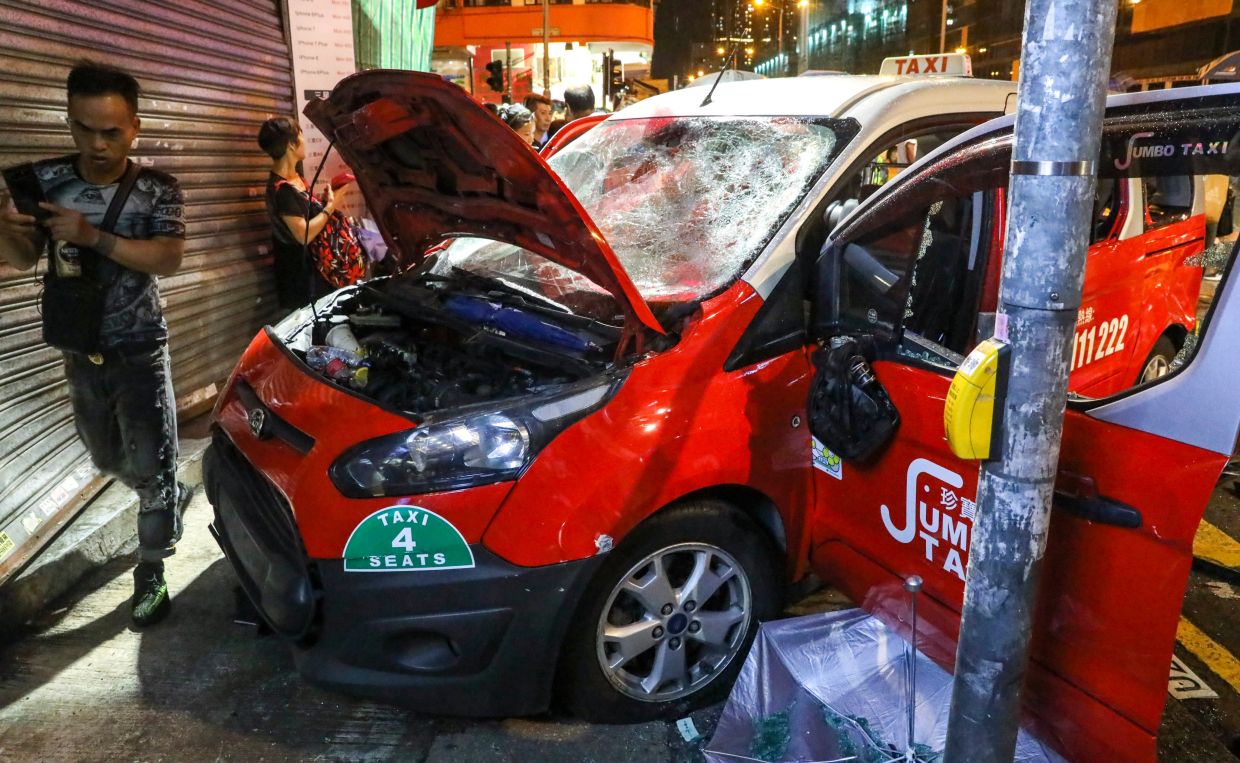
A Hong Kong kindergarten clerk severely injured when a taxi mounted a pavement and hit her during the 2019 pro-democracy demonstrations has launched a legal battle to recover at least HK$8.4 million (approximately US$1.07 million) in damages from the vehicle's driver. The case, heard before Mr Justice Simon Leung Chun-man, highlights the lingering consequences of the turbulent period and raises thorny questions about liability and victimhood during episodes of civil unrest that claimed many casualties on both sides.
Park Hoi-lam's legal team argued in court this week that taxi driver Henry Cheng Kwok-chuen failed to exercise reasonable care when his vehicle struck both her and another woman on Yen Chow Street in Sham Shui Po on October 6, 2019. The plaintiff's counsel, Susanna Leong, emphasised that the collision itself demonstrated negligence, pointing out that Cheng never sounded his horn or applied the brakes before impact. This factual account of the moments immediately preceding the accident forms the crux of the plaintiff's negligence claim, separating the mechanics of the collision from the broader context of violence that unfolded that afternoon.
The incident occurred during one of the most volatile periods of Hong Kong's recent history, when the city was convulsed by widespread demonstrations and street violence. According to Park's testimony, she had been attempting to reach Tsim Sha Tsui by public transport when road closures forced her bus to stop in Sham Shui Po. Upon discovering that the city's railway network had also been suspended, she and her companions decided to walk to Mong Kok. Separated from her friends while navigating the crowded streets, Park found herself in the vicinity of Cheng's taxi when the incident occurred. She described the immediate surroundings as relatively calm before hearing commotion near the vehicle, only to turn and see the taxi accelerating toward her at what she characterised as very high speed.
The consequences of those few seconds have fundamentally altered Park's life trajectory. She sustained severe injuries to her lower limbs requiring seven surgical interventions within three months of the accident. Following her discharge in January 2020, she continued to require outpatient therapy, and her medical team informed her that her condition would plateau despite further treatment. Today, nearly five years after the incident, Park experiences persistent knee pain that restricts her mobility to roughly one hour of walking before she requires rest. Her employment as a pharmaceutical packer at the time of the accident has given way to work as a kindergarten clerk, a position that paradoxically demands physical capability—lifting objects, soothing distressed children—that her injuries now prevent her from performing at full capacity.
The defendant's legal strategy takes a fundamentally different approach, reframing Cheng himself as a casualty of the violence that engulfed the city that day. Defence counsel emphasised that the taxi driver was subsequently subjected to a "vicious attack" involving metal rods and hard objects, positioning him as an innocent working person caught in dangerous circumstances beyond his control. The defence argument contends that while Park's injuries are undoubtedly serious, seeking compensation through the courts from "another victim of the violence" does not constitute genuine justice. This line of argument attempts to deflect focus from the immediate mechanics of the collision toward the broader context of mob violence, suggesting that both parties warrant sympathy rather than one bearing liability to the other.
Defence counsel Ashok Sakhrani's cross-examination strategy revealed attempts to undermine Park's credibility and the severity of her ongoing disability. He questioned why she had brought legal representation when giving her police statement in March 2020, implying that her caution suggested involvement in the protest or concern about her own legal exposure. Park denied both suggestions, stating she was simply protecting her interests as someone injured in a serious traffic incident. More significantly, the defence presented covert surveillance footage obtained by a private detective, purporting to show Park conducting routine activities such as shopping and dining without apparent difficulty. The plaintiff's response—questioning whether ordinary daily tasks equate to a meaningful life—captures the distinction between functional mobility and genuine wellbeing, a tension often lost in personal injury litigation.
Park's medical prognosis adds another dimension to the case's significance. Her cosmetic surgeon has recommended reconstructive procedures to address scarring on her legs, but lack of funds has prevented her from pursuing this treatment. More troublingly, medical professionals have indicated that knee replacement surgery may become necessary in the future, suggesting that her injury trajectory continues to worsen despite the passage of years. The cumulative financial burden—past medical costs, ongoing therapy, cosmetic procedures, and potential future interventions—substantially exceeds what might be apparent to observers seeing her navigate everyday tasks. This gap between surface-level functioning and underlying disability forms a crucial battleground in personal injury cases, particularly when defensive strategies rely on visual evidence of limited utility.
The timing of the incident and the lawsuit's commencement in 2022—more than three years after the collision—reflects the complexity of pursuing legal remedies during and after periods of social upheaval. By the time Park initiated proceedings, the political context in Hong Kong had shifted dramatically, yet the physical and financial consequences of that October afternoon remained acutely real. The case arrives in court as the territory has substantially stabilised following the implementation of the National Security Law, creating psychological and legal distance from the turbulent protest period without resolving the human costs imposed on individuals injured during those events.
The trial, expected to occupy six days of court time, will ultimately require the judiciary to navigate competing narratives of victimhood and responsibility. The defence's characterisation of Cheng as an innocent driver defending himself against mob violence presents a sympathetic image, yet it potentially allows negligent operation of a vehicle to escape legal consequences by appeal to broader social circumstances. Conversely, accepting Park's claim acknowledges that individuals who happen to be in the wrong place during civil unrest retain legal recourse against those whose actions directly caused their injuries, even if those actors themselves faced threats. The judgment will signal how Hong Kong's legal system balances individual accountability with contextual understanding of violence occurring during civil disturbance.
For Malaysian observers, the case offers instructive parallels regarding the intersection of civil unrest, personal injury, and legal liability. Southeast Asia has experienced its own episodes of street violence and protest, raising similar questions about how courts should treat accidents occurring amid broader civil disorder. The principle that negligence cannot be excused merely by reference to surrounding chaos carries implications across the region, where political demonstrations periodically erupt. Park's struggle to establish that professional negligence—failure to brake, failure to signal—constitutes grounds for compensation despite the tumultuous context reflects broader questions about rule of law and individual accountability that resonate throughout Southeast Asia's diverse legal systems.

