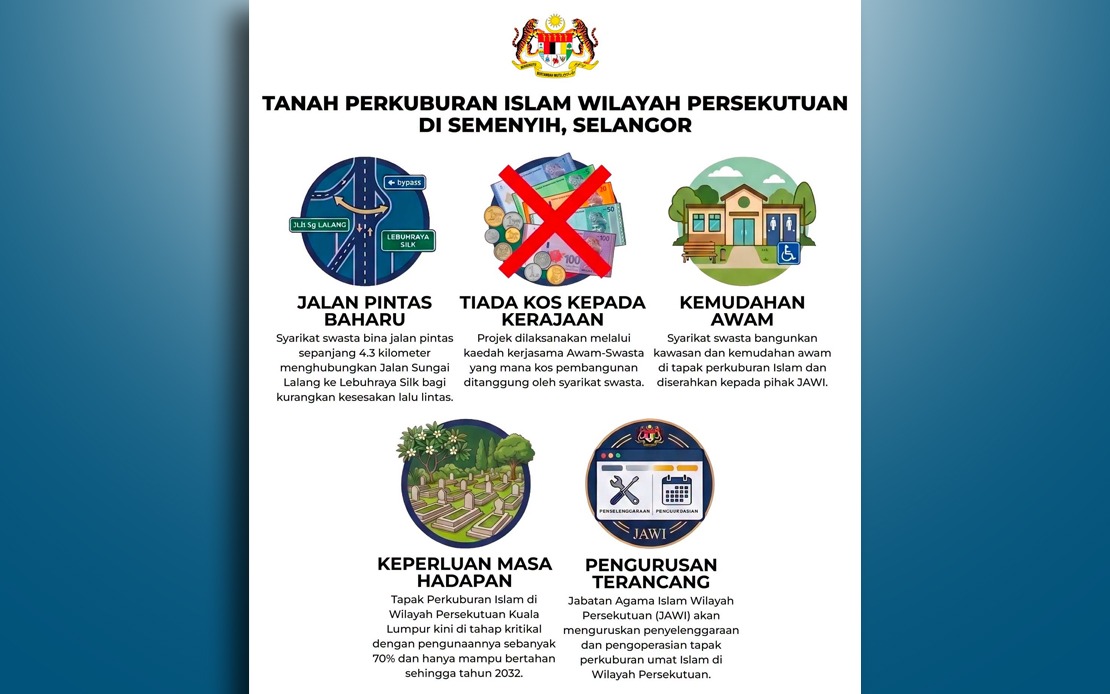
The Malaysian government has moved to clarify the scope and timeline of the Federal Territory Muslim Cemetery Development Project in Hulu Semenyih, Selangor, emphasizing that planning for this initiative began nearly two decades ago. Minister in the Prime Minister's Department (Federal Territories) Hannah Yeoh issued the statement through a Facebook post to address widespread confusion that had spread across social media platforms regarding the cemetery project's origins and purpose.
The clarification came amid mounting public discussion about the development, which aims to resolve a pressing demographic challenge facing Malaysia's federal capital. With the existing Islamic burial grounds in Kuala Lumpur already operating at more than 70 per cent capacity, planners have determined that available plots are rapidly depleting. Government records indicate that as of June 2023, only approximately 29 per cent of remaining burial capacity—roughly 34,496 plots—remained available in current facilities, a shortfall that officials project will be exhausted by around 2032 without intervention.
The cemetery development will occupy a substantial 332.6-acre site that remains under the ownership and control of the Federal Lands Commissioner. The project design accommodates 104,470 Muslim burial plots intended primarily for residents of the Federal Territory of Kuala Lumpur, though the planning framework also recognizes the broader regional context. Approximately 10 per cent of the cemetery's capacity will be allocated for residents from surrounding areas in Selangor, reflecting the interconnected nature of burial services across the Klang Valley and acknowledging that mourners and families often travel across administrative boundaries.
The implementation structure relies on a public-private partnership arrangement, with a private developer agreeing to finance the entire project while government retains ownership and regulatory oversight. The developer will shoulder full responsibility for constructing the necessary infrastructure, including staff accommodation facilities, a surau for religious observances, administrative offices, catering facilities, toilet amenities, security infrastructure, and comprehensive earthworks preparation. Significantly, Hannah Yeoh emphasized that the Federal Territories Islamic Religious Department (JAWI) will retain complete authority over the management, administration, and operational control of the cemetery, ensuring that religious and cultural protocols remain under government jurisdiction rather than private management.
A critical component of the project involves constructing a 4.3-kilometre link road connecting Jalan Sungai Lalang to the SILK Highway. This infrastructure development carries a total cost of RM93.89 million, which will be financed entirely by the private developer as part of the conditions imposed by the Selangor state government. Officials have positioned this road construction as integral to addressing traffic congestion patterns in Semenyih, with the understanding that a dedicated route will provide local residents with improved accessibility and shorter travel times to key destinations.
The project has undergone rigorous scrutiny within government processes and external validation frameworks. Hannah Yeoh pointed to the completion of technical assessments and a Value Management Lab evaluation as evidence of thorough planning. The development has secured formal approval from both the Selangor state government and the Federal Government, suggesting alignment across multiple administrative levels despite the project's location in Selangor while primarily serving residents of the Federal Territory.
For Malaysian readers, the significance of this project extends beyond simple infrastructure provision. The shortage of burial plots in Kuala Lumpur reflects broader demographic trends and urban planning challenges characteristic of Malaysia's major metropolitan areas. The decision to plan for burial capacity nearly two decades in advance demonstrates government recognition of long-term demographic planning requirements, a factor that resonates across multiple aspects of urban development from housing to social services.
The transparency of the government's clarification also signals an attempt to manage public perception and misinformation regarding large-scale development projects. In an era when contentious infrastructure announcements can generate viral social media responses, the proactive communication strategy employed by the Federal Territories Ministry represents an evolving approach to public engagement in Malaysia's governance framework. The emphasis on maintaining religious oversight through JAWI reflects sensitivity to community concerns about the proper conduct of Islamic burial practices.
For residents of the Klang Valley, the completion of the link road connection presents potential traffic benefits that extend beyond cemetery users. The improved connectivity between Jalan Sungai Lalang and the SILK Highway could reshape commuting patterns for the broader Semenyih community, potentially offering alternative routes that bypass existing congestion points. This secondary benefit illustrates how infrastructure projects often create spillover effects that influence regional accessibility networks.
The Federal Territory Muslim Cemetery Development Project ultimately represents a convergence of practical governance challenges—managing burial capacity, accommodating population growth, and improving transportation infrastructure—with broader questions about how Malaysia's major urban centers plan for long-term demographic needs. The two-decade planning horizon underscores the complexity of large-scale cemetery development, involving land acquisition, environmental assessments, religious considerations, and integration with existing transportation networks. As Malaysian cities continue expanding and becoming more densely populated, such projects will likely become increasingly common aspects of urban management and forward planning.

