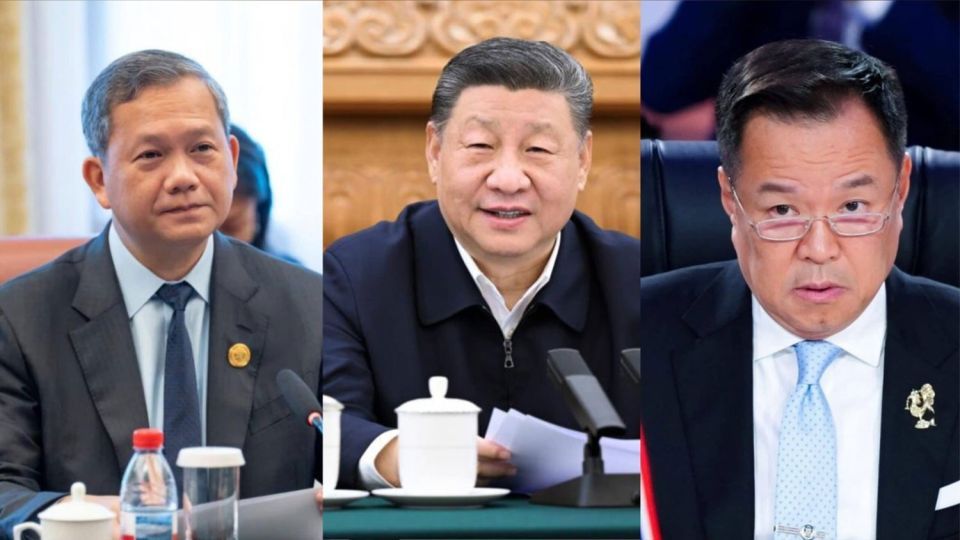
The prime ministers of Cambodia and Thailand, Hun Manet and Anutin Chanvirakul, are poised to convene in Shanghai next month for the opening session of the World AI Conference 2026, having accepted an invitation from Chinese President Xi Jinping. The July 17 gathering presents a significant diplomatic moment, particularly given the two leaders' inability to resolve simmering territorial tensions that have prevented substantive negotiations for the past seven months. The strategic timing of this high-profile technology conference underscores the deepening engagement between Southeast Asia's major powers and Beijing, whilst simultaneously raising questions about whether China might leverage this platform to advance peaceful resolution of the Cambodian-Thai border dispute.
Hun Manet's delegation will be substantial, reflecting the diplomatic weight Phnom Penh is placing on the three-day visit from July 15 to 17. Accompanying the Cambodian premier will be Foreign Minister Prak Sokhonn, Defence Minister Tea Seiha, and Sun Chanthol, the first vice-chairman of the Council for the Development of Cambodia. This composition suggests Cambodia intends to address both political and security dimensions of its relationship with China. Similarly, Anutin Chanvirakul will bring his foreign minister, Sihasak Phuangketkeow, indicating that Bangkok also views the conference as an occasion for substantive bilateral engagement beyond the stated conference agenda. Both delegations are scheduled for separate meetings with Xi Jinping and Chinese Premier Li Qiang, demonstrating China's interest in consolidating ties with each nation individually.
From Cambodia's perspective, the visit represents far more than attendance at a technology forum. An official foreign ministry statement emphasised that the journey underscores the shared commitment between Phnom Penh and Beijing to deepen their historical friendship and pursue mutually advantageous cooperation. The language deployed—referencing the Comprehensive Strategic Partnership of Cooperation, the Diamond Cooperation Framework, and an "all-weather" Cambodia-China Community with a Shared Future—signals Cambodia's intention to strengthen its position as China's primary strategic ally in mainland Southeast Asia. These frameworks collectively represent Cambodia's reliance on Chinese economic support, military assistance, and diplomatic backing on the international stage.
Thailand has similarly positioned the Shanghai gathering as an occasion to strengthen the Thailand-China Comprehensive Strategic Cooperative Partnership. Bangkok's more measured official rhetoric suggests a different calculus; whilst Thailand values its relationship with China economically, its geopolitical position differs substantially from Cambodia's, given its historical alignment with Western powers and its complex relationship with regional institutions. The conference offers Thailand an opportunity to reinforce economic ties without necessarily ceding diplomatic ground on other fronts, including its ongoing territorial disputes with Cambodia.
The elephant in the room remains the unresolved border conflict. When Hun Manet and Anutin last encountered each other at the ASEAN Future Forum in Hanoi during early June, their handshake for photographers concealed the absence of any substantive discussion about their dispute. Observers have noted this pattern: whilst senior leaders maintain cordial public relations, the underlying territorial grievances persist unaddressed. The December 2025 Fuxian Consensus, brokered by China itself, established a framework for negotiations, yet neither side has demonstrated sufficient political will to implement its terms fully.
According to Kin Phea, director of the Royal Academy of Cambodia's International Relations Institute, the principal impediment to resolution lies not with civilian leadership but with institutional actors who jealously guard operational autonomy. Phea argued that Thailand's military apparatus has systematically ignored agreements reached by civilian government officials with their Cambodian counterparts, utilising this gap between political commitment and military implementation to advance territorial claims. This dynamic reflects Thailand's broader civil-military tensions, where the armed forces maintain considerable institutional power despite nominal civilian oversight. The Cambodian analyst contended that such military actions, which include incursions into Cambodian territory, represent violations of both bilateral agreements and international law.
Phea advocated for a more assertive Chinese role in mediating the dispute, moving beyond ceremonial diplomacy toward active arbitration. Given China's considerable economic leverage over both nations—as the largest foreign investor and trading partner for both Cambodia and Thailand—Beijing theoretically possesses significant tools to encourage compliance. Phea specifically urged China to enforce the principles of the December 2025 Fuxian Consensus, compelling Thailand to withdraw military personnel from occupied Cambodian territories and return to formal negotiations through the Joint Boundary Commission. This advocacy reflects a Cambodian perspective that views China as the only external actor capable of restraining Thai military adventurism.
The human cost of the stalemate cannot be overlooked. Approximately 20,000 Cambodian civilians remain displaced from their homes, unable to return due to Thai military occupation of several border areas. These communities exist in a form of limbo, their displacement extending across years without resolution. The humanitarian dimension adds moral weight to calls for accelerated negotiations; prolonging the dispute perpetuates suffering for populations already vulnerable due to limited economic opportunities in border regions.
From a Southeast Asian perspective, the Shanghai conference represents an inflection point. The World AI Conference itself reflects China's technological ambitions and its desire to position itself as a global innovation leader. By hosting Cambodia and Thailand's premiers at this event, China simultaneously signals its centrality to regional diplomacy. Whether Beijing will actively seize the opportunity to push for border resolution remains uncertain; such mediation efforts could antagonise Thailand or constrain China's own strategic flexibility in Southeast Asia. Conversely, failing to use its influence might suggest that China prioritises maintaining positive relations with multiple parties over resolving specific disputes, a posture that prioritises stability over justice.
The Shanghai gathering occurs within a broader context of Southeast Asian regional fragmentation. ASEAN's consensus-based decision-making has rendered it increasingly ineffective at managing major disputes between member states. As Cambodia and Thailand struggle to resolve their differences bilaterally, China has emerged as an alternative venue for negotiation and problem-solving. This trend underscores a fundamental shift in Southeast Asian international relations: whilst ASEAN remains symbolically important, practical diplomacy increasingly flows through bilateral channels with major powers, particularly Beijing.
For Malaysian observers, the Shanghai conference carries particular relevance. Malaysia itself has maritime disputes with several neighbours and depends significantly on great power forbearance to maintain regional stability. The manner in which China handles the Cambodian-Thai border question may serve as a template for how Beijing approaches other regional disputes. If China uses its economic and political leverage to push for peaceful settlement, it sets a precedent beneficial to Malaysia's own interests. If Beijing adopts a more hands-off approach, preferring to cultivate relationships with multiple disputants rather than impose solutions, Malaysia must calibrate its own expectations accordingly.
The international law dimension, which Kin Phea emphasised, deserves particular attention. The Royal Academy director explicitly called for border disputes to be resolved through frameworks rooted in international jurisprudence rather than military fait accompli. Such an approach would require both Cambodia and Thailand to accept binding arbitration or court rulings—a step neither has fully embraced. China's diplomatic power could theoretically facilitate such acceptance, though doing so would demand China to position itself as supporting rules-based resolution rather than merely backing whichever party it favours strategically.
Ultimately, the Shanghai conference presents China with a significant opportunity to demonstrate whether its self-proclaimed role as a responsible great power extends to actively mediating regional disputes or remains limited to bilateral relationship management. The gathered delegations, the scheduled meetings with Xi and Li Qiang, and the formal frameworks referenced in official statements all suggest the infrastructure for substantive engagement exists. Whether that infrastructure will be mobilised to advance the Cambodian-Thai resolution process, however, depends upon decisions that may not become apparent for months or even years.

