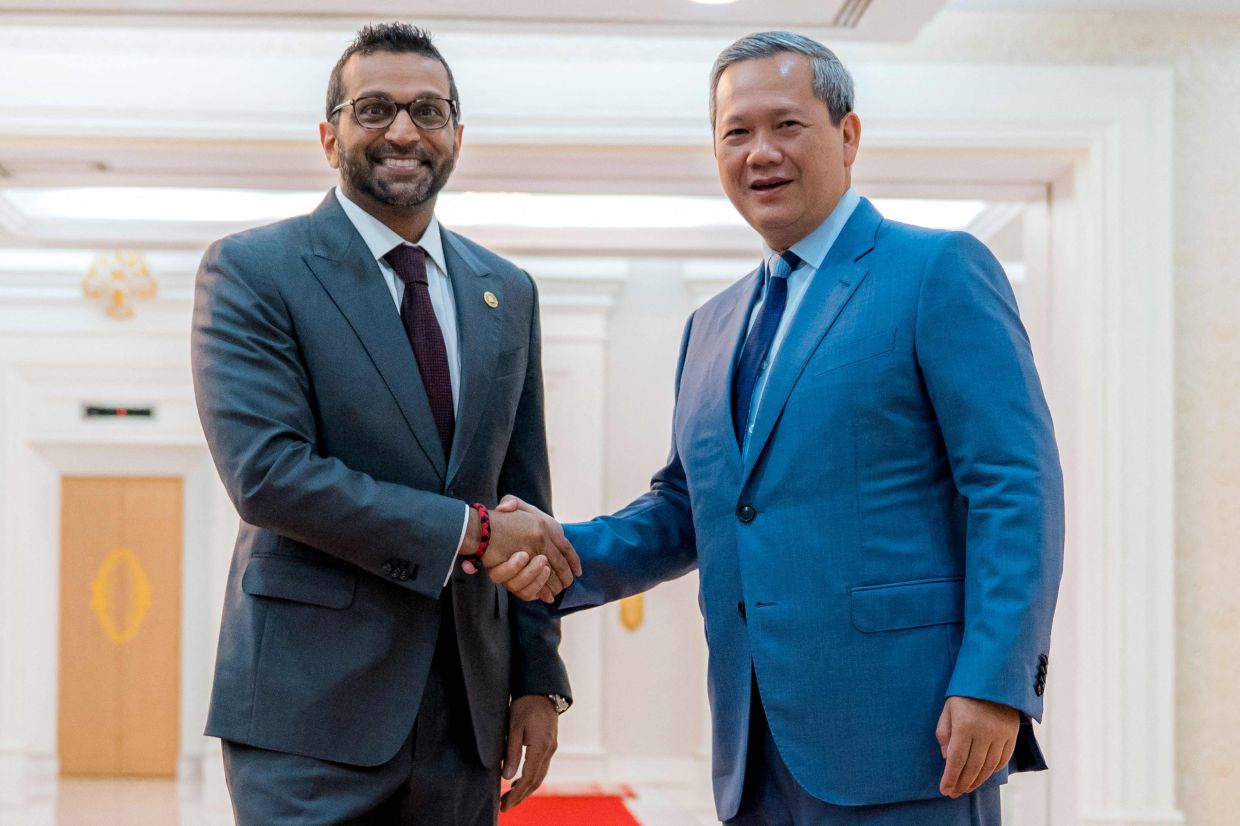
Cambodian Prime Minister Hun Manet has pledged to intensify Cambodia's fight against transnational online fraud networks, but acknowledged that criminal gangs are proving resilient by restructuring into smaller, scattered operational units distributed throughout Southeast Asia. Speaking during a recent Bloomberg Television interview, the Cambodian leader outlined an agenda to render the country inhospitable for scammers while recognizing that technological advancement has fundamentally altered how these criminal enterprises function across borders.
The Cambodian government has already dismantled more than 670 illicit scam operations and has been broadening cooperative arrangements with international law enforcement bodies. Hun Manet's comments came immediately after a bilateral engagement with US Federal Bureau of Investigation Director Kash Patel, signaling Washington's sustained concern about Cambodia's role in facilitating cybercrime that victimizes American citizens. The Prime Minister's characterization of the challenge underscores the cat-and-mouse dynamic playing out in the digital underground, where law enforcement disruptions prompt criminal networks to adopt more agile operational structures that prove harder to track and dismantle.
The proliferation of online scam operations across Southeast Asia has accelerated dramatically in the post-pandemic period, with Cambodia, Myanmar and Laos emerging as primary locations for organized criminal networks engaged in large-scale fraud. Despite escalating enforcement operations by regional governments, international human rights organizations and monitoring bodies maintain that the practical impact of these crackdowns remains circumscribed. The complexity of the problem extends beyond simple enforcement; it involves coordinating across multiple jurisdictions, tracking digital assets that move instantaneously across borders, and confronting entrenched corruption within state and commercial institutions that may benefit from the illicit industry's presence.
Hun Manet assumed leadership in August 2023 following a carefully managed transition that saw his father, Hun Sen, relinquish the premiership after nearly four decades in that role. The younger Hun, a West Point alumnus now 48 years old, has cultivated an image of technocratic governance while preserving the centralised political authority the Cambodian People's Party has maintained continuously since overthrowing the Khmer Rouge regime in 1979. His father remains an influential figure within Cambodia's power structure, serving as Senate President and ruling party chief, a configuration that preserves family control while superficially suggesting renewal. This transition has been watched carefully by international observers seeking signs of whether Cambodia's new leadership will substantively address longstanding governance concerns or simply perpetuate existing patterns under different branding.
International pressure on Cambodia regarding scam compounds emanates from both Western and Chinese sources, reflecting the genuinely global character of the problem. The United Nations and various human rights organizations have documented extensive evidence that multibillion-dollar fraud schemes, frequently interlinked with human trafficking and forced labour operations, function with implicit or explicit protection from individuals occupying senior positions within Cambodia's political hierarchy and business establishment. This nexus between state actors and criminal enterprise represents perhaps the most intractable dimension of the issue; no law enforcement initiative can succeed if elements within government apparatus actively shield perpetrators from accountability.
The United States has demonstrated willingness to employ sanctions as a tool against suspected enablers, targeting Cambodian senators Ly Yong Phat and Kok An with international financial restrictions based on allegations that they facilitated human trafficking, coerced labour arrangements and cybercriminal compound networks responsible for defrauding substantial numbers of American victims. Hun Manet characterized these designations as judicial proceedings unfolding through court processes, a somewhat evasive response that neither confirms nor denies the substantive allegations. He asserted that state institutions are actively investigating cases implicating government officials and corporate executives, and cited the dismissal and prosecution of military commanders and provincial administrators as evidence of institutional willingness to pursue accountability regardless of rank.
The magnitude of financial harm wrought by these scam operations has reached staggering proportions. The United Nations Office on Drugs and Crime released a report indicating that losses attributable to online fraud schemes throughout East Asia, Southeast Asia, Australia and New Zealand during the previous year potentially reached US$114 billion, a figure that dwarfs the economic output of many countries and underscores the scale at which these criminal enterprises operate. This sum reflects not merely financial transfers but represents genuine economic damage affecting individuals, families, and institutions across multiple nations, while the proceeds typically flow toward purchasing power within countries harbouring the operational infrastructure.
Beyond cybercrime, Hun Manet addressed Cambodia's festering border tensions with Thailand, appealing for Bangkok to recommence joint boundary demarcation negotiations that would facilitate the return of more than 20,000 displaced persons to their residences in frontier provinces. Although a ceasefire has technically held since armed conflict erupted approximately one year prior, Hun Manet characterized the peace as precarious, noting that tens of thousands of military personnel remain positioned directly opposite one another along the demarcation line, creating sustained potential for escalation. The persistence of this troop deployment reflects underlying mutual distrust and unresolved territorial disputes that superficial ceasefires cannot remediate.
Regarding Thailand's assertion that Cambodia's pursuit of United Nations maritime dispute resolution mechanisms justifies suspending land-boundary demarcation discussions, Hun Manet rejected this rationale as inaccurate and inequitable. He emphasized that these represent legally distinct matters operating under separate bilateral frameworks, and that conflating them serves no constructive purpose. His call for momentum in boundary negotiations reflects the humanitarian imperative of restoring normalcy to displaced populations while also addressing Cambodia's strategic interest in stabilizing its western frontier, a concern that becomes increasingly pressing as regional security dynamics remain unsettled and great power competition intensifies throughout Southeast Asia.

