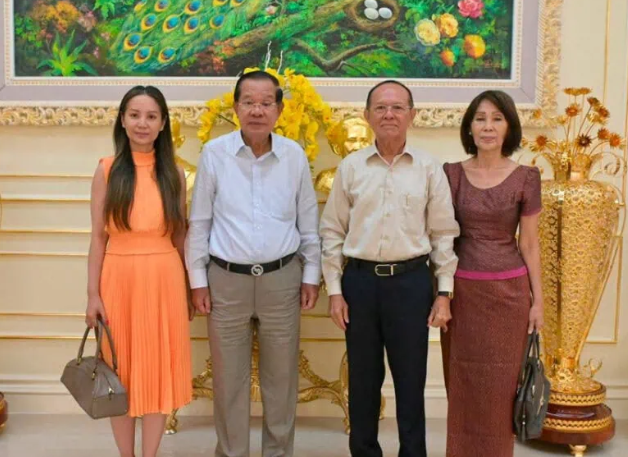
Cambodia's political landscape is showing subtle signs of reconfiguration as Hun Sen, the country's long-dominant Senate president, extends an olive branch to Kem Sokha, the man who once stood as his principal antagonist. During a Sunday morning encounter at his residence on August 16, Hun Sen spent three hours with Sokha and his family, a development that carries symbolic weight given the two men's history of deep rivalry. The meeting underscores a broader pattern of gradual rehabilitation for Sokha, who emerged from years of legal confinement and movement restrictions following a controversial treason conviction.
Hun Sen's publicised comments about the gathering focused notably on Kem Monovithya, Sokha's daughter, whom he described in social media remarks as an "excellent human resource for the nation." This characterisation stands out as particularly significant given Monovithya's previous tight association with the Cambodia National Rescue Party, the opposition movement that her father led before Cambodia's Supreme Court dissolved the party in November 2017. The specific praise of Sokha's daughter suggests Hun Sen may be signalling openness towards integrating figures from the former opposition establishment into broader national endeavours, though neither side has publicly framed these interactions as part of any formal reconciliation or political arrangement.
The Sunday gathering was not Sokha's first visit to Hun Sen's home in recent weeks. According to Hun Sen's account, Sokha had visited several weeks prior, before undertaking a journey to the Cambodia-Thailand border region to meet troops and civilians displaced by ongoing border tensions. This pattern of repeated contact between the two former antagonists marks a departure from years of hostility and legal warfare. The three-hour duration of Sunday's meeting—stretching from nine in the morning until noon—suggests substantive discussion beyond perfunctory pleasantries, though Hun Sen declined to reveal what subjects dominated their conversations or whether political matters featured in their talks.
Sokha's path to these renewed connections has traversed a lengthy legal ordeal that exemplified Cambodia's contested political environment. In 2023, he received a 27-year prison sentence on charges of conspiracy with a foreign power, a conviction he appealed through Cambodia's court system. When the Phnom Penh Appeal Court upheld his sentence on April 30, 2026, his legal situation appeared entrenched, with the court additionally imposing a five-year prohibition on international travel. Yet the trajectory shifted dramatically when a royal pardon on May 25 terminated his remaining imprisonment and house arrest, restoring his personal freedom after years of confinement, though political activity restrictions remained intact.
The easing of constraints around Sokha accelerated in July, when a royal decree on the 24th removed his overseas travel prohibition entirely. This succession of decrees incrementally restored Sokha's capacity to move freely and engage publicly, even as the ban on political participation persisted. Just four days after the travel ban's removal, Sokha made a carefully framed public appearance in Banteay Meanchey province, where he visited communities affected by the Cambodia-Thailand border conflict. During that visit, Sokha characterised his actions as those of a concerned private citizen rather than a partisan political figure or state representative, a positioning that allowed him to maintain plausible distance from political activity while still emerging into public prominence.
The former opposition leader's transformation from convicted prisoner to recipient of high-level social engagement must be contextualised within Cambodia's fractured political history. From 2013 onwards, the Cambodia National Rescue Party, which Sokha co-founded and presided over, became the nation's most credible electoral challenge to Hun Sen's Cambodian People's Party. The 2013 national election demonstrated CNRP's growing political muscle, and the 2017 commune elections confirmed its organisational strength and popular support. This ascending trajectory ended abruptly in 2017 when Sokha's arrest preceded the Supreme Court's dissolution of the entire party, eliminating Cambodia's primary opposition force and consolidating one-party dominance in the kingdom's politics.
The current rapprochement between Hun Sen and Sokha thus represents a reversal of that recent confrontational history. Rather than remaining permanent adversaries, the two men are now conducting meetings in settings that imply personal amicability or at least productive engagement. Hun Sen's particular emphasis on commending Monovithya suggests he may be attempting to position himself as magnanimous and inclusive, capable of recognising talent from the opposition sphere. Whether this represents genuine reconciliation, strategic positioning ahead of political developments, or a calculated effort to neutralise residual opposition sentiment remains unclear, as both parties have refrained from articulating any formal understanding or announced reconciliation framework.
For regional observers and Southeast Asian analysts, the warming between these two figures carries implications extending beyond Cambodia's borders. The Cambodia-Thailand border disputes mentioned in the context of Sokha's recent activities remain a live security concern affecting the broader region. Sokha's engagement with affected communities, coupled with his mention of raising displaced Cambodians' plight with international interlocutors, positions him as a potential bridge between domestic constituencies and external actors. His rehabilitation and reintegration into public life could reshape Cambodia's diplomatic positioning on these regional issues, particularly if his increasing visibility translates into any formal role in addressing cross-border matters.
Malaysian and other Southeast Asian observers should note that Cambodia's political evolution continues to unfold in ways that diverge from typical liberal democratic trajectories. The sequence of imprisonment, pardon, and gradual reintegration that Sokha has experienced reflects dynamics particular to contemporary Cambodia, where former adversaries can shift from mortal enemies to social interlocutors within relatively short timeframes when political or strategic considerations warrant. This flexibility, paradoxically, suggests both Cambodia's political system's adaptability and its underlying volatility, as fortunes and relationships can transform dramatically based on decisions taken at the highest levels.
The lack of clarity regarding whether these meetings signal any prospective political role for Sokha or Monovithya leaves multiple interpretations in play. Hun Sen's comments could represent nothing more than polite acknowledgment of Monovithya's professional capacities in some non-partisan domain. Alternatively, they might foreshadow some involvement of former opposition figures in state institutions or national projects, representing a form of elite integration that broadens the ruling coalition's apparent legitimacy. Without explicit announcements from either party about political arrangements or reconciliation processes, observers must remain cautious about overinterpreting these interactions, even as they clearly mark a significant departing point from Cambodia's recent history of deep political antagonism.

