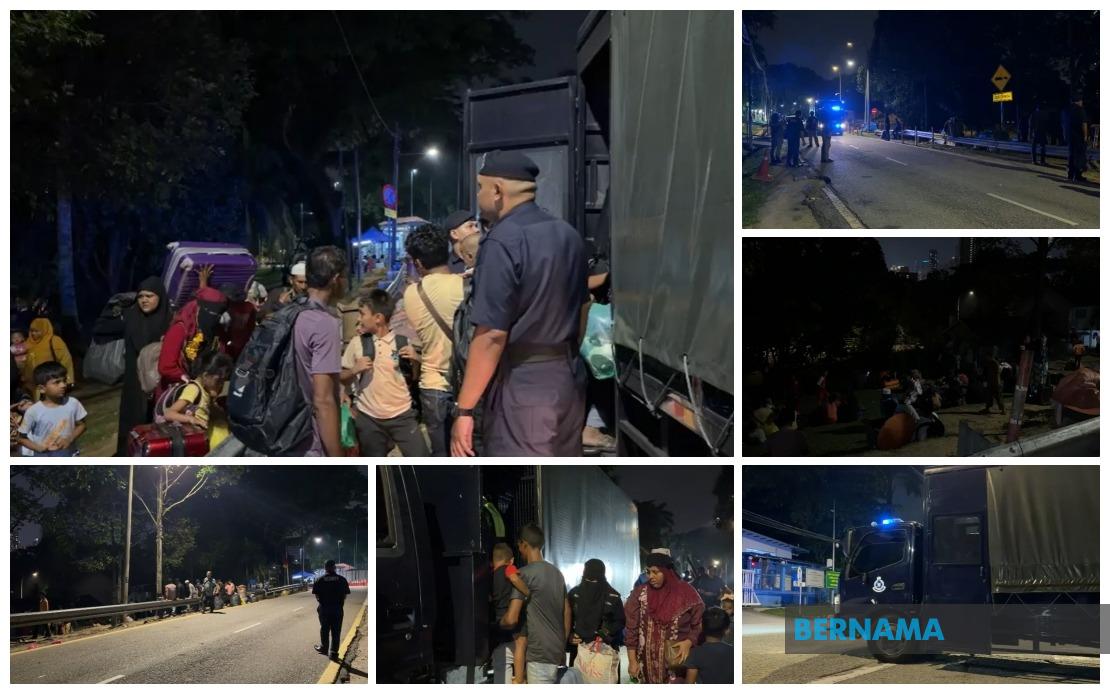
Hundreds of Rohingya refugees who assembled outside the United Nations High Commissioner for Refugees office in Jalan Bukit Petaling were transported to the Kuala Lumpur Police Contingent Headquarters on July 27 for systematic documentation and identity verification procedures. The relocation operation commenced at 8.20 pm following coordination between police and relevant agencies, marking an escalation in the government's approach to managing refugee populations within the capital.
Kuala Lumpur police chief Datuk Fadil Marsus confirmed that all foreign nationals involved in the gathering were successfully transferred to police headquarters during the evening. The operation required deployment of four police trucks to accommodate the large number of individuals, a necessity that arose after initial vehicles proved inadequate for the volume of refugees and their accumulated belongings. This logistical adjustment underscored the scale of the unauthorised assembly and the complexity of managing such situations within an urban environment.
The refugees are currently undergoing comprehensive identity verification procedures as authorities prepare recommendations for their eventual placement. These checks represent a critical phase in determining each individual's legal status and eligibility for continued residence in Malaysia. Officials are cross-referencing personal information against existing records and verifying claims regarding refugee documentation.
The National Security Council is expected to coordinate further action on the matter, with particular emphasis on distinguishing between individuals holding valid UNHCR documentation and those without proper refugee credentials. This distinction carries significant implications for the individuals involved, as it determines whether they qualify for continued protection within Malaysia or face other consequences. The MKN's involvement signals the government's perception of the gathering as a matter requiring coordinated national security response rather than routine immigration management.
Refugees presenting legitimate UNHCR documentation will be evaluated for suitable placement arrangements, potentially including options for resettlement or integration support. However, individuals unable to produce valid refugee identification or who fail to establish their legitimate status face transfer to the Immigration Department, which will process them for potential repatriation. This two-track system reflects Malaysia's attempt to balance humanitarian obligations with border security and public order imperatives.
Prime Minister Datuk Seri Anwar Ibrahim addressed the situation by reaffirming the government's position that no refugee group would be permitted to disrupt public order or attempt territorial control within Malaysia. His statement represented an unmistakable message regarding official tolerance thresholds and the primacy of maintaining social stability. The Prime Minister's remarks indicated that enforcement would be uniformly applied regardless of the vulnerable status of refugee populations.
Enforcement agencies including the Royal Malaysia Police, Immigration Department, and local authorities have received explicit instructions to pursue firm action against anyone violating applicable laws. This directive ensures that policing responses remain consistent with government policy and that individual officers understand the political and administrative expectations surrounding refugee-related enforcement. The unified approach reflects coordination across multiple government levels and departments.
The Rohingya group had arrived in Kuala Lumpur on three buses early on July 27 after relocating from their settlement in Penang, suggesting the gathering was a planned movement rather than a spontaneous protest. The coordinated nature of their arrival and subsequent assembly outside the UNHCR office indicates deliberate intent to draw attention to their circumstances or make specific demands. The timing and location of their gathering outside the UNHCR offices suggest they may have been seeking direct engagement with the UN agency regarding their protection and status concerns.
This incident occurs against the backdrop of Malaysia's ongoing challenges with managing the Rohingya refugee population, estimated at over 180,000 individuals, the largest displaced community within the country. While Malaysia has not formally endorsed the 1951 Refugee Convention, it has permitted UNHCR operations and provided de facto humanitarian access to refugee populations. The tension between maintaining generous humanitarian policies and managing public order concerns remains a persistent challenge for policymakers.
The relocation operation demonstrates the government's capacity and willingness to deploy substantial resources for managing refugee assemblies, but also raises questions about the underlying grievances that prompted the gathering. Rohingya communities in Malaysia frequently cite inadequate documentation, restricted employment opportunities, and limited access to services as sources of frustration. Without addressing these structural issues, similar incidents may recur, creating recurring challenges for law enforcement and government coordination.
For Malaysian security officials and policymakers, this event represents a test case in managing refugee populations in ways that satisfy both humanitarian obligations and public order requirements. The approach taken—rapid identification, documentation, and differentiation based on legal status—reflects a practical framework for managing future incidents. However, sustained pressure may emerge if displaced populations perceive their circumstances as deteriorating or if international attention focuses on treatment outcomes.

