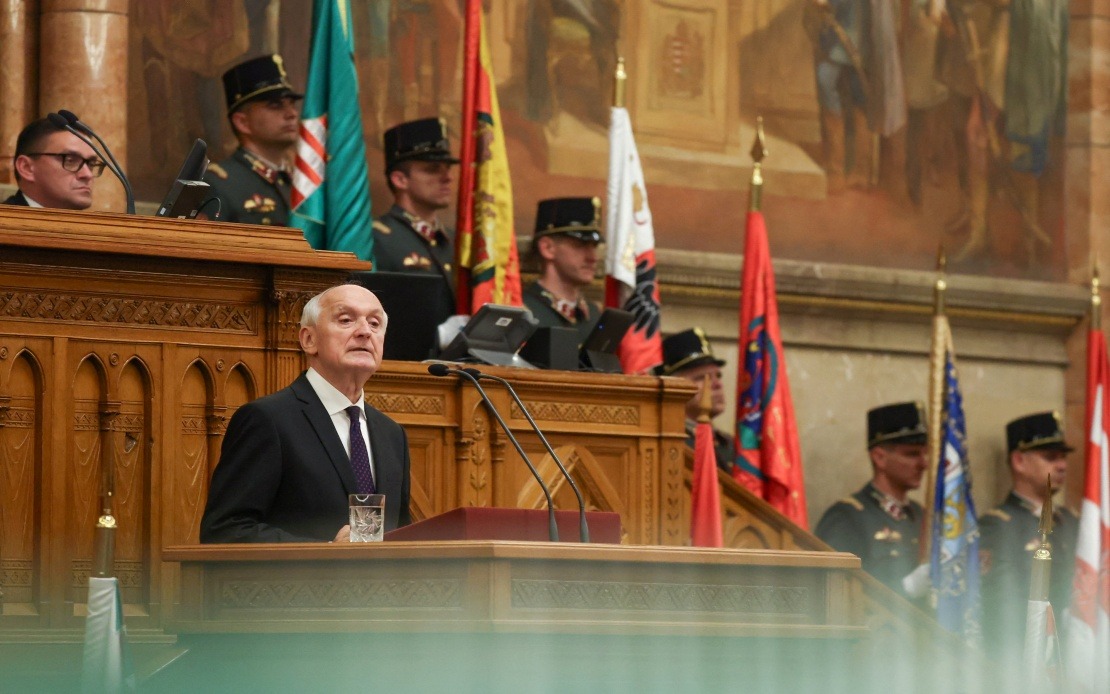
Andras Baka officially assumed the Hungarian presidency on August 19, 2026, marking a significant transition in the country's leadership structure. Prime Minister Peter Magyar announced the swearing-in through social media, extending wishes for the incoming president's success and health in his new role. Baka's ascension comes three weeks after the Hungarian Parliament elected him on August 11, following the constitutionally mandated removal of his predecessor, Tamas Szujok.
The new president brings substantial experience in Hungary's judicial system, having previously led the Supreme Court of Hungary from 2009 to 2011. During his tenure in that position, Baka encountered significant institutional challenges stemming from judicial reform initiatives pursued by then-Prime Minister Viktor Orban's administration. Rather than continue under the reformed system, Baka chose to resign from the Supreme Court, a decision that reflected tensions between judicial independence and government restructuring efforts that characterised Hungary's political landscape during that period.
Before his first leadership role in Hungary's judiciary, Baka worked at the European Court of Human Rights in Strasbourg, gaining international experience in human rights jurisprudence. This background distinguishes him as a legal professional with exposure to both international standards and domestic Hungarian law. Following his departure from the Supreme Court in 2011, he served as chairman of the Hungarian Curia from 2012 to 2020, a position he held throughout the tenure of the reformed judicial structure. The Curia itself had been established as part of the comprehensive Supreme Court reform that prompted his earlier resignation, positioning him as a key figure navigating Hungary's evolving institutional landscape.
The transition to Baka's presidency occurred amid significant political division within Hungary's parliamentary chamber. Two major opposition parties, Fidesz and the Christian Democratic People's Party, orchestrated a boycott of the presidential election proceedings. Their refusal to participate in the ballot represented a formal protest against the constitutional amendment process that led to Szujok's removal. This boycott strategy reflects deeper polarisation within Hungarian politics, where disputes over presidential succession have become intertwined with broader conflicts over constitutional amendments and the balance of power between different governmental branches.
The circumstances surrounding Szujok's departure underscore ongoing constitutional controversies in Hungary. The previous president's removal through constitutional amendments, rather than through the customary conclusion of a presidential term, generated considerable political friction. Opposition parties viewed this mechanism as problematic, arguing that it represented an unconventional use of constitutional powers. By boycotting the election of his replacement, these parties sought to signal their disapproval of both the removal process and the broader political direction it represented.
Baka's election nonetheless proceeded despite the boycott, indicating that the governing coalition maintained sufficient parliamentary support to advance the transition. His selection as president reflects a preference for a candidate with deep roots in Hungary's legal profession and institutional memory spanning multiple governmental administrations. The decision to elevate him to the presidency suggests an emphasis on continuity in judicial matters and potentially an expectation that his experience navigating complex institutional reforms would serve him in the largely ceremonial yet symbolically important presidential position.
The political dynamics surrounding this presidential transition carry implications for Hungary's international standing and domestic governance structures. As a European Union member state, Hungary has faced scrutiny regarding judicial independence and democratic norms. The appointment of a former Supreme Court president with experience in international human rights law could influence perceptions of Hungary's commitment to such standards. However, the opposition boycott and the controversial nature of the preceding president's removal suggest that these judicial and constitutional matters remain contentious domestic issues.
For Malaysian and Southeast Asian observers, Hungary's experience offers instructive parallels regarding the intersections of constitutional law, judicial reform, and political conflict. Like several nations in the region, Hungary has experienced tensions between executive authority and judicial independence, with constitutional amendments serving as tools in broader political struggles. The manner in which societies navigate such institutional disputes—whether through consensus-building or through the assertion of majority parliamentary power—shapes democratic governance and international credibility.
Baka's presidency commenced at a moment when Hungary's political system faces questions about institutional balance and constitutional propriety. The new president's background suggests he understands both the technical dimensions of judicial administration and the international human rights frameworks that inform contemporary expectations of democratic governance. How he exercises the presidential office during his tenure, particularly regarding judicial matters and constitutional interpretation, will likely influence Hungary's trajectory on democratic governance and inform ongoing international assessments of the country's institutional health.

