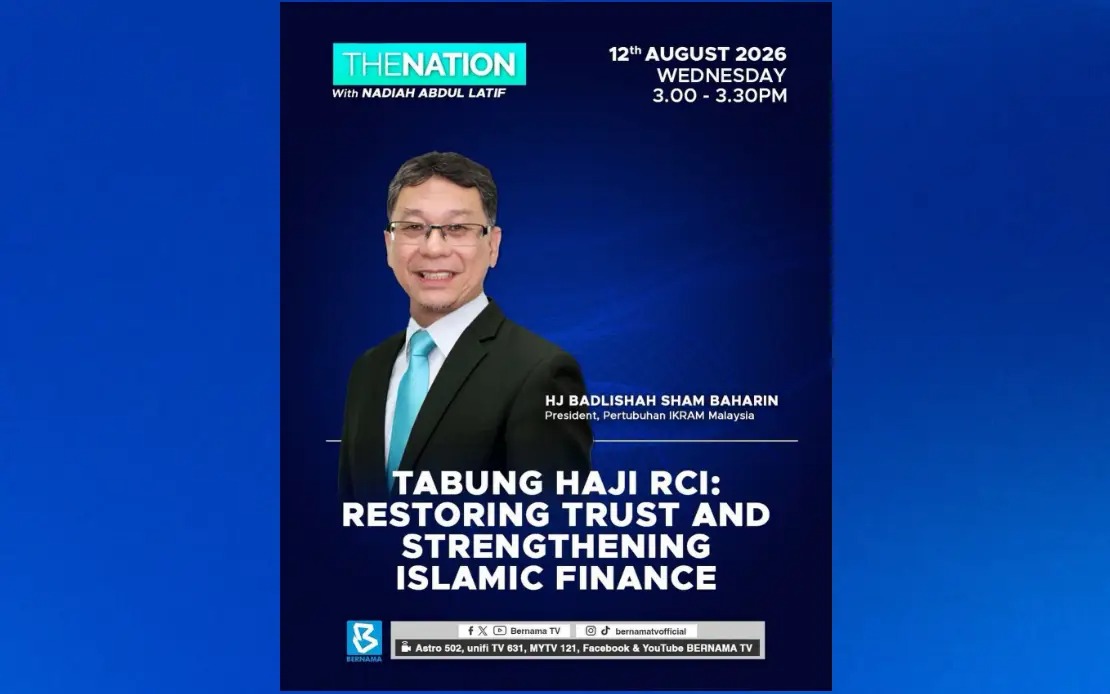
The president of Pertubuhan IKRAM Malaysia has rejected growing demands from lawmakers across both government and opposition benches for a fresh Royal Commission of Inquiry into Tabung Haji, contending that current investigations by law enforcement agencies offer sufficient accountability. Badlishah Sham Baharin made the remarks following a parliamentary debate on the pilgrim fund's troubled financial history, during which multiple elected representatives called for a new probe to cover the 2021-2025 period beyond the existing RCI's remit.
Badlishah Sham's intervention reflects a measured approach to addressing public concerns about the Islamic pilgrimage savings institution, which has become a focal point for broader questions about governance and financial stewardship in Malaysia's Islamic banking sector. His position suggests that establishing multiple investigative commissions risks diluting their institutional weight and deterring lawmakers and the public from treating future inquiries with appropriate seriousness. By limiting RCIs to genuinely exceptional circumstances, he argued, the government preserves their utility as tools for examining systemic failures of the highest order.
The underlying dispute centres on the scope and adequacy of existing accountability mechanisms. The original RCI investigation, which concluded in July and was made public on July 29, examined management and operational weaknesses spanning 2014 to 2020. Parliamentary critics argue that this chronological gap leaves a three-year period—from the end of 2020 through 2025—unexamined, potentially obscuring losses incurred or decisions made during the transition to new leadership. This temporal limitation has become a rallying point for transparency advocates on both sides of the political aisle.
The financial magnitude of Tabung Haji's problems underscores why the inquiry debate has transcended routine oversight. Finance Minister II Datuk Seri Amir Hamzah Azizan disclosed during the Dewan Rakyat special session that the institution sustained nearly RM13 billion in losses through 14 failed investment ventures, with seven of these positions generating total write-downs. The government injected RM10.2 billion through a 2018 bailout mechanism known as Urusharta Jamaah Sdn Bhd, while Tabung Haji recorded RM2.6 billion in additional impairment losses between 2018 and 2025 on ongoing investments. These figures translate to direct harm affecting nearly 10 million depositors whose retirement and pilgrimage savings face erosion.
The Al-Rawda hotel investment epitomises the scale of misjudgement that permeated Tabung Haji's portfolio during the period under examination. The fund committed approximately RM1.5 billion—equivalent to 1.4 billion Saudi riyals—through intermediaries to lease accommodations in Makkah and Madinah for pilgrims between 2015 and 2017. When the counterparty began defaulting on rental obligations in early 2019, Tabung Haji eventually accepted a complete impairment loss of RM1 billion recorded in 2024, representing a total write-off of capital and anticipated returns. This single transaction illustrates the absence of adequate due diligence and risk assessment protocols that should have prevented such exposure.
Badlishah Sham's position on conducting new inquiries does include qualified support for stronger preventive mechanisms. He endorsed a proposal to establish a multi-agency taskforce focused on scrutinising investments that pose emerging risks and identifying patterns that might foreshadow future losses. This approach channels investigative energy toward forward-looking risk management rather than reopening historical questions, effectively redirecting the debate from accountability for past failures toward preventing future ones. He emphasised that rigorous due diligence, ethical compliance reviews, and procedural adherence must precede all investment decisions at Tabung Haji, reinforcing the need for structural reforms rather than additional inquiries.
The controversy gained an additional dimension when opposition lawmakers walked out during the Dewan Rakyat special session addressing the RCI findings. Badlishah Sham characterised this parliamentary departure as a dereliction of democratic duty, noting that elected representatives carry explicit responsibility to represent constituents' interests and exercise legislative oversight regardless of partisan disagreements. He highlighted the disconnect between opposition members' public advocacy for Tabung Haji accountability on social media platforms and their abandonment of the chamber where formal legislative action occurs, framing the walkout as performative rather than substantive.
This assessment reflects broader concerns within Malaysian civil society about the quality of parliamentary scrutiny applied to major government institutions and public funds. The RCI report, released after its July 29 public disclosure, documented extensive governance deficiencies across the 2014-2020 period and advanced 25 recommendations for institutional remediation. Tabung Haji has implemented approximately 75 per cent of these proposals as of late July, suggesting receptiveness to reform, yet critics contend that ongoing vulnerabilities in the post-2020 period warrant explicit examination through formal investigative channels.
The Malaysian Anti-Corruption Commission represents the primary alternative investigative pathway that Badlishah Sham highlighted as adequate for pursuing potential breaches of law and prosecuting wrongdoing. The MACC's statutory mandate encompasses public sector financial misconduct, conflicts of interest, and abuse of authority—domains directly relevant to Tabung Haji's investment decisions and oversight failures. By channelling accountability through existing law enforcement mechanisms rather than establishing parallel commissions, policymakers can concentrate investigative resources and maintain institutional continuity with precedent.
For Malaysian readers and the broader Southeast Asian context, the Tabung Haji dispute reflects wider tensions in Islamic financial governance across the region. Multiple Muslim-majority nations operate pilgrimage savings schemes with comparable mandates, and operational failures at one institution inevitably generate scrutiny of management practices elsewhere. The debate about investigation scope and methodology carries implications for how regional governments balance public accountability demands against concerns about repeated institutional intrusions potentially destabilising confidence in Islamic financial products more broadly.
The standoff between lawmakers demanding comprehensive inquiry and figures like Badlishah Sham arguing for measured, existing-mechanism approaches ultimately hinges on assessments of institutional capacity and investigative necessity. If current authorities possess adequate statutory tools and investigative capacity to pursue wrongdoing and identify vulnerabilities, establishing redundant RCIs arguably generates diminishing returns while consuming political capital. Conversely, temporal gaps in examination and the scale of financial damage suggest that supplementary inquiry covering post-2020 operations could yield insights unavailable through conventional law enforcement channels.

