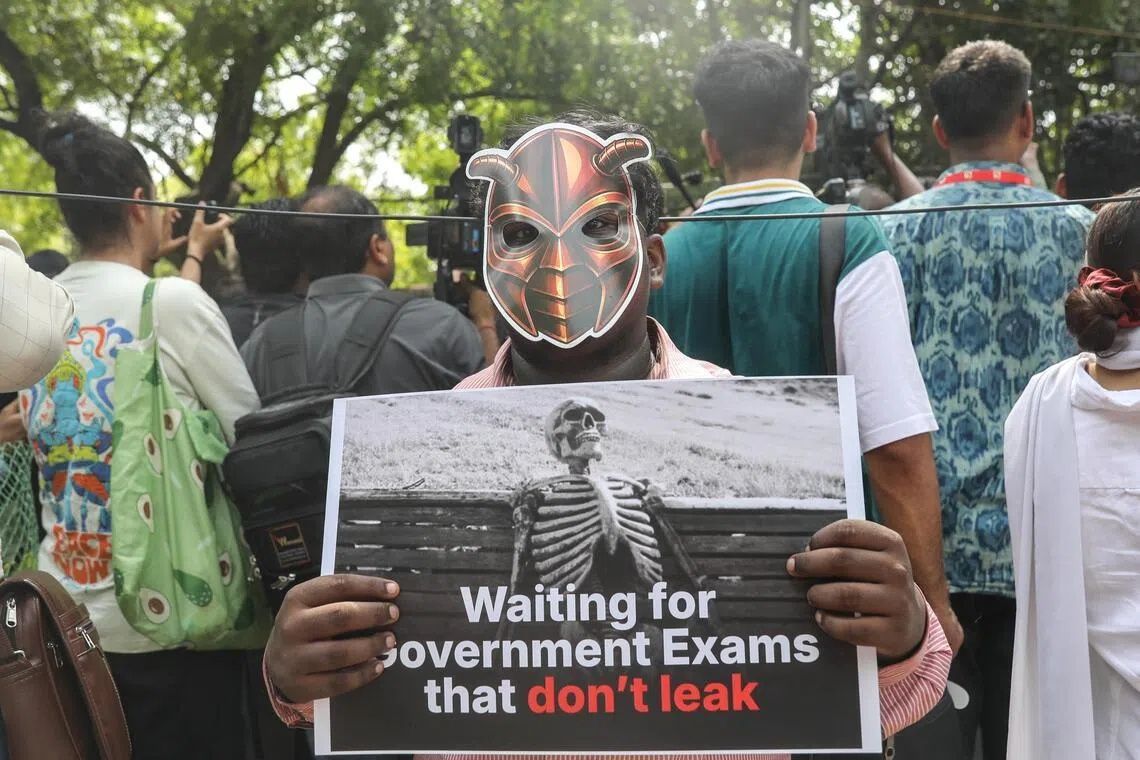
India is conducting a critical retake of its national medical entrance examination on Sunday for 2.2 million students, deploying an extraordinary security apparatus to prevent a repeat of the cheating scandal that forced cancellation of the original test in May. The National Eligibility cum Entrance Test, universally known as NEET, represents the sole pathway to India's coveted medical college seats, with fierce competition for just over 100,000 undergraduate positions annually. The original examination's compromise by a paper leak exposed vulnerabilities in one of the world's largest competitive testing systems and unleashed a firestorm of public anger that has reverberated through Indian politics and civil society.
The fallout from the failed exam has proven extraordinary in scale and intensity. Beyond the immediate invalidation of May's test results, investigations confirmed reports that several teenagers took their own lives following the scandal, and parents across the country organised mass protests demanding accountability. The incident crystallised broader anxieties about educational equity and institutional integrity in a system where success in NEET effectively determines students' medical careers. The controversy catalysed an unusual form of public dissent: a satirical political movement called the Cockroach People's Party emerged and rapidly accumulated millions of social media followers, explicitly calling for Education Minister Dharmendra Pradhan's resignation.
Authorities have implemented an elaborate multi-layered security framework that reflects the severity of the breach. More than 200,000 officials, including armed police personnel, will oversee the examination across thousands of centres nationwide. The National Testing Agency has integrated biometric authentication systems to verify candidate identity, deployed artificial intelligence-enabled camera surveillance to monitor test administration in real time, and introduced GPS tracking mechanisms for all question paper movements to provide an auditable chain of custody. The examination will commence at 2 pm local time, with these technological and human safeguards designed to create an environment where the likelihood of institutional failure is minimised.
The original leak exposed how India's coaching industry and sophisticated criminal networks had identified examination vulnerabilities and monetised them. Paper leaks and organised cheating have become increasingly lucrative enterprises in India's educational ecosystem, where the stakes attached to NEET success generate enormous financial incentives. The Central Bureau of Investigation arrested an alleged principal orchestrator identified as a chemistry lecturer, suggesting that inside knowledge within educational institutions had been weaponised for profit. This revelation highlighted how examination integrity depends not merely on external security but on the trustworthiness of officials embedded within the system itself.
Communications technology played a crucial enabling role in the scheme that authorities have now moved to restrict. Investigators determined that cheating syndicates utilised Telegram, a messaging application favoured for its encryption and apparent resistance to surveillance, to distribute leaked questions among paying candidates. In response, Indian authorities implemented a week-long restriction on Telegram access—a severe measure that raised eyebrows internationally regarding proportionality and digital rights. However, Telegram's chief Pavel Durov pushed back against the utility of such restrictions, noting that illicit networks would simply migrate to alternative platforms and that the fundamental problem resided with the individuals within institutions who leaked examination materials rather than the technological platforms that facilitated distribution.
The NEET scandal did not occur in isolation but coincided with a separate controversy affecting nearly two million high school students. Authorities implemented an online marking system that malfunctioned in ways that generated widespread allegations of grading errors and misallocated results. Parents reported that candidates received incorrect marks or that results were assigned to entirely wrong individuals—failures that suggested systemic problems extending beyond NEET into India's broader examination infrastructure. This parallel crisis compounded public suspicion about institutional competence and fuelled demands for sweeping reforms across India's testing apparatus.
For Malaysian and broader Southeast Asian observers, the Indian examination scandal offers instructive lessons about the vulnerabilities of large-scale, high-stakes testing systems. Malaysia's own educational assessment mechanisms, including university entrance processes, operate within similar competitive pressure environments where success rates for premium programmes remain severely constrained relative to application volumes. The Indian experience demonstrates how inadequate security protocols, insider corruption, and technological exploitation can undermine examination credibility—consequences that extend beyond individual students to affect public confidence in educational institutions themselves. The scale of India's retesting operation, involving over two million students, underscores the logistical and reputational costs of failing to prevent cheating before rather than after examination administration.
The intensity of public and political response to the NEET crisis reflects deeper anxieties about meritocratic systems in contexts of high population density and limited opportunity. With millions competing for thousands of places, any perception that examinations are compromised triggers not merely individual disappointment but collective anxiety about whether institutional systems function equitably or whether wealth and connections corrupt outcomes. The emergence of satirical political movements critiquing the education system indicates how examination failures can catalyse broader disillusionment with governmental competence. Education ministers in South Asian democracies operate under intense scrutiny, and professional consequences for examination failures remain substantial.
The technological solutions deployed for the retaken examination—biometric verification, AI surveillance, GPS tracking—represent an escalation in examination security that raises questions about scalability and implementation quality across India's vast geography. Whether such systems can be consistently applied across rural and urban test centres, how effectively AI monitoring can detect sophisticated cheating, and whether GPS tracking genuinely prevents organised paper theft remain empirical questions that will become apparent only after Sunday's administration. The sheer complexity of coordinating 200,000 officials suggests implementation risks and potential for inconsistent execution across different locations.
Looking forward, the incident has prompted broader discussion about whether India's examination architecture requires fundamental restructuring rather than enhanced security measures. Some educational experts argue that the extreme competitiveness of NEET itself creates the conditions where cheating syndicates thrive, and that alternative selection mechanisms might reduce both organised fraud and the psychological toll on students. Others contend that India's testing infrastructure, despite this crisis, remains remarkably robust given the scale of administration required. The retaken examination will serve as a test not merely of student knowledge but of whether rapid security enhancement can overcome institutional vulnerabilities exposed by the scandal.

