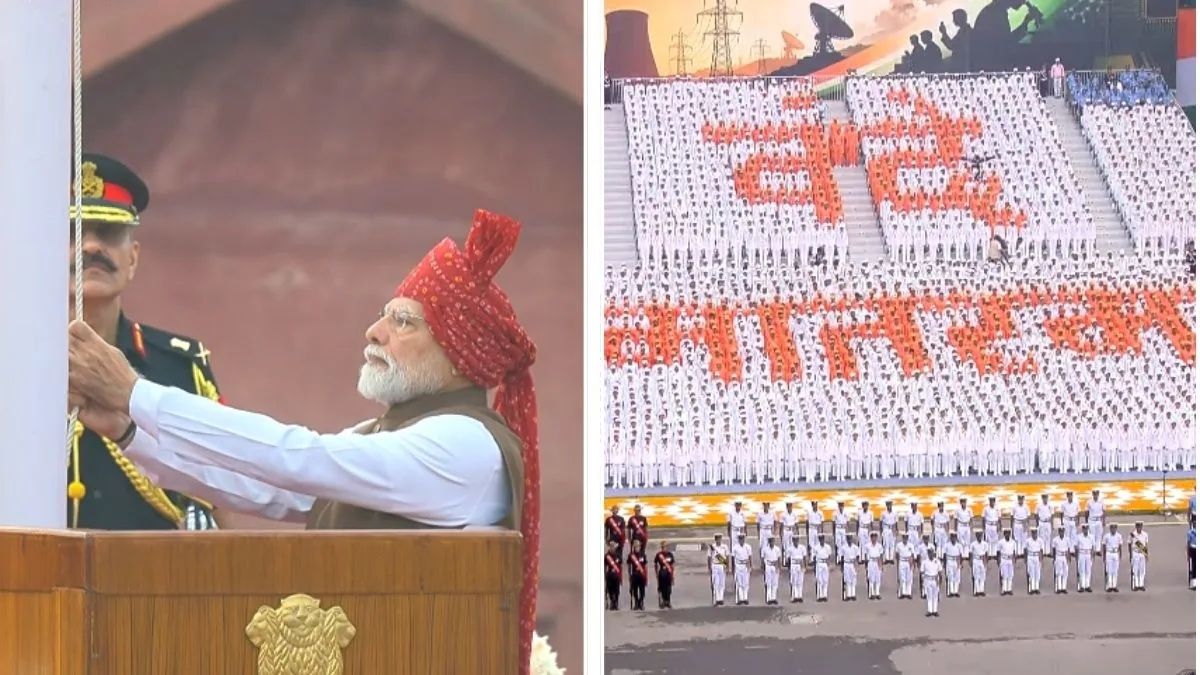
India has declared an ambitious national aspiration to achieve developed-country status by 2047, according to Prime Minister Narendra Modi, who used the nation's 80th Independence Day address to articulate this transformative vision. Speaking from the Red Fort on Saturday (Aug 15), Modi framed the pursuit of 'Viksit Bharat'—developed India—as a defining goal that would reshape both domestic progress and global perceptions of the country. This articulation of intent signals a fundamental recalibration of India's self-image and strategic positioning as it looks toward the centenary of independence.
The Prime Minister emphasised that India's trajectory has fundamentally shifted in recent years, moving from what he characterised as a period of constraint to one animated by renewed confidence and purpose. He sought to reframe the national conversation around what he termed the necessity of thinking beyond conventional limitations, arguing that incremental ambitions no longer align with India's potential or aspirations. This rhetorical pivot carries significant implications for Southeast Asian observers, particularly as it positions India as a dynamic economic power increasingly focused on structural transformation rather than marginal improvements. Modi's framing reflects a deliberate political strategy of mobilising national sentiment around transformative goals rather than routine governance achievements.
The Prime Minister's retrospective analysis of India's economic performance over the past decade-and-a-half provided concrete evidence to substantiate this optimism. He highlighted India's graduation from membership in the so-called Fragile Five—a category that once encompassed Brazil, Russia, India, Indonesia and South Africa—to emergence as a major growth engine within the global economy. This repositioning within international economic classifications carries weight beyond ceremonial pronouncement, reflecting structural improvements in macroeconomic stability and growth resilience. For regional economies watching competitive dynamics within Asia, India's trajectory offers both opportunity and challenge, particularly as it seeks to attract manufacturing and investment flows competing with Southeast Asian hubs.
Moderate but significant sectoral gains characterised Modi's enumeration of developmental achievements. Defence manufacturing output has expanded fourfold during this period, reflecting both deliberate policy emphasis on self-reliance in military-industrial capacity and growing demand from India's armed forces modernisation agenda. Simultaneously, traditional khadi and gram-based production has surged fivefold, suggesting that development policy encompasses both high-technology sectors and culturally-rooted cottage industries. Electronic manufacturing has experienced sevenfold expansion, whilst mobile telephony production has grown by one-third. These sectoral disparities illustrate the multifaceted nature of India's economic diversification strategy, spanning defence, artisanal production, consumer electronics, and technology. Digital transaction volumes have doubled, indicating rapid adoption of cashless financial infrastructure across a substantial portion of the population.
A ceremonial dimension infused the Independence Day proceedings with symbolic weight. The full rendition of 'Vande Mataram', India's national song, resounded at the Red Fort on August 15 for the first time in the nation's post-independence history. Modi characterised this moment as historically significant, suggesting that this constitutional omission had previously reflected political sensitivities or administrative precedent now deemed superseded by changed circumstances. The symbolic assertion of this patriotic anthem in the capital's most iconic location represents a deliberate recalibration of national commemoration practices, aligning ceremonial practices with what the government perceives as appropriate expressions of national identity and historical narrative.
The flag-hoisting ceremony itself exemplified India's emphasis on indigenous military capacity. The 21-gun salute utilised 105-millimetre Light Field Guns manufactured domestically rather than imported alternatives, underscoring the government's 'Atmanirbhar Bharat' (self-reliant India) initiative. Major Pawan Singh Shekhawat commanded the 1721 Field Battery (Ceremonial), with Naib Subedar Anuthosh Sarkar serving as Gun Position Officer and Assistant Instructor in Gunnery. This ceremonial deployment of indigenous defence equipment carried symbolic resonance, embedding the military-industrial diversification agenda within the patriotic ceremony itself. For defence-focused analysts across South Asia and Southeast Asia, such demonstrations signal India's determination to reduce dependence on foreign military procurement and technology transfer agreements.
Modi's address confronted the immediate humanitarian challenge of monsoon flooding that had affected substantial portions of the country in preceding days. Rather than treating disaster management as a separate administrative matter, he integrated assurances of national solidarity into the broader narrative of collective purpose and mutual support. This rhetorical integration suggests recognition that national aspiration requires addressing immediate vulnerabilities and demonstrating that development vision encompasses both long-term transformation and immediate relief. The framing positioned national resilience and flood response within the same ideological framework as the 2047 development goal, emphasising continuity between present-day crisis management and future prosperity.
The synthesis of aspirational national goal-setting with immediate crisis acknowledgement reveals sophisticated political communication strategy. Modi's address moved fluidly between celebrating economic sectoral achievements, articulating transformative 25-year objectives, reinforcing patriotic symbolism through ceremonial innovation, and expressing concern for flood-affected populations. This multipronged approach targets varied constituencies—economists and policy analysts focused on sectoral performance, nationalist audiences drawn to patriotic symbolism, and ordinary citizens requiring assurance of state support during hardship. For Malaysian observers and regional analysts, the address illuminates how India's leadership frames the country's competitive positioning within Asia through simultaneous emphasis on growth, self-reliance, and inclusive development.
The 'Viksit Bharat' framework carries particular resonance for Southeast Asian development discourse and intra-regional competition. India's explicit commitment to developed-country status by 2047 establishes a temporal anchor for policy planning and resource allocation that distinguishes it from vaguer aspirational rhetoric characterising some other emerging economies. This clarity provides a reference point for international engagement, investment decisions, and regional strategic positioning. For Malaysia and other ASEAN members evaluating India's trajectory and potential as economic partner and strategic actor, Modi's articulation of this goal supplies concrete benchmarking against which to assess India's capacity to deliver on pledged transformation.
The broader implications extend beyond India's domestic agenda to shape regional dynamics and global economic architecture. A successfully developed India in 2047 would represent transformation of the world's most populous country into a high-income economy, with ramifications for manufacturing relocation patterns, technology transfer flows, capital markets, and geopolitical influence. The audacity of this goal—particularly articulated at a moment when India retains substantial development challenges—signals leadership intent and ideological commitment. Whether the aspiration translates into institutional implementation, consistent policy execution, and structural transformation remains contingent on domestic political coalitions, global economic conditions, and investment flows over the coming quarter-century. For Southeast Asia, India's success or faltering would reshape regional development models and strategic partnerships.

