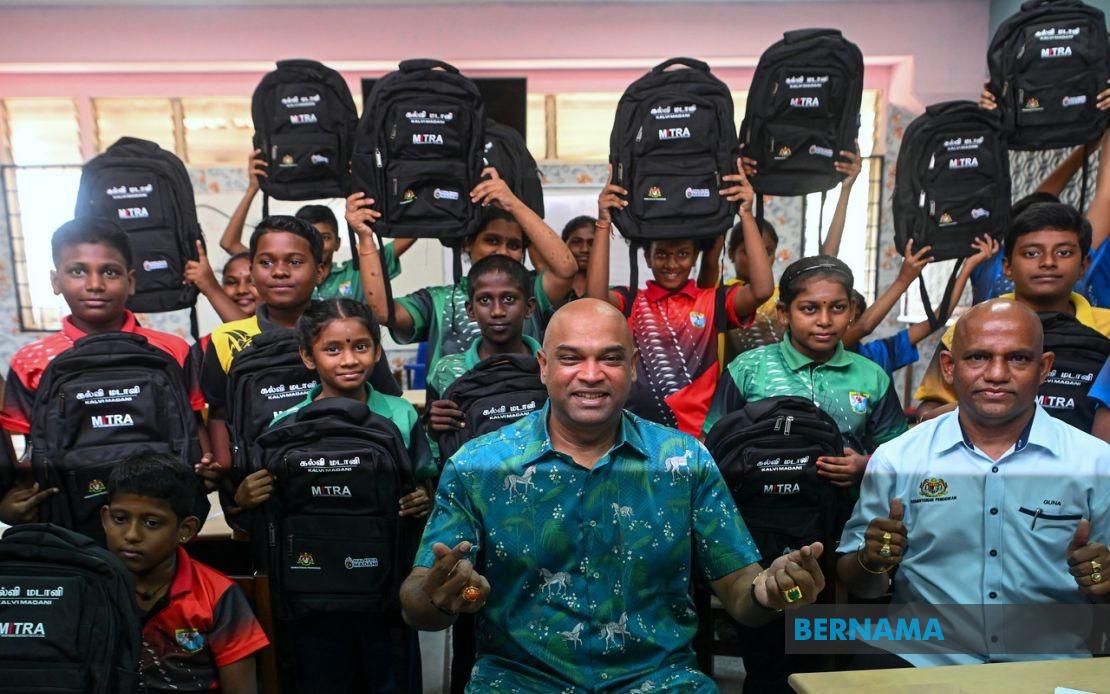
Pakatan Harapan's appeal to Indian voters in Negeri Sembilan will be tested this Saturday when 867,151 eligible voters head to the polls for the 16th state election. The coalition's confidence in its standing among this demographic has been underscored by PKR vice-president Datuk Seri R. Ramanan, who contends that programme attendance and community participation offer a more reliable gauge of political support than opposition rhetoric or polling predictions.
Ramanan, who doubles as Human Resources Minister and Member of Parliament for Sungai Buloh, directly challenged claims made by the Barisan Nasional-aligned MIC, which has asserted that Indian voters increasingly lean towards supporting the BN slate. Rather than engaging in a war of words, Ramanan shifted the debate onto observable, measurable ground—the actual turnout and engagement levels when PH organises outreach events targeted at the Indian community. This strategic pivot reflects a calculated approach to countering what the coalition evidently views as unfounded assertions from a rival party seeking to shore up its traditional support base.
The distinction Ramanan drew is significant for understanding Malaysian electoral politics. Political claims about voter sentiment, especially from competing parties, carry little weight unless corroborated by concrete evidence of community mobilisation. By emphasising that "anyone can make such claims," Ramanan implicitly dismissed MIC's narrative as mere campaign rhetoric. The real test, he suggested, lies in what the Indian community actually chooses to do when presented with opportunities to engage with PH initiatives—their attendance figures, their questions, their visible enthusiasm or reservation all speak volumes beyond polling day itself.
To further demonstrate this presumed groundswell of support, the PH leadership has scheduled a significant meeting between Prime Minister Datuk Seri Anwar Ibrahim and representatives of the Indian community for the day following Ramanan's remarks. This high-profile engagement serves dual purposes: it provides a platform for the government to articulate its policies and achievements directly to a key demographic, while simultaneously offering observers—including the media, analysts, and rival parties—a visible demonstration of community reception. The optics matter considerably in a tight electoral contest where perceptions about voter sentiment can influence undecided voters and energise or demoralise party supporters.
Ramanan's comments also took aim at electoral forecasting, particularly predictions advanced by political analysts like Taylor's University Adjunct Professor Dr Ong Kian Ming, who has publicly anticipated a joint BN-Perikatan Nasional victory in Negeri Sembilan. The PKR leader pointedly noted that analytical predictions do not necessarily materialise into actual electoral outcomes. He used the Johor state election as a comparative case study, observing that although Johor presented a particularly challenging political terrain, each state possesses its own distinct electoral dynamics that cannot be mechanically transposed from one contest to another.
This argument carries substantial merit in the Malaysian context. State-level elections are often shaped by localised issues, personalities, and community priorities that diverge sharply from national trends. The Johor polls, which took place earlier this year, operated within a different political ecosystem than Negeri Sembilan, despite both being mainland states. Voter priorities in resource-rich Johor centred on economic management and development trajectories, whereas Negeri Sembilan voters may prioritise different governance concerns. Analysts who assume uniform voting patterns across different states risk misreading the particular concerns animating local electorates.
The Indian community represents a numerically significant constituency within Negeri Sembilan's overall electorate, and their voting preferences have historically been pivotal in determining parliamentary and state-level outcomes across Malaysia. Traditionally, the MIC—as the BN's designated vehicle for Indian community outreach—has commanded substantial support from this demographic. However, recent years have witnessed fragmentation of this once-reliable voting bloc, with segments of the Indian community increasingly receptive to opposition messaging, particularly around issues affecting their economic mobility, educational opportunities, and cultural representation within the broader Malaysian political structure.
PH's intensified focus on demonstrating community engagement through visible programmes reflects a strategic recognition that winning or retaining Indian voter support requires more than ancestral political ties. The coalition must articulate tangible benefits delivered by its government and convince voters that their interests are being substantively addressed. Whether through economic initiatives, educational scholarships, cultural preservation efforts, or targeted infrastructure development in predominantly Indian areas, the PH campaign strategy evidently emphasises concrete deliverables rather than abstract political positioning.
The upcoming Negeri Sembilan election will provide empirical data regarding the actual state of Indian community sentiment. Results at the constituent assembly and state parliament levels will reveal whether PH's assessment of community receptiveness reflects genuine electoral dynamics or represents wishful thinking from party leadership. The turnout rates in predominantly Indian constituencies, the margin of victory or defeat in seats with substantial Indian populations, and demographic breakdowns of voting patterns will collectively indicate whether Ramanan's confidence has a solid foundation or whether MIC's counter-claims about BN affinity carry greater weight.
For Malaysian political observers and strategists, the Negeri Sembilan contest offers a crucial datapoint regarding the current state of ethnic-community voting patterns. If PH successfully consolidates or expands Indian community support, it would suggest a broader realignment of Malaysia's traditionally race-based electoral coalitions. Conversely, if BN and PN recover traditionally MIC-controlled constituencies, it would indicate that efforts to rebuild the historic BN coalition architecture are bearing fruit. These outcomes will reverberate well beyond Seremban, shaping national political calculations for years to come.
Beyond the immediate electoral stakes, the contest encapsulates broader questions about representation and community governance in Malaysia. Which political coalition can most credibly claim to address the specific needs, aspirations, and concerns of the Indian community? Whose programmes and leadership genuinely resonate with voters who have experienced decades of political marginalisation and economic disadvantage? These questions transcend partisan positioning and speak to fundamental issues of democratic legitimacy and inclusive governance that will continue animating Malaysian politics regardless of Saturday's outcome.

