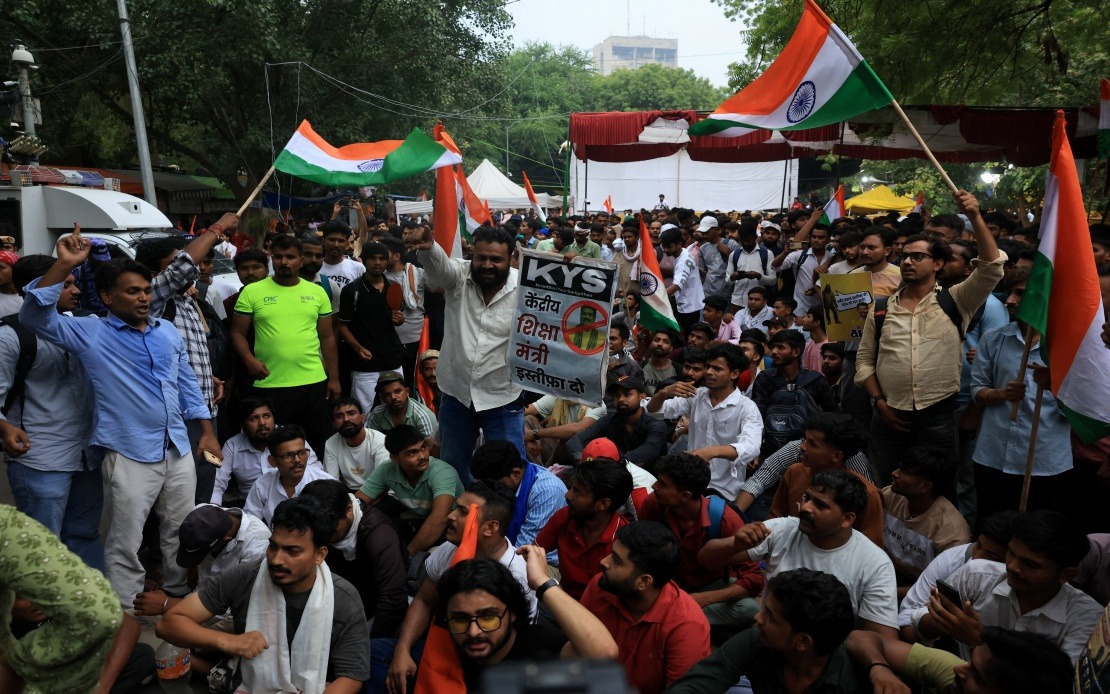
Thousands of students and young people converged on New Delhi's parliamentary district on Monday in a demonstration organised by a newly-formed youth movement, mounting pressure on the government to overhaul India's academic framework. The movement, which claims to command millions of followers across digital platforms, seized the momentum of the Monsoon Session's opening to push educational reform onto the legislative agenda at a critical moment when lawmakers gathered to shape national policy.
The assembly, dubbed "Sansad Chalo" or "march to parliament," quickly escalated into a confrontation with law enforcement as demonstrators attempted to breach police cordons establishing boundaries around parliament. Officers deployed standard crowd-control measures to prevent the gathering from advancing further toward the building itself, creating a tense standoff that highlighted the deep frustrations young Indians harbour toward existing educational structures. The protest unfolded against police restrictions on public assembly, which authorities had put in place specifically in anticipation of potential demonstrations during the parliamentary session.
The underlying discontent reflected in Monday's mobilisation points to broader anxieties within India's youth about the relevance and effectiveness of its educational system. The newly-launched movement appears to have tapped into significant public sentiment, accumulating millions of online adherents relatively quickly, suggesting that demands for academic reform resonate far beyond those who physically participated in the march. The timing of the protest during parliament's opening session was deliberately strategic, intended to force legislators to confront these issues while media attention focused on the capital.
Prime Minister Narendra Modi departed the parliamentary complex as police worked to contain the crowds assembling outside. The security apparatus responded to the gathering by tightening controls across multiple zones throughout the national capital, reflecting official concern about maintaining order during parliamentary proceedings. These measures underscored the seriousness with which authorities regarded the demonstration, even as the protest remained focused on civil demands for systemic change rather than broader political confrontation.
For Malaysian observers and policymakers, India's education protest carries instructive lessons about youth engagement with governance and the power of digital mobilisation to catalyse offline activism. India's experience demonstrates how disaffection with academic structures can rapidly translate into coordinated street action when channelled through social media networks. The movement's success in amassing followers before its public debut suggests sophisticated digital-age organising that transcends traditional institutional boundaries.
The specific content of the academic reforms being demanded remains crucial context. India's education system has long faced criticism for emphasizing rote learning over critical thinking, maintaining rigid curricula that struggle to adapt to evolving job markets, and perpetuating inequalities in access across regional and socioeconomic lines. These concerns echo throughout Southeast Asia, where governments including Malaysia grapple with similar pressures to modernise educational offerings while preserving cultural values and educational standards. The Indian movement's platform therefore extends relevance beyond Delhi's boundaries.
The parliamentary calendar placed the protest at a juncture when lawmakers could theoretically incorporate educational reform discussions into legislative agendas during the Monsoon Session. This tactical timing reflected understanding that legislative windows close quickly and that visible demonstration at moments of legislative opportunity amplifies pressure on decision-makers. For developing democracies across the region, such protests illuminate the intersection between extra-parliamentary mobilisation and formal legislative processes.
Second-order effects of Monday's gathering deserve consideration. The success of a youth movement in commanding police attention and forcing security escalations may inspire similar demonstrations on other policy fronts, potentially establishing precedent for future protest dynamics. The police response itself—managing crowds without reported violence or mass arrests—suggests official tolerance for dissent coupled with determination to prevent occupation or disruption of state institutions. This balance reflects India's democratic character even amid tensions between authorities and demonstrators.
Regional governments watching India's education protests should note the transnational dimensions. Information about Indian youth movements, their tactics, and their grievances circulates readily through Southeast Asian digital networks. Malaysian students and young professionals consume content about Indian activism, and successful mobilisation models propagate across borders. Should India's academic reform movement achieve legislative victories, those outcomes would influence thinking among Southeast Asian youth advocates about what reform programmes appear achievable.
The Monsoon Session's opening represented parliament's moment of maximum public visibility and accessibility, making it the natural focal point for movements seeking to insert demands into legislative consciousness. This strategic choice by protest organisers demonstrates sophisticated understanding of institutional rhythms and media cycles. Malaysian policymakers might consider how their own parliamentary calendars and media environments shape opportunities for organised civil society participation in governance conversations.

