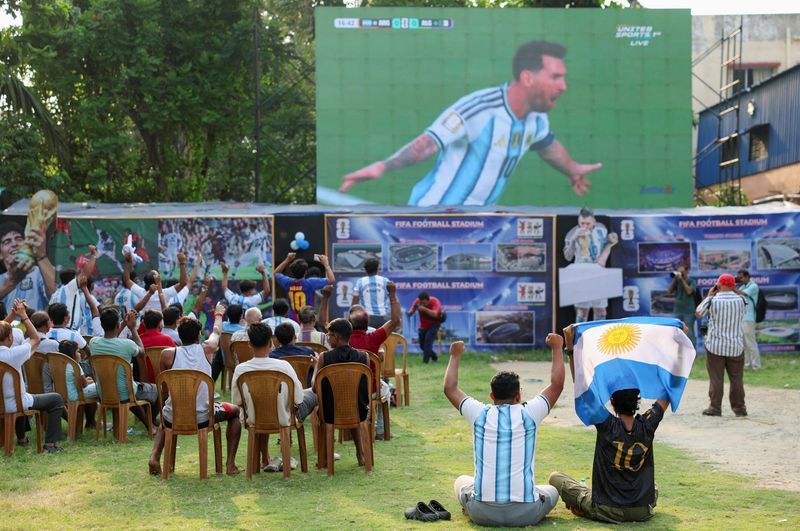
For Gourav Roy, a software engineer based in San Francisco, attending both semi-finals and the final of the recent World Cup represented a pilgrimage of sorts—a substitute for the experience he has cherished since childhood but may never witness in reality. Roy drove over 6,000 miles across the United States to satisfy that hunger, yet his journey underscores a painful reality: India's path to the World Cup appears increasingly blocked by obstacles that defy simple solutions. Ranked 138th in the world and failing even to secure a place at next year's Asian Cup, a nation of 1.45 billion people finds itself watching from the sidelines as countries with minuscule populations like Curacao and Cape Verde advance to the 2026 tournament.
The irony is stark. While cricket has transformed India into a sporting superpower with unparalleled wealth and global influence, football—the world's most popular sport—remains mired in structural decay. "I've learned to love without expectation. That's the burden of the Indian football fan," Roy reflected, capturing the resignation that has settled over those who hope their country might one day compete at the highest level. Yet this resignation masks deeper, more systemic failings that experts warn will require generational commitment to repair.
Those embedded within Indian football identify problems that operate on multiple levels simultaneously. The country's All India Football Federation (AIFF) struggles to enforce a coherent vision across state associations, creating a fragmented landscape where ambition exists but coordination does not. Youth development systems lack the rigour and consistency necessary to identify and nurture talent at scale. Beyond infrastructure and coaching gaps, football simply does not command the cultural space in most of India that it occupies in nations with smaller populations but stronger footballing traditions. While pockets of genuine enthusiasm exist—particularly in West Bengal, Goa, Kerala, Mizoram, and Manipur—the sport remains marginal in the cricket-obsessed consciousness of the Indian mainstream.
Ravi Puskur, CEO of ISL club FC Goa, articulated the scale of the challenge with sobering clarity. Cleaning up the system and reorganising it would require at least four years of intensive effort, followed by another 20 to 25 years of sustained development before India could realistically target World Cup qualification. This timeline reflects not pessimism but honest assessment of how far the country has fallen behind. The Indian Super League, launched in 2014 with backing from Reliance Industries, one of India's largest conglomerates, represented an ambitious attempt to transform the domestic game through investment and professional glamour. Yet despite these resources, success has proven limited and increasingly fragile.
The recent collapse of partnership negotiations between the AIFF and Reliance Industries illustrates the governance chaos that now grips Indian football. In 2025, the two entities failed to renew their agreement as a Supreme Court case proceeded regarding implementation of a new federation constitution. This legal uncertainty, combined with leadership disputes between the federation and clubs, has left the ISL in disarray heading into the new season. The league has yet to finalise a broadcaster agreement or announce its fixture schedule—fundamental requirements for any professional competition. Some teams were forced to suspend player salaries in the previous year, a development that rippled through development programmes already starved of resources.
NorthEast United CEO Mandar Tamhane, formerly of Bengaluru FC, emphasised that clubs alone cannot engineer the transformation Indian football requires. The challenge demands coordination among government bodies, corporate investors, state associations, and civil society. "You're talking about the government, corporate India... it has to be a collective effort," he stated, pointing to the absence of the unified commitment that has enabled football development in other South Asian and East Asian contexts. The federation must serve as an orchestrator, ensuring that clubs, state associations, corporate partners, and other stakeholders function within a shared strategic framework rather than pursuing competing interests.
AIFF executive committee member Lalnghinglova Hmar, who also serves as Mizoram's sports minister, emphasised that while government can provide infrastructure support, the real transformation must occur within youth football systems. Countries like South Korea and Japan develop young players through competitive matches—over 40 per season in some cases—a contrast that highlights Indian shortcomings. Most Indian under-15 players participate in merely 12 to 15 competitive games annually, yet some are selected for national youth camps having played fewer than 20 official matches. The coaching workforce remains inadequate in both numbers and quality, with many states lacking even basic youth league structures. These gaps create a developmental bottleneck impossible to overcome through national team talent camps alone.
India's sheer geographic size and population diversity, while rendering it an enormous and attractive sports market, paradoxically complicates the implementation of uniform reforms across state boundaries. The spectacular success of cricket's Indian Premier League demonstrates that properly structured sporting competition can captivate the Indian imagination and attract substantial investment. Yet the AIFF cannot simply replicate that model across football's more distributed grassroots base. Hmar suggested that even if half of India's states implemented proper grassroots development systems, momentum would build sufficiently to drive national improvement. Currently, that baseline has not been achieved, leaving the system vulnerable to periodic crises that derail progress.
The government's bid to host the 2036 Olympics has prompted consideration of a "sports passport" initiative that would permit Indian-origin athletes living abroad to represent the country in international competition. AIFF leadership has backed this proposal, viewing it as a potential pathway to strengthening the national team through imported talent and expertise. Yet the proposal remains far from legislative reality, and Hmar warned that even if adopted, it could not compensate for India's failure to match the development pace of competitors who are not standing still. The window for strategic intervention narrows as rival nations invest more heavily in youth systems, coaching education, and competitive infrastructure. India risks a scenario where modest improvements still leave it permanently behind because other nations have advanced further in the interim.
The governance instability afflicting Indian football extends to commercial partnerships and broadcast arrangements—the financial lifeblood of any modern sporting enterprise. The ISL's uncertainty has deterred broadcasters from committing resources and audiences from sustaining interest. Puskur noted that providing stability would gradually attract increased investment from corporate and broadcast partners, yet the federation and clubs have struggled to establish the consensus necessary for that stability. Without predictable, professionalised competition, the league cannot develop the fan bases and media presence that generate revenue and prestige.
For supporters like Roy, hope persists only in the possibility that expanded World Cup formats might provide additional pathways to qualification. The proposed 64-team tournament in 2026 would increase participating nations, creating marginally better odds for teams currently unable to break through regional qualifiers. Yet Roy himself acknowledged this offers no guarantee—merely a statistical improvement in chances. His remarks capture the tentative optimism that characterises Indian football's trajectory: modest hope tempered by realistic understanding that incremental rule changes cannot substitute for the deep structural transformation the game requires in India.
The question now facing Indian football transcends sporting competition. It concerns whether a nation of 1.45 billion can marshal the governmental coordination, corporate patience, state-level cooperation, and cultural investment necessary to build world-class development systems across football. South Korea and Japan have demonstrated that Asian nations can reach football's highest levels, yet their success required decades of sustained commitment across multiple institutional levels. India possesses the human capital and resources to follow that path, but only if the current fragmentation gives way to unified strategy implemented with the consistency that has proved elusive thus far.

