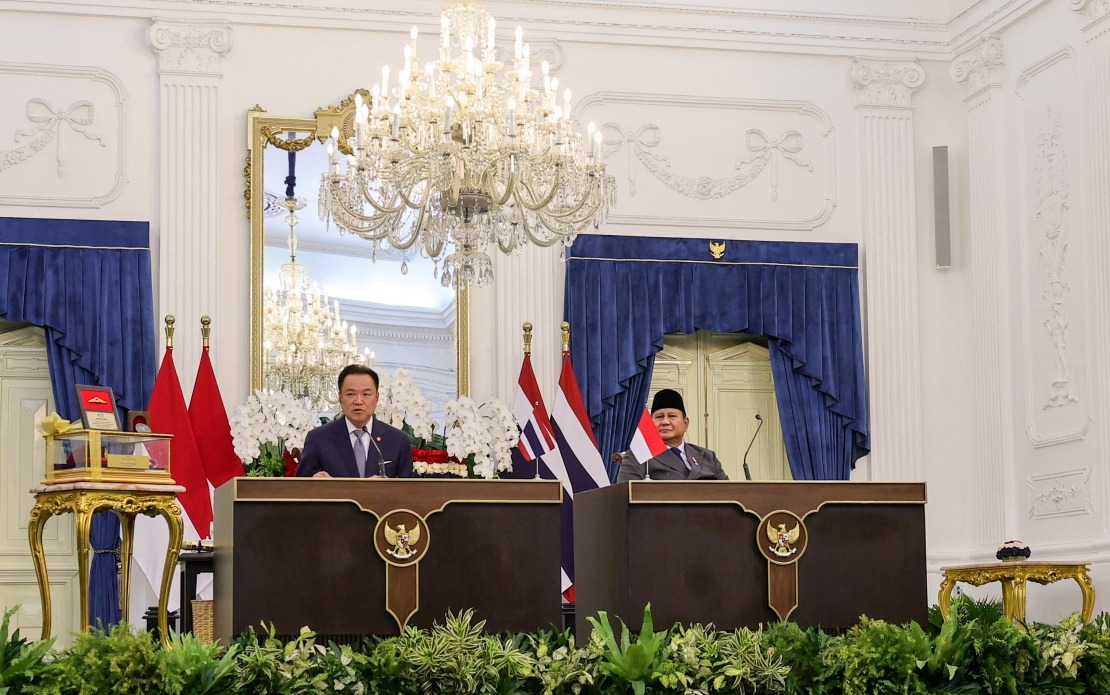
Indonesian President Prabowo Subianto and Thai Prime Minister Anutin Charnvirakul have reaffirmed their nations' commitment to advancing regional stability through continued support for ASEAN's Myanmar peace agenda during high-level consultations in Jakarta. The second Leaders' Consultation between the two Southeast Asian neighbours culminated in a joint pledge to pursue the Five-Point Consensus through sustained dialogue and humanitarian intervention, marking a significant moment for ASEAN unity at a time when Myanmar's internal conflict continues to destabilise the broader region.
The meeting underscored Indonesia and Thailand's shared belief that ASEAN's institutional coherence remains central to any viable pathway toward resolving Myanmar's humanitarian and political crisis. By reaffirming the bloc's centrality and unity, both leaders signalled that unilateral action by external powers would be counterproductive, a subtle but important message to Beijing and Washington as geopolitical competition in Southeast Asia intensifies. The emphasis on inclusive dialogue reflects growing recognition that Myanmar's fractured political landscape demands broad-based participation rather than narrow negotiation confined to a single faction.
Prabowo articulated a sophisticated understanding of contemporary security challenges, framing transnational crime as an existential threat requiring coordinated regional responses. This reflects Malaysia's own experience with transnational criminal networks and cybercrime syndicates that often operate across multiple jurisdictions, making bilateral and multilateral law enforcement cooperation essential. The Indonesian president's explicit linkage between non-traditional security threats and ASEAN's strategic relevance demonstrates how regional powers are adapting their security frameworks to address challenges that transcend conventional military concerns.
The agreement to establish a Transnational Referral Mechanism represents an institutional innovation designed to address one of Southeast Asia's most pressing humanitarian challenges. Online scam operations, often involving sophisticated criminal networks spanning Thailand, Cambodia, Myanmar, and beyond, have ensnared thousands of citizens across the region. By creating a formal mechanism for identifying, protecting, and repatriating victims with dignity, Indonesia and Thailand are establishing a precedent that could be adopted region-wide. Malaysia, which has similarly grappled with large-scale scam trafficking, would likely benefit from similar frameworks.
Thailand's facilitation of nearly 1,000 Indonesian repatriations from online scam syndicates illustrates the scale and severity of this transnational phenomenon. These victims, many of whom were deceived into joining criminal operations, represent not merely statistics but individuals whose repatriation requires coordinated diplomatic channels, law enforcement investigations, and social rehabilitation. Prabowo's public acknowledgment of Thailand's role demonstrates the value of bilateral goodwill, even as both nations recognise that more comprehensive regional architecture is needed to dismantle the criminal networks perpetuating these schemes.
Anutin's proposal for expanded defence industry collaboration, specifically the supply of 36 amphibious wheeled armoured vehicles, signals Thailand's confidence in deepening military interoperability with Indonesia. This procurement arrangement goes beyond symbolic gestures, suggesting concrete operational readiness for joint maritime operations and coastal defence scenarios. For a region increasingly concerned about maintaining freedom of navigation and territorial integrity, such military modernisation carries strategic implications that extend beyond bilateral relations.
The emphasis on maritime security cooperation reflects shared concerns about sea lanes and resource security in Southeast Asia's strategic waters. Indonesia's archipelagic geography and Thailand's significant maritime boundaries make them natural partners in addressing piracy, illegal fishing, and smuggling operations that plague regional waters. Enhanced joint training exercises and information sharing will improve both nations' capacity to project power and maintain order in their maritime zones, contributing to broader regional stability.
The commitment to combat human trafficking and drug trafficking alongside online scams demonstrates a holistic approach to transnational crime that recognises interconnections between different criminal enterprises. Many organisations operating online scams also engage in human trafficking and narcotics smuggling, leveraging similar infrastructure and personnel. By addressing these crimes as part of an integrated strategy rather than isolated problems, Indonesia and Thailand are adopting a more sophisticated security posture that should improve enforcement effectiveness.
Anutin's visit represents the first official Thai prime ministerial trip to Indonesia in 15 years, underscoring how political and leadership transitions can create opportunities for relationship recalibration. His appointment as Thailand's 32nd prime minister in September 2025 provided an occasion for resetting bilateral ties at the highest level. This temporal gap itself speaks to periods of diplomatic distance that have now been bridged, suggesting renewed political will to prioritise bilateral engagement alongside multilateral commitments through ASEAN.
The intelligence sharing and financial tracking mechanisms outlined in the bilateral agreement address the operational vulnerabilities that criminal networks exploit. By coordinating financial surveillance and investigative resources, Indonesia and Thailand can trace money flows, disrupt command structures, and prosecute key operatives. Such cooperation also creates deterrent effects for criminals considering operations in the region, as the prospect of coordinated law enforcement responses increases risks and reduces profit margins.
For Malaysia, these developments carry important implications. Online scam networks operating from Southeast Asia frequently victimise Malaysians, and enhanced Indonesia-Thailand cooperation may disrupt regional criminal infrastructure that crosses Malaysian borders. Additionally, Malaysia's own bilateral relationships with Indonesia and Thailand could benefit from expanding security cooperation frameworks modelled on these arrangements, creating opportunities for trilateral or broader ASEAN-level initiatives against transnational crime.
The broader context of these consultations reflects ASEAN's ongoing struggle to remain relevant amid geopolitical pressures and internal crises. Myanmar's unresolved conflict threatens regional cohesion, whilst transnational crime undermines state capacity and public security. By demonstrating concrete bilateral cooperation on these fronts, Indonesia and Thailand are proving that ASEAN nations can take decisive action to address shared threats, even as consensus-based decision-making sometimes paralyses multilateral responses. This model of bilateral deepening within multilateral frameworks may represent the pragmatic path forward for ASEAN's future effectiveness.

